
A hotel agent is asked whether a specific room has a crib. Properties differ, and a typical hotel is not a safe guess. Which source should the architect require?
Select an answer to reveal the explanation.
Short Explanation
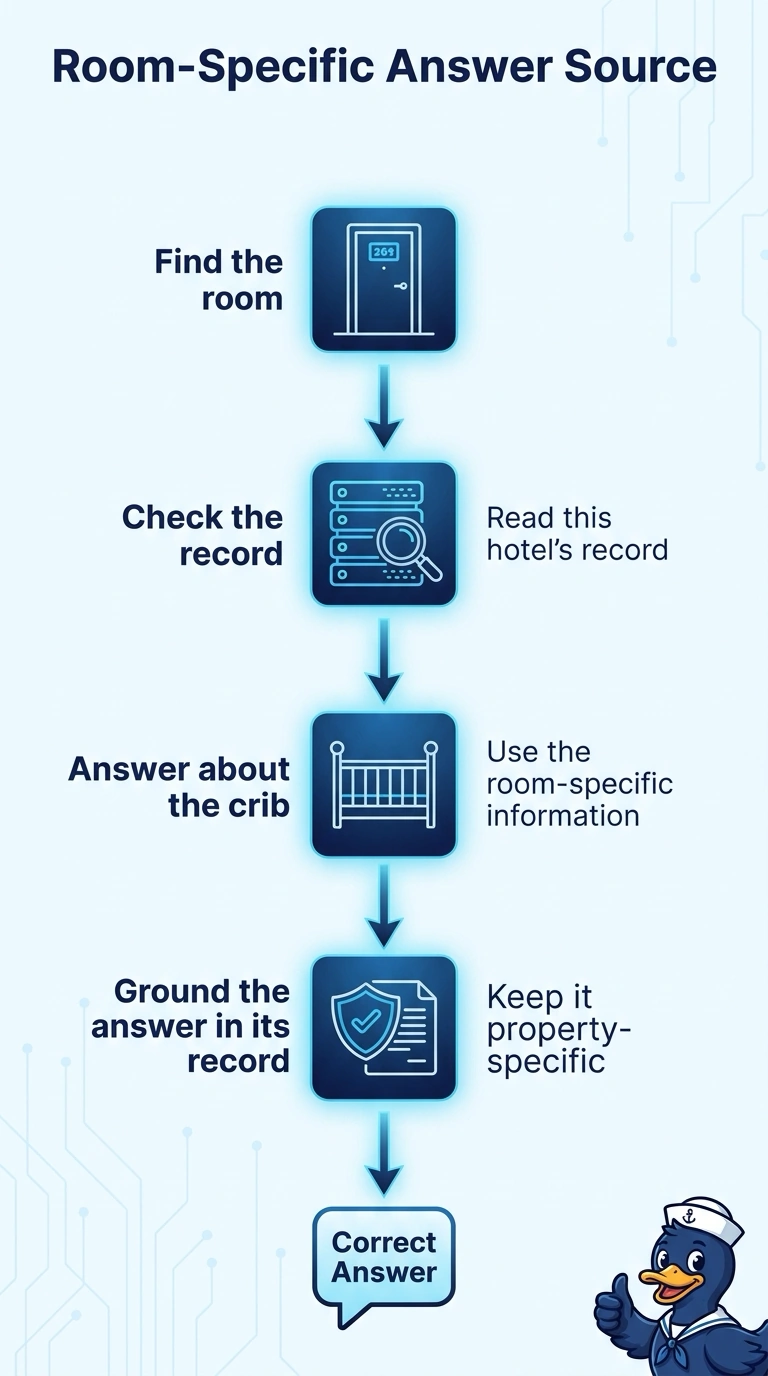
You would not tell a guest the room has a crib because most hotels you remember do. You require this property's knowledge source for that room, so the answer is this hotel's record. A typical hotel living in the model's memory will be wrong the first time a property differs.
Full Explanation
Room-amenity answers are property facts, and properties differ, so the agent has to answer from the property knowledge source for that room. The model's memory of a typical hotel is not a source the hotel controls, and it will invent a crib, a view, or a rollaway that this room does not have. Requiring the property knowledge source keeps the answer on the record for this hotel. Using the model's memory with no property source connected is the failure the architect is trying to remove. A generic chain brochure that describes a standard room is still the wrong document when it is not this property's current room record, and a guest can be standing in a room the brochure does not describe. A note from a previous stay at a different property is someone else's room, and treating it as the source for this room copies the wrong building. Exam caveat: a knowledge source that is present but stale is a timeliness problem, not a reason to fall back to model memory. The source has to be this property's current record. Operational check: ask about a crib for a room whose record says there is none, and confirm the agent quotes that record rather than a generic yes.