
A consultancy's client requires every agent answer to cite a source in the engagement file. Which design does that constraint remove?
Select an answer to reveal the explanation.
Short Explanation
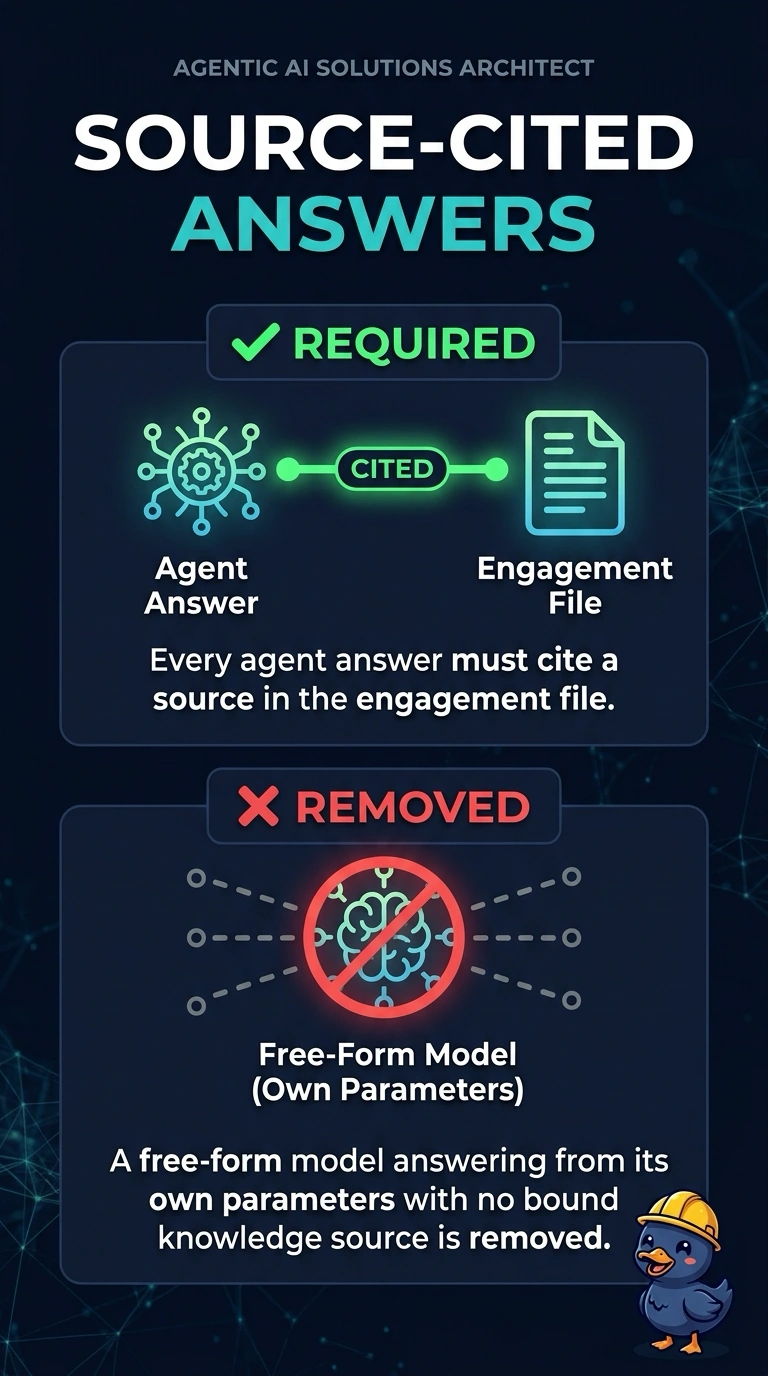
A paper with no footnote fails a client who asked for a footnote on every claim. You drop the free-form model that answers with no knowledge source bound to the reply. A grounded answer that cites the engagement file is what the constraint keeps.
Full Explanation
A constraint that every answer cite a source in the engagement file requires a knowledge binding. A free-form model that answers from its own parameters, with no source bound to the reply, cannot point at that file, so the constraint removes it. A grounded reply that cites the engagement-file passage is the pattern the constraint demands, not a pattern it removes. A refusal when the file has no supporting passage is how the agent stays inside the rule instead of inventing a citation. A review that checks the citation before release is an extra control on the same rule, and it is compatible with the constraint. Exam caveat: binding a knowledge source is what makes a citation possible. Adding the words 'cite a source' to a prompt, with no source connected, does not satisfy the client. The design this constraint removes is the one that can speak with no file attached. Operational check: ask a question whose answer is in the engagement file and confirm the reply names that passage, then ask one that is not in the file and confirm the agent refuses rather than answering from model memory.