
A bank's customer-service agent must hand a suspected fraud case to a fraud agent. The customer-service agent must not receive the full transaction archive. What should the design set?
Select an answer to reveal the explanation.
Short Explanation
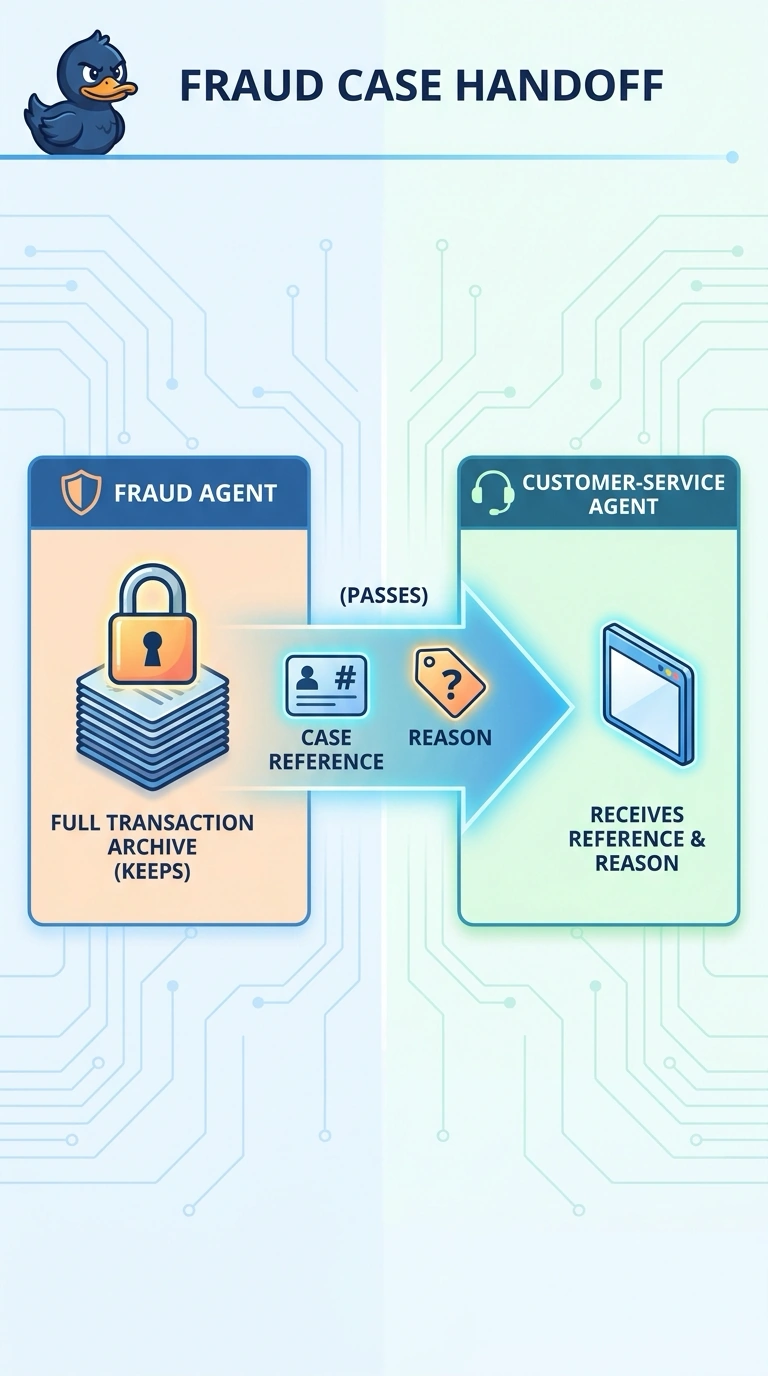
The teller can walk a case to the fraud desk without carrying the vault list. You design a handoff that passes the case reference and the reason, and you keep the full transaction archive with the fraud agent. A copy in the customer bot is a leak.
Full Explanation
The two agents have different jobs and different rights to transaction data. The customer-service agent needs to hand off a suspected fraud case, and it must not receive the full archive, so the boundary should pass a case reference and the reason for the handoff and leave the archive with the fraud agent. A shared copy of the full transaction archive so the customer-service agent can explain every charge gives the customer bot the data the requirement withholds. One merged agent that keeps the archive in the same conversation the customer can see erases the boundary and puts the archive on the customer channel. A tool on the customer-service agent that reads the archive whenever the customer asks about a charge is the same leak, reached by a tool instead of a copy. Exam caveat: the handoff can include the fields the fraud agent needs to find the case. Those fields are not the archive. Operational check: capture a handoff payload and the customer-service agent's tool list, and confirm neither one contains the full transaction archive.