
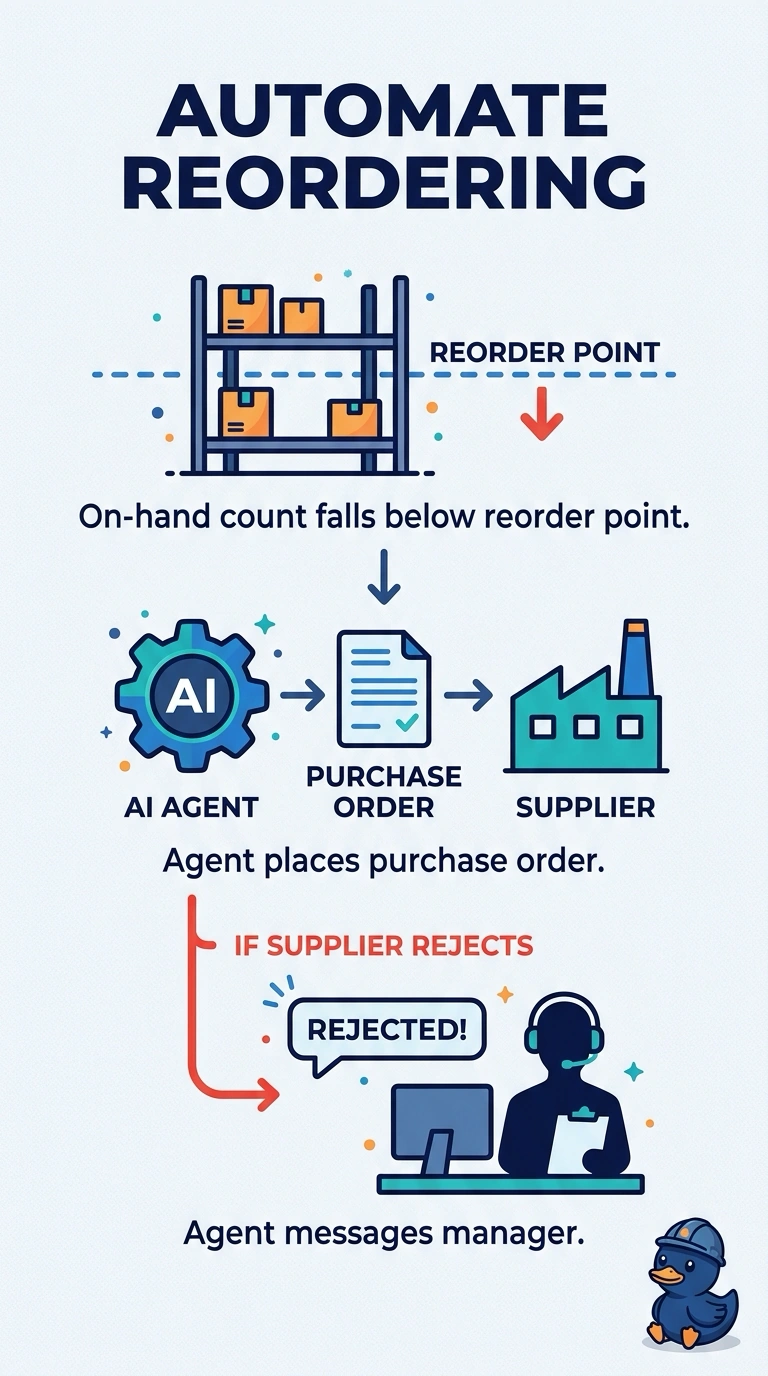
A regional grocery chain wants an agent that places a purchase order when a store's on-hand count for a staple item falls below the reorder point, and messages the manager only if the supplier rejects that order. Which use of an agent matches this requirement?
Select an answer to reveal the explanation.
Short Explanation
Picture a night clerk who already knows the rule and just sends the order. You want task automation, because the agent performs a defined action when the count drops. The trap is calling it decision support when nobody is waiting to approve a recommendation.
Full Explanation
Task automation is the right fit when the business rule is already decided and the agent only has to carry it out. Here the reorder point is the rule, the purchase order is the action, and the manager is told only if the supplier rejects the order. That is an operational action, not a request for a new insight and not a recommendation sitting in a queue. Data analytics would be the right use if the chain wanted the agent to find a demand pattern or explain why a staple is selling faster, and then stop before placing an order. Decision support would fit if a buyer had to accept or reject a recommendation before any order left the building, which this design explicitly does not do. Knowledge lookup would fit if the agent only retrieved the written policy for a person to apply, but the requirement says the agent places the order. Exam caveat: a notification to a manager after a failure does not turn an automated action into decision support. Operational check: write the trigger, the action, and the exception path on one page and confirm a person is in the path only when the supplier rejects the order.