
A bank wants a dispute summary written in the customer's own words. A flow already creates the case in the servicing system. Which split should the design use?
Select an answer to reveal the explanation.
Short Explanation
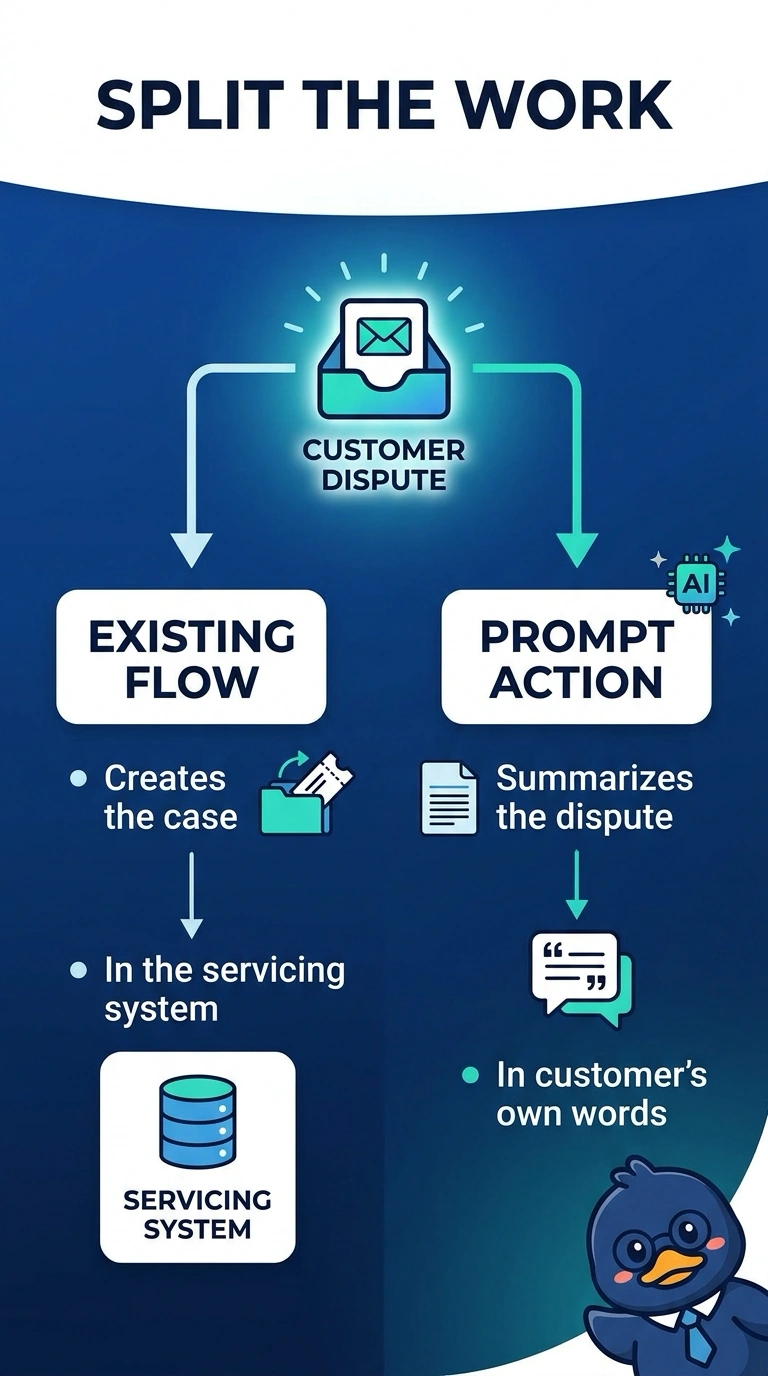
The translator writes the note, and the clerk is the one who opens the file. You use a prompt action for a summary in the customer's words, and you leave case creation in the flow that already writes the servicing system. One component should not swallow both of those jobs.
Full Explanation
A prompt action is the model step: it takes the customer's words and returns a summary shaped by the instructions. Creating the case is a fixed write the bank has already placed in a flow, with the connector and the audit that belong on that write, so the design keeps that split. An agent flow that both writes the summary in the customer's words and creates the servicing case forces a wording judgment into a fixed path. A prompt action that writes the summary in the customer's words and also creates the case, leaving the existing flow unused, moves the system-of-record write into the model step and drops the flow that already does it. A custom Foundry model trained to draft dispute summaries and to insert the servicing case row is a new model for a summary a prompt action can produce, and it still should not be the component that inserts the case. Exam caveat: the flow may take the summary as an input. That does not mean the flow should author the wording. Operational check: confirm the prompt action's output is only the summary text, and that a case row appears only when the existing flow runs.