
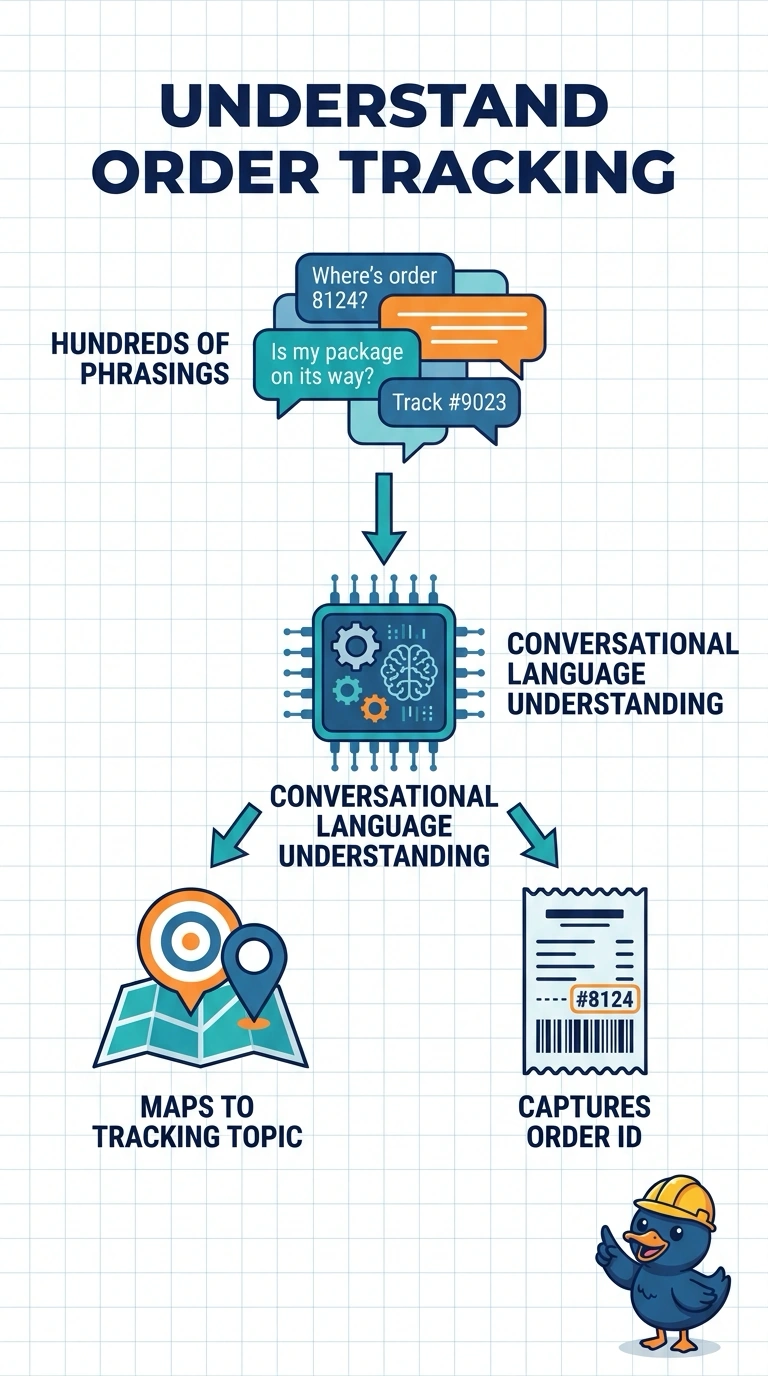
Customers of a retailer ask where an order is in hundreds of phrasings. Each phrasing must open the same tracking topic and capture the order id. Which understanding approach fits?
Select an answer to reveal the explanation.
Short Explanation
Hundreds of ways to ask where a package is still belong at one tracking desk, with the order id in hand. You use conversational language understanding so those phrasings open the tracking topic and capture the order id. A short list of exact phrases covers only the sentences someone wrote down.
Full Explanation
The intent set is closed, the wording is wide, and the design must do two specific things: open one tracking topic and capture the order id. Conversational language understanding is the fit for many phrasings of a known intent plus an entity the topic needs. A short list of exact trigger phrases only catches the sentences the team wrote down, and hundreds of phrasings will miss that list. Generative orchestration that replies in prose, with no duty to open the tracking topic or fill the order id, can describe a shipment without ever entering the topic that does the tracking work. A custom vision model that reads a shipping label from a product photo solves a different input. These customers are typing a question, and a photo of a label is not the request. Exam caveat: generative orchestration is a fair choice when a prose answer is enough. It is the wrong choice when a named topic and a named entity are required. Operational check: send three phrasings the team did not write, each with an order id, and confirm the tracking topic opens with that id filled.