
A university edits the handbook file that grounds a help agent directly in production. How should lifecycle management treat that handbook?
Select an answer to reveal the explanation.
Short Explanation
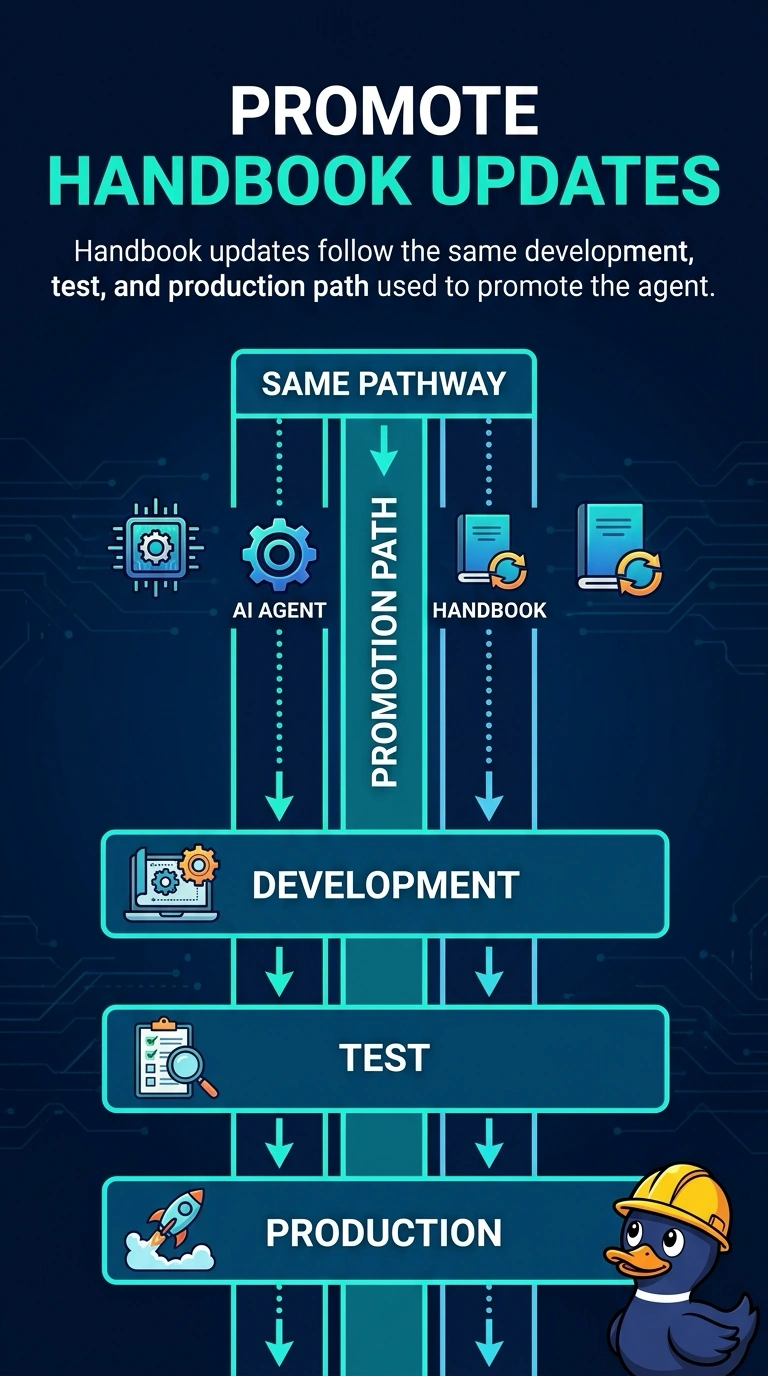
You would not rewrite the live textbook while students are still reading yesterday's page with no copy to restore. You move handbook updates through the same development, test, and production path as the agent. An edit made only in production has no rehearsal and no prior file.
Full Explanation
Grounding data belongs in the same lifecycle as the agent that reads it. The handbook is edited in production today, so an update should enter in development, be proven against the agent in test, and then move to production with the agent. Keeping the production edit in place means students meet an untested change, and there is no separate copy that was validated first. Emailing a PDF to faculty and leaving the agent's production file on the previous edition splits the handbook into two sources, so the agent keeps answering from the old file. Storing edits only in a chat transcript makes a conversation the system of record, which is not a promotable knowledge file and cannot be rolled back as data. Exam caveat: emailing a new PDF to faculty while the production file stays on the previous edition leaves the agent on the old handbook. The file the agent reads has to travel the same path as the agent. Students should meet the tested file, not a surprise edit made on the live copy. Operational check: change one handbook rule in a non-production copy, confirm the test agent answers from that copy, and only then promote the file with the agent.