
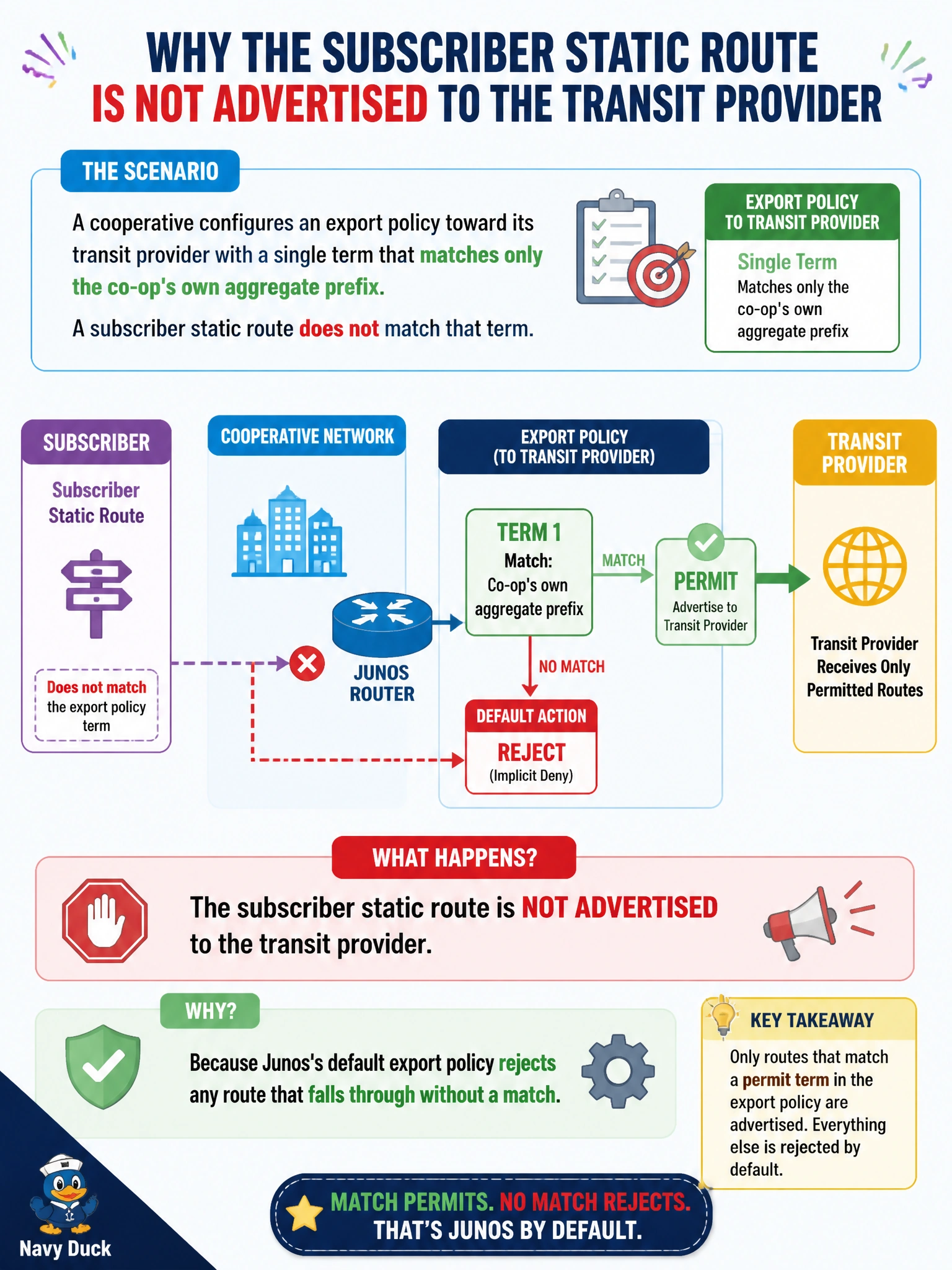
A cooperative configures an export policy toward its transit provider with a single term that matches only the co-op's own aggregate prefix. A subscriber static route does not match that term. What happens to the subscriber static route with respect to advertisement to the transit provider?
Select an answer to reveal the explanation.
Short Explanation
Export policy is the strict sibling of import: if a route doesn't match any term, the built-in default export action is to reject it, meaning nothing leaves the router toward that neighbor unless a term explicitly says so. That subscriber static route falls straight through the single aggregate-only term and never gets advertised. There's no waiting period and no preference-based exception.
Full Explanation
The default export policy in Junos rejects any route that falls through every term of every configured export policy without matching, which means the subscriber static route here is simply never advertised to the transit provider, since the only configured term matches solely the aggregate prefix. This default-reject behavior is deliberate: an ISP's routers should never leak an unintended prefix to a peer just because a policy happened to be incomplete, so silence is the safe failure mode on the export side. The first distractor is wrong because it reverses the actual default, applying import's accept-by-default behavior to export instead, when the two directions have opposite defaults precisely to protect against accidental advertisement. The second distractor invents a queuing or pending mechanism that Junos routing policy does not have; a route that fails to match simply falls through to the default action immediately, with no deferred retry. The route-preference distractor is a non sequitur here, since preference decides which source wins among multiple options for the same prefix inside the local routing table, and has no bearing on whether an export policy chooses to advertise a route it never matched. The operational implication for a cooperative is that every prefix intended for a peer, including subscriber statics, must be explicitly matched by some term, or it stays home by default. A concrete check is show route advertising-protocol bgp <transit-neighbor>, which will show the subscriber static route is absent from what is actually sent.