
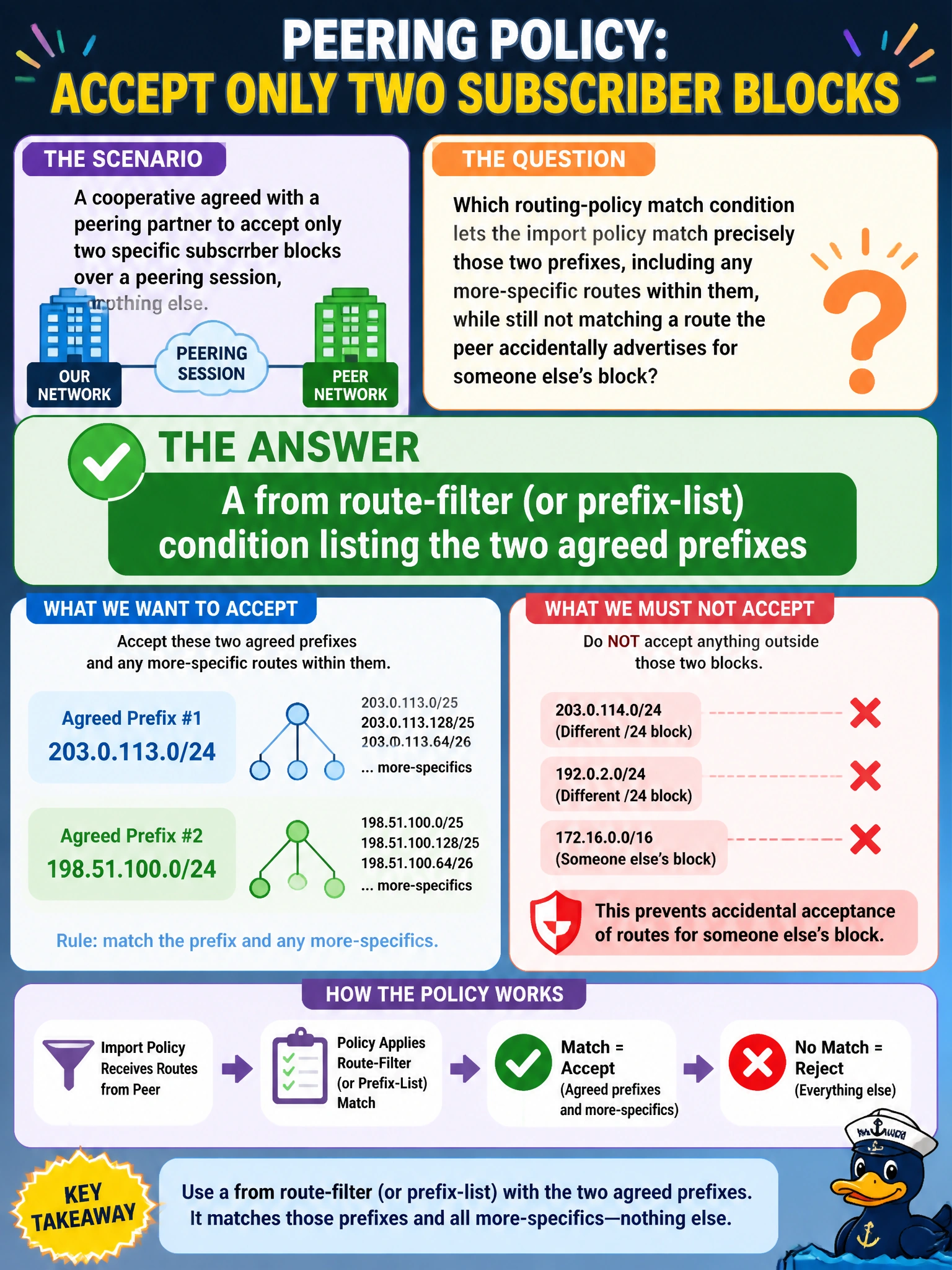
A cooperative agreed with a peering partner to accept only two specific subscriber blocks over a peering session, nothing else. Which routing-policy match condition lets the import policy match precisely those two prefixes, including any more-specific routes within them, while still not matching a route the peer accidentally advertises for someone else's block?
Select an answer to reveal the explanation.
Short Explanation
To only let in the exact blocks a co-op actually agreed to, the tool is a route-filter (or a referenced prefix-list) inside the from condition of an import term, naming those two prefixes specifically. Anything advertised outside that list simply doesn't match and falls to the default reject-everything-else term you'd pair with it. Matching on protocol alone or on the neighbor's address is far too broad for this job.
Full Explanation
A from condition that references a route-filter, or a prefix-list containing the two agreed subscriber blocks, is the precise tool for matching only those specific prefixes on import, and route-filter match types can further specify whether more-specific routes within those blocks should also match. This granularity is exactly what a peering agreement calls for, since accepting only agreed prefixes means everything else the peer might mistakenly or maliciously advertise needs to fall through to a later reject term instead of being installed. The first distractor is wrong because a reject with no from condition matches every route unconditionally, rejecting everything including the two agreed blocks, which is the opposite of the intended outcome. The protocol-only distractor is far too broad, since from protocol bgp matches any route learned via BGP from any peer on any session, with no ability to distinguish the two agreed prefixes from anything else that peer might send. The neighbor-address distractor confuses import policy, which is not commonly matched on a specific inbound neighbor the way export's to condition targets an outbound one, and even if it were usable here it would still match every prefix that peer sends rather than just the two agreed ones. A caveat is that route-filter match types like exact, orlonger, and upto change what 'including more-specific routes' actually means, so the type must be chosen deliberately. A concrete check is show route receive-protocol bgp <peer>, compared against the two agreed prefixes, to confirm nothing outside that list was installed.