
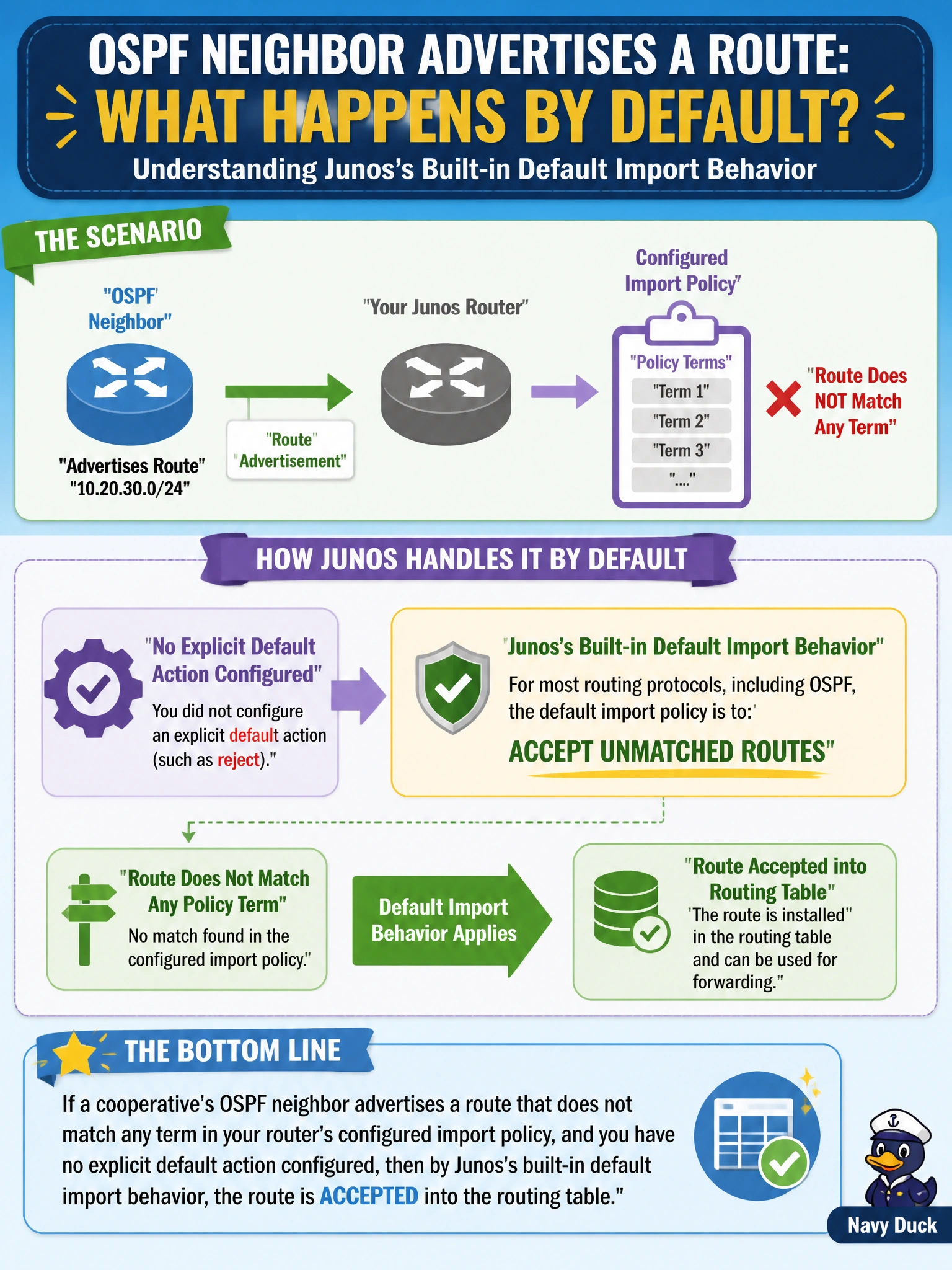
A cooperative's OSPF neighbor advertises a route that does not match any term in the router's configured import policy. With no explicit default action configured, what happens to that route by Junos's built-in default import behavior?
Select an answer to reveal the explanation.
Short Explanation
Unlike a firewall filter's implicit deny, routing policy's built-in default on the import side leans the other way: if nothing in the policy matches a route, Junos's default import behavior is to accept it into the table anyway. Import isn't trying to be strict by default, it's trying to make sure a protocol still has everything it needs to route correctly. That's a genuinely different philosophy from packet filtering.
Full Explanation
When a route falls through every term of every configured import policy without matching, Junos applies each protocol's own default import policy, which for most protocols, including OSPF, IS-IS, and BGP, accepts the route into the routing table rather than discarding it. This design exists because interior gateway protocols in particular depend on having a complete, accurate view of learned routes to compute correct paths, so silently dropping unmatched routes on import could quietly break connectivity across a cooperative's core network. The route-filter-accept distractor is wrong because it inverts the point of a default policy: a default only ever kicks in for a route that failed to match any term's conditions, so requiring a route-filter match to accept it describes ordinary policy matching, not the fallback behavior being asked about here. The firewall-filter comparison is the tempting but incorrect answer, because it assumes routing policy mirrors packet-filtering behavior, when in fact the default leans toward acceptance on import specifically, which is the opposite philosophy from a firewall filter's implicit deny at the bottom of its term list. The pending-approval distractor invents a manual review workflow that does not exist anywhere in Junos routing policy, which always resolves a route's fate automatically and immediately during evaluation. A caveat worth remembering is that export policy behaves oppositely, defaulting to rejecting anything unmatched, so import and export cannot be assumed to share the same default philosophy. A concrete check is show route protocol ospf <prefix> to confirm an unfiltered route was in fact installed into the table as expected.