
Prairie Broadband Cooperative's engineers want to control which routes get installed in the routing table or advertised to a neighboring carrier, without changing how the routing protocol itself calculates best paths. Which Junos mechanism is built for this job?
Select an answer to reveal the explanation.
Short Explanation
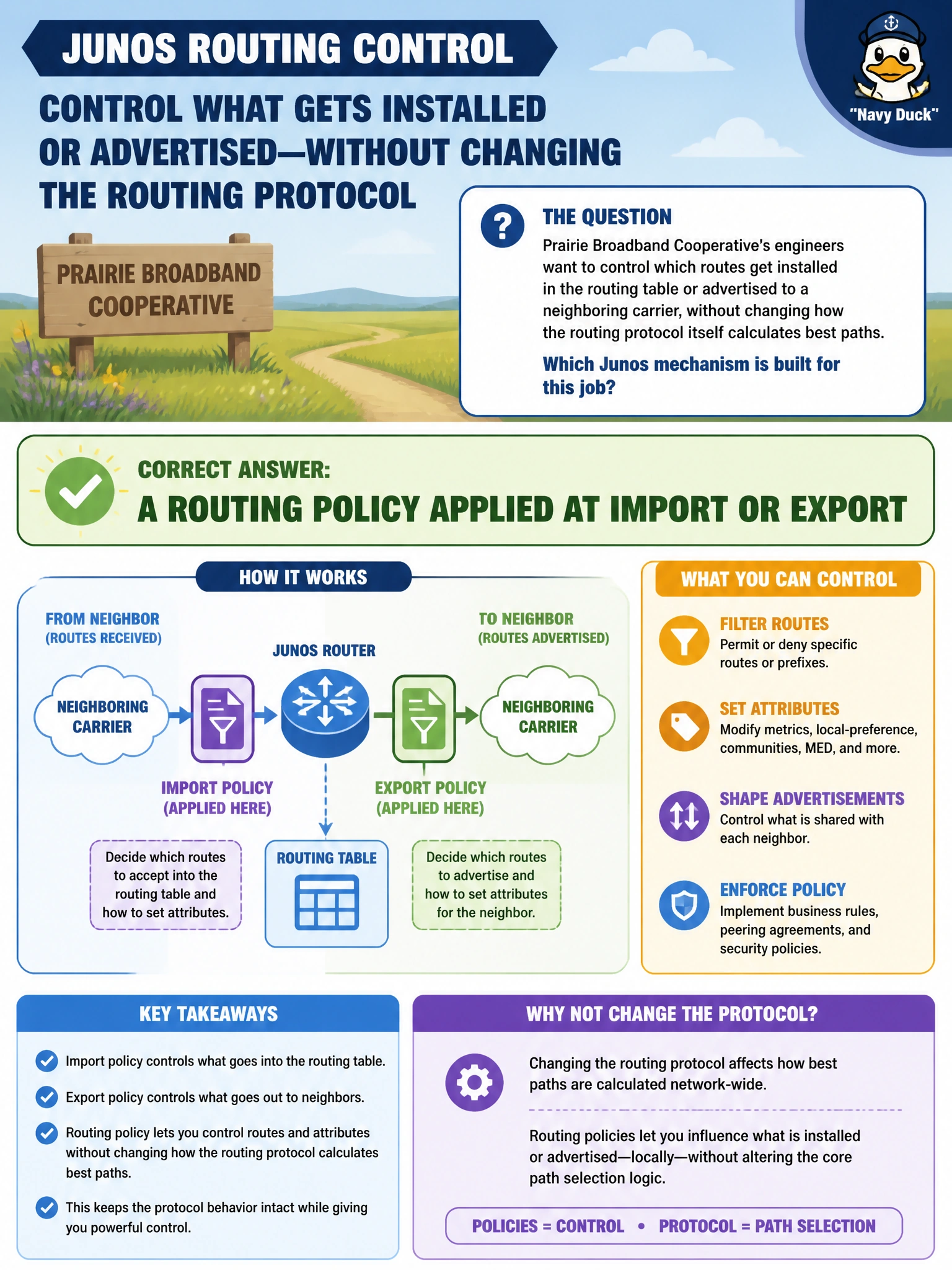
Think of routing policy as the co-op's sorting room for routes: the protocol still figures out the fastest path to a town, but the policy decides which routes actually get filed into the table or handed to a neighbor. It works alongside the protocol's own math rather than changing it. A firewall filter, a preference tweak, and a CoS class all solve different problems entirely.
Full Explanation
A routing policy is the Junos construct purpose-built to control which routes enter the routing table or leave it toward a neighbor, independent of the protocol's own best-path math. At a rural cooperative aggregating dozens of subscriber prefixes into a handful of upstream sessions, engineers attach policy at two points: import, where routes coming from a protocol are evaluated before installation, and export, where routes leaving the table are evaluated before advertisement. The policy inspects match conditions on each route and applies an action, but it never touches metrics, cost, or the underlying SPF or best-path selection. A firewall filter is the wrong layer because it acts on packets crossing an interface in the forwarding path, not on routes in the control plane, so it cannot decide what gets installed or announced. Adjusting route preference changes which protocol's copy of a prefix wins when several sources offer it, but it cannot selectively permit or block individual prefixes. A CoS forwarding class only changes how a packet is queued and scheduled on egress and has no bearing on route selection. A useful caveat: a misconfigured policy fails silently, with no protocol adjacency error, so routes can vanish from the table without any alarm firing. A concrete check is running show route <prefix> detail to confirm installation, then show route advertising-protocol bgp <neighbor> to confirm the route actually went out.