
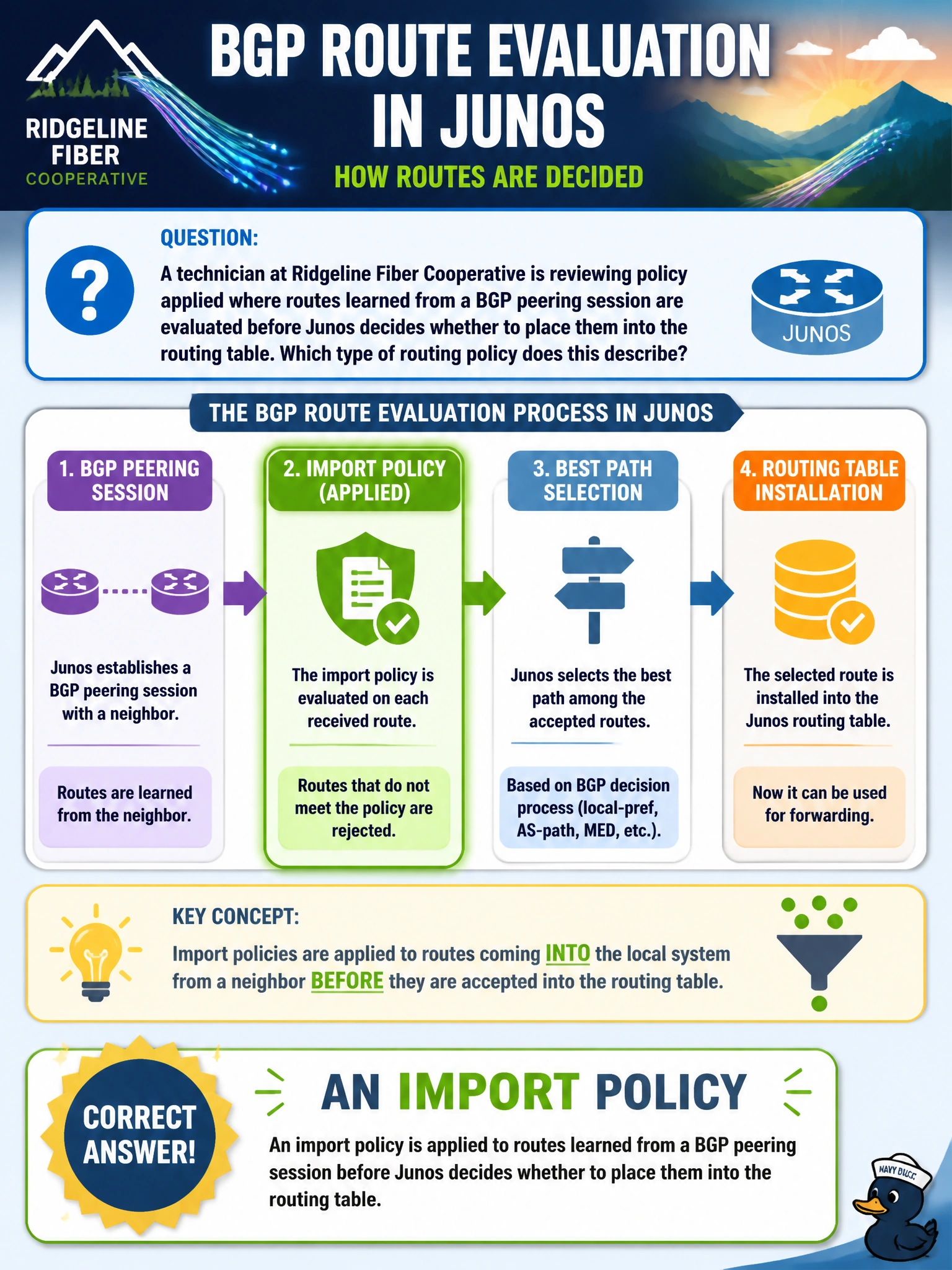
A technician at Ridgeline Fiber Cooperative is reviewing policy applied where routes learned from a BGP peering session are evaluated before Junos decides whether to place them into the routing table. Which type of routing policy does this describe?
Select an answer to reveal the explanation.
Short Explanation
Picture routes arriving at the co-op's edge router like mail coming through the front door: before anything gets filed into the address book, it passes an import policy that decides whether it belongs in the routing table at all. Import always looks at routes on their way in, from a protocol toward the table. Everything else here handles a different direction or a different job entirely.
Full Explanation
An import policy is applied to routes as they are received from a routing protocol and considered for placement into the routing table, which makes it the correct description of routes evaluated right after a BGP session hands them over. This is the point where a cooperative's edge router can decide whether a peer's advertised prefixes are trustworthy enough to install, before they ever influence forwarding decisions. An export policy is the mirror image and works in the opposite direction, evaluating routes already in the table as they are about to be advertised outward, so it does not fit routes that have just arrived. A firewall filter operates on packets crossing an interface in the data plane and has no role in deciding what gets installed into the routing table, since it never inspects the control-plane route itself. A rescue configuration is an unrelated safety mechanism, a saved snapshot of the device's configuration that an administrator can load if the active configuration becomes unusable, and it has nothing to do with evaluating incoming routes. The caveat worth remembering is that import policy runs before the protocol's own best-path selection finishes competing among sources, so a rejected route never gets a chance to be compared against alternatives. To verify an import policy's effect, compare show route receive-protocol bgp <neighbor>, which shows what was offered, against show route <prefix>, which shows what actually made it into the table.