
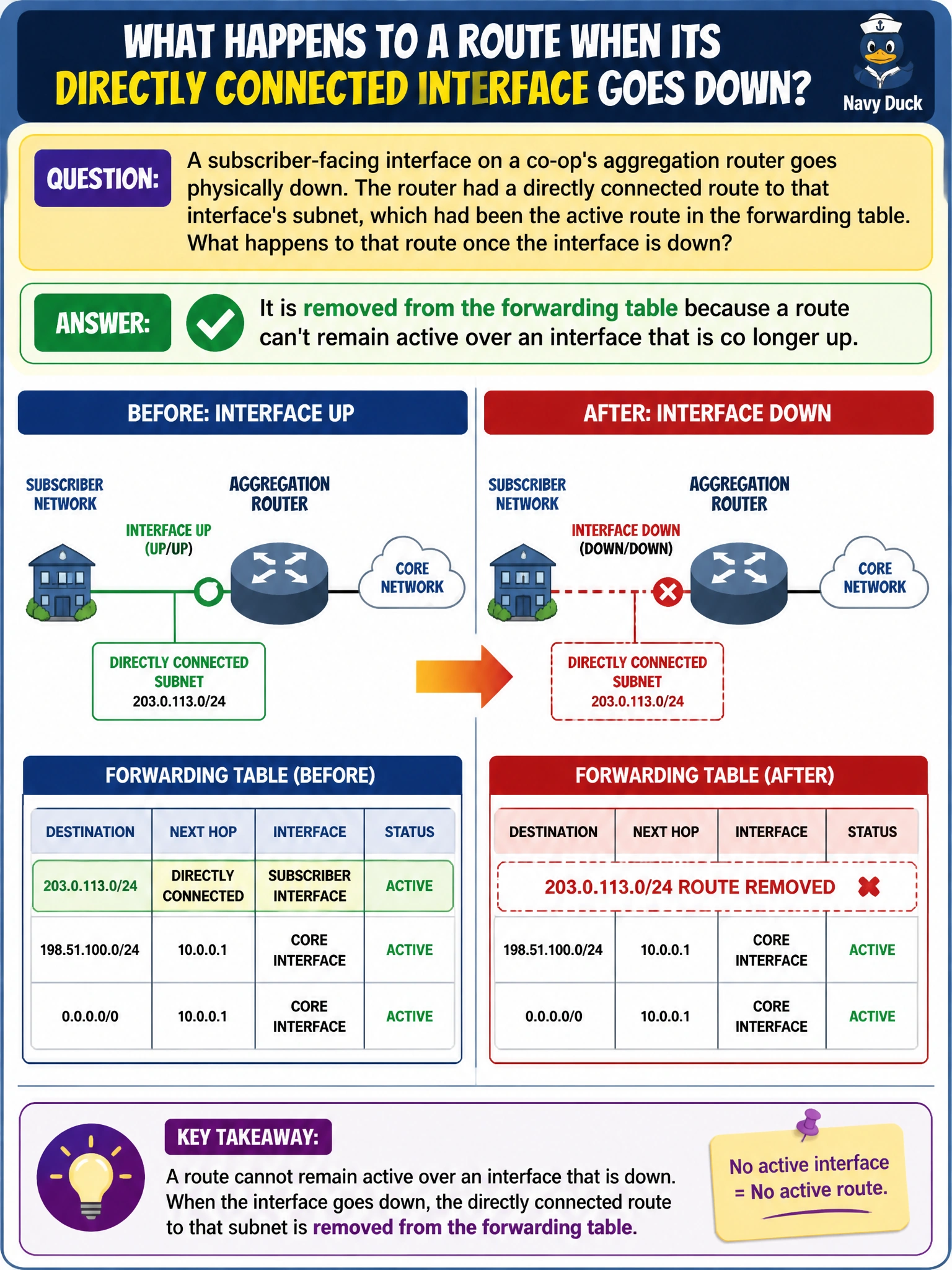
A subscriber-facing interface on a co-op's aggregation router goes physically down. The router had a directly connected route to that interface's subnet, which had been the active route in the forwarding table. What happens to that route once the interface is down?
Select an answer to reveal the explanation.
Short Explanation
A route riding on a dead interface can't keep forwarding traffic, so Junos pulls it the moment that interface drops. No route stays 'active' over a path that physically doesn't exist anymore — it has to go.
Full Explanation
A directly connected route only exists in the routing table because its associated interface is up and has a valid address configured; when that interface transitions down, Junos removes the dependent route from both the routing table and the forwarding table, since there's no longer a valid path to forward traffic over. This is automatic and immediate — it doesn't require any administrator action, which rules out the idea of the route lingering active until someone manually intervenes; leaving a dead route active would mean silently blackholing traffic instead of letting Junos search for an alternate path if one exists. Nothing about an interface failure causes a route to move into a different routing instance; routing instances are a static configuration boundary, not a failover destination triggered by link state. The route also doesn't transform into a static route — its type doesn't change at all; it simply ceases to exist once its underlying interface condition is no longer met. The practical consequence worth noting is that if a floating static route or an alternate path was configured toward that same subnet, losing the direct route can allow that alternate to become active in its place. An operational check is show interfaces terse alongside show route <prefix>, confirming the interface state and that the previously-active direct route has indeed disappeared.