
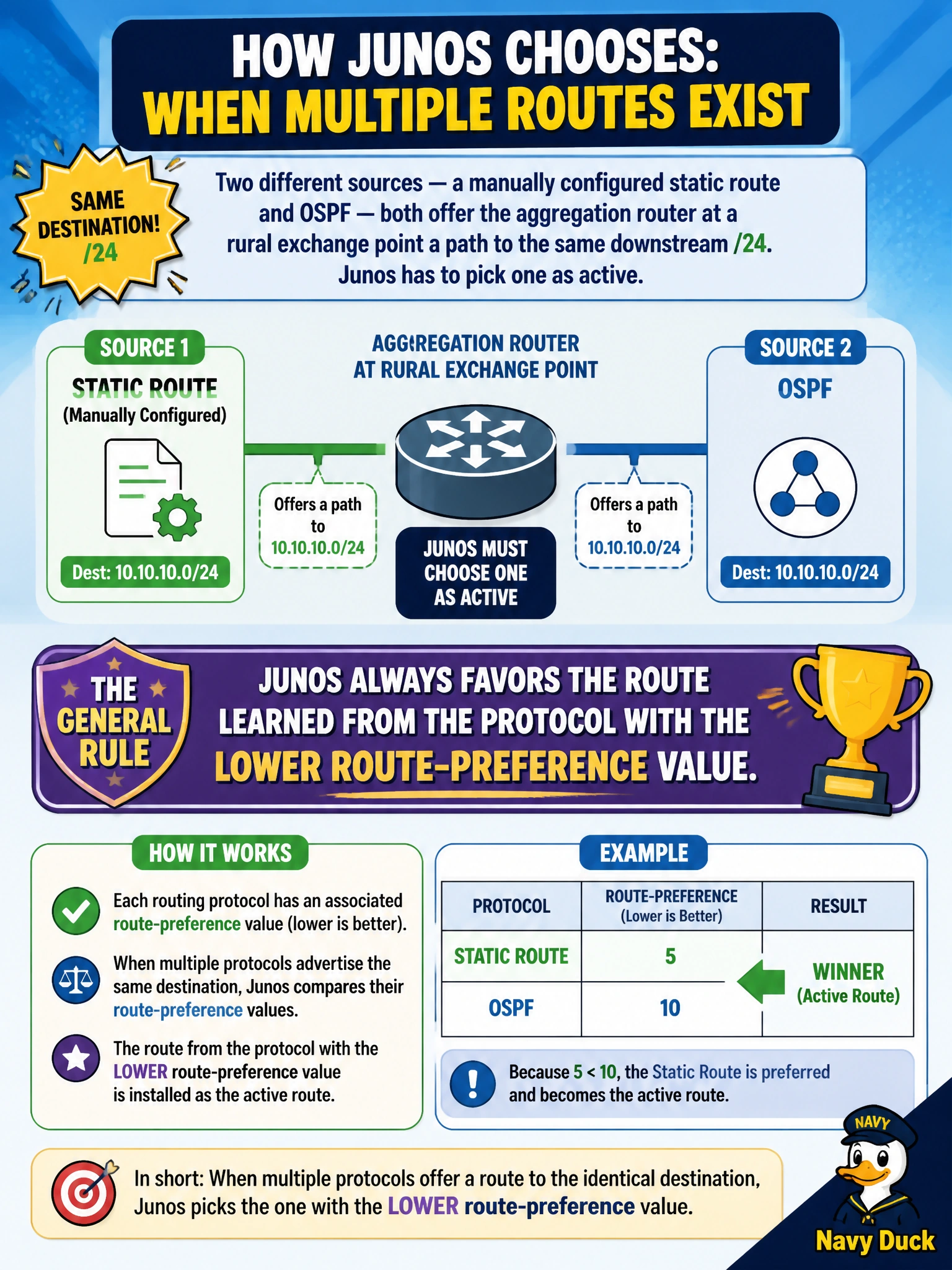
Two different sources — a manually configured static route and OSPF — both offer the aggregation router at a rural exchange point a path to the same downstream /24. Junos has to pick one as active. What general rule governs that choice when multiple protocols offer a route to the identical destination?
Select an answer to reveal the explanation.
Short Explanation
Route preference is Junos's built-in trust score for each protocol, and here's the twist: lower is better. It's like a co-op ranking its suppliers — supplier #5 beats supplier #100 every time, so the route with the smallest preference number wins the active slot.
Full Explanation
Every route Junos installs carries a route-preference value, and when the routing table holds more than one candidate route to the same destination, Junos selects the one with the numerically lowest preference as the active route. This is a deliberately counterintuitive convention — lower is more preferred, not higher — so it's worth stating precisely rather than guessing. Configuration recency plays no role at all; Junos doesn't track or use a timestamp to break ties between competing routes. Claiming OSPF always beats a static route regardless of preference gets the mechanism backwards: with Junos defaults, the static route actually wins here because its default preference of 5 is lower than OSPF internal's default of 10 — the opposite of what that claim assumes. The rule is about the numeric preference value, never the protocol's name, and an administrator can override either value to change the outcome. A caveat worth remembering for the exam: route preference only matters when two different protocols offer competing paths to the same prefix; within a single protocol, its own internal metric (like OSPF cost) breaks ties first. An operational check is show route <prefix>, which lists every candidate route along with its preference value and marks the active one.