
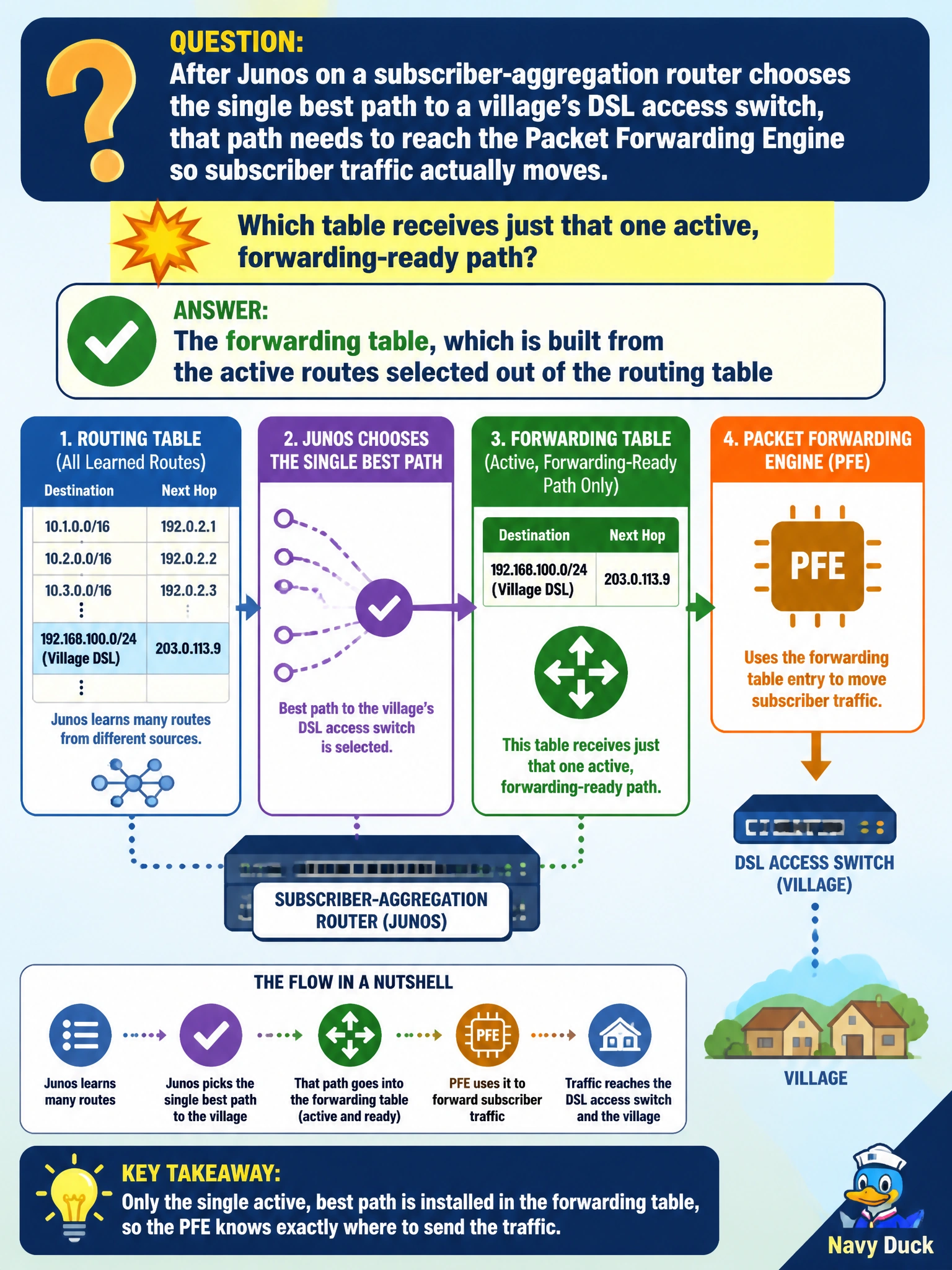
After Junos on a subscriber-aggregation router chooses the single best path to a village's DSL access switch, that path needs to reach the Packet Forwarding Engine so subscriber traffic actually moves. Which table receives just that one active, forwarding-ready path?
Select an answer to reveal the explanation.
Short Explanation
The routing table is the co-op's whole binder of possible routes; the forwarding table is the single sticky note the router actually acts on. Once Junos picks a winner for each destination, only that winner gets copied down to the forwarding table. That's the version the Packet Forwarding Engine reads on every packet.
Full Explanation
Junos maintains a clear split between the routing table and the forwarding table. The routing table can hold multiple candidate routes to the same destination, learned from different sources with different preferences. The forwarding table (as seen in the forwarding-plane view) holds only the currently active route for each destination — the one route Junos actually installs for the Packet Forwarding Engine to use when moving traffic. The MAC address table is a Layer 2 construct on a switch, mapping learned source MACs to interfaces; it has nothing to do with Layer 3 path selection toward a remote subnet. A neighbor table tracks protocol adjacencies (who a router is talking to, and whether that session is up) rather than destination reachability itself. This separation matters operationally: if an engineer sees a route sitting in the routing table but traffic isn't flowing along it, the likely explanation is that a different route to the same destination is active instead, and only the active one ever reaches the forwarding table. A quick check is comparing the routing table's best-route flag for that destination against what's actually forwarding traffic.