
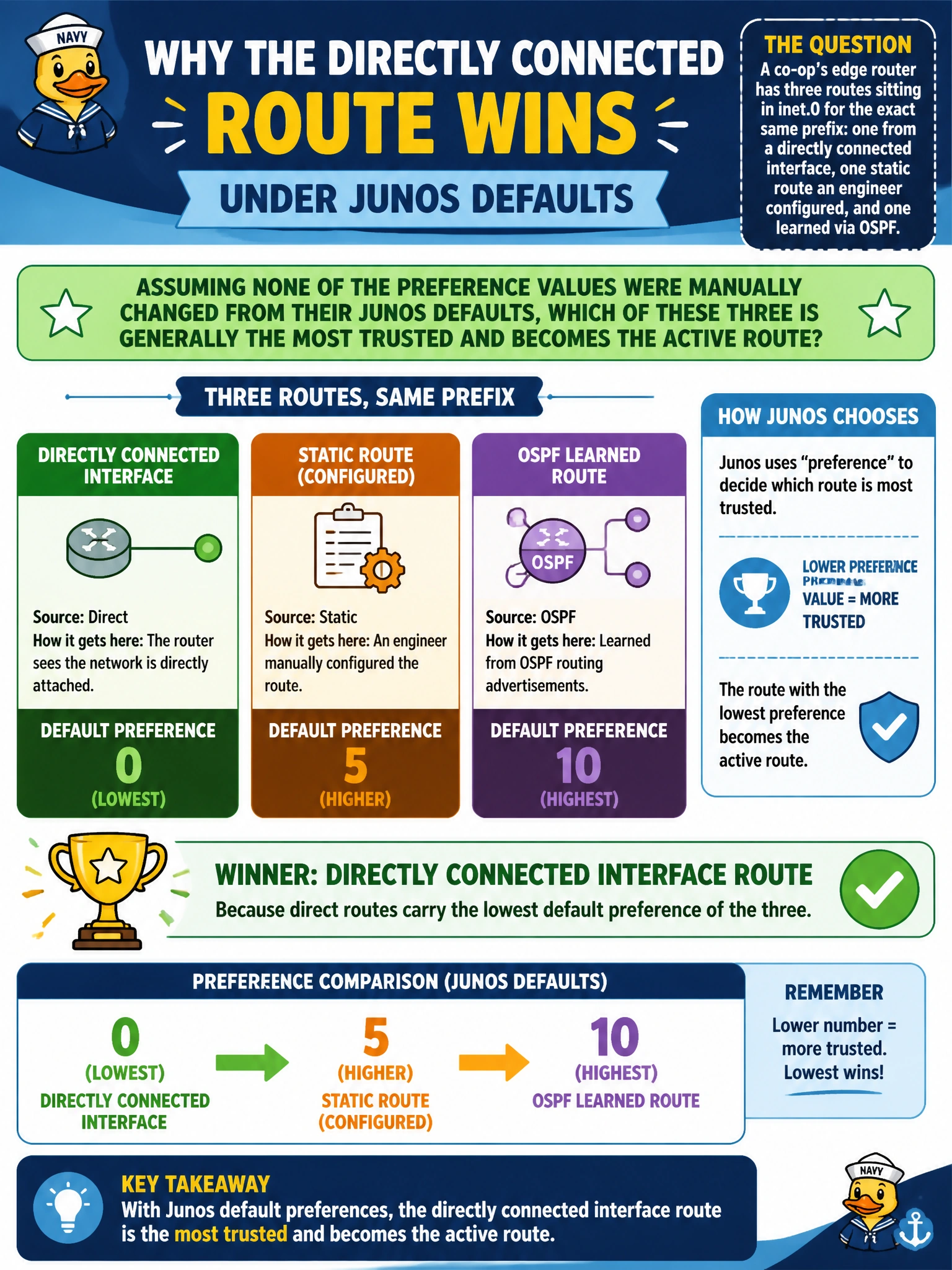
A co-op's edge router has three routes sitting in inet.0 for the exact same prefix: one from a directly connected interface, one static route an engineer configured, and one learned via OSPF. Assuming none of the preference values were manually changed from their Junos defaults, which of these three is generally the most trusted and becomes the active route?
Select an answer to reveal the explanation.
Short Explanation
Picture the co-op's most trusted source as the ground truth right in front of you: a directly connected interface. Junos treats that as about as certain as routing information gets, so it defaults to trusting it over anything a person typed in or a protocol calculated. Static and OSPF both rank behind it by default.
Full Explanation
By default, Junos assigns directly connected interface routes the lowest (most preferred) route-preference value of any route type, ahead of both static routes and any dynamic IGP like OSPF. The reasoning is straightforward: a directly attached subnet is the most certain, lowest-risk information the router has — there's no protocol calculation or manual entry that could be stale or mistaken. Claiming OSPF always outranks manual configuration reverses the actual default ordering for this specific comparison; OSPF's default preference is numerically higher (less preferred) than a direct route's. Trusting the static route because a human configured it confuses administrative intent with Junos's preference mechanism — Junos doesn't weigh routes by who or what created them beyond the fixed default preference assigned to each source type. And Junos doesn't use arrival time as a tiebreaker at all; preference values, not timestamps, decide the active route. As a caveat, all of these defaults can be overridden per route, which is exactly the mechanism behind techniques like floating static routes. A useful check is show route <prefix> detail, which lists the preference value next to each candidate.