
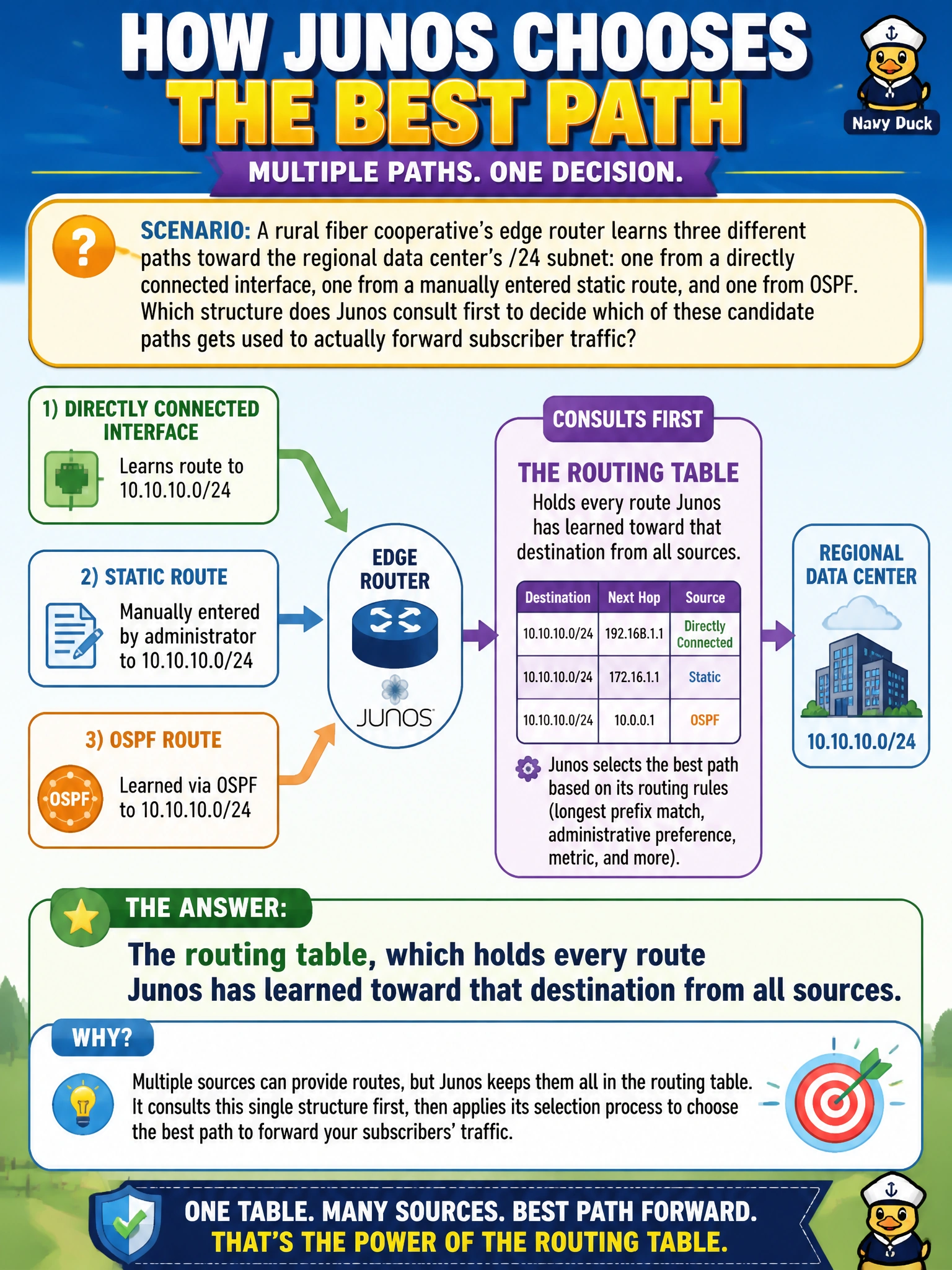
A rural fiber cooperative's edge router learns three different paths toward the regional data center's /24 subnet: one from a directly connected interface, one from a manually entered static route, and one from OSPF. Which structure does Junos consult first to decide which of these candidate paths gets used to actually forward subscriber traffic?
Select an answer to reveal the explanation.
Short Explanation
Think of the routing table as the co-op's master ledger of every possible road toward a destination, no matter who reported it. Junos writes down the direct connection, the static entry, and OSPF's answer side by side in that ledger before deciding which one actually gets used. The picking-a-winner part comes next.
Full Explanation
The routing table (inet.0 for the default unicast table) is where Junos records every route it has learned toward a destination, from every source: directly connected interfaces, static routes an engineer typed in, and dynamic protocols like OSPF. It's a superset — nothing is discarded from it just because a better path exists elsewhere. The chassis alarm log only tracks hardware and interface events, not route candidates, so it plays no role in path selection. The candidate configuration is a staged, not-yet-active set of configuration statements; it can contain a static route definition, but it isn't a live data structure Junos forwards against. The ARP cache resolves a known next-hop IP to a Layer 2 address for framing a packet — that happens after a route is already chosen, not as part of picking one. Once all candidate routes for a destination sit in the routing table, Junos applies route preference to select the single active route, which is then copied into the forwarding table. As an operational check, a candidate route appearing correctly in the candidate configuration but never in the routing table usually points to a commit that hasn't happened yet.