
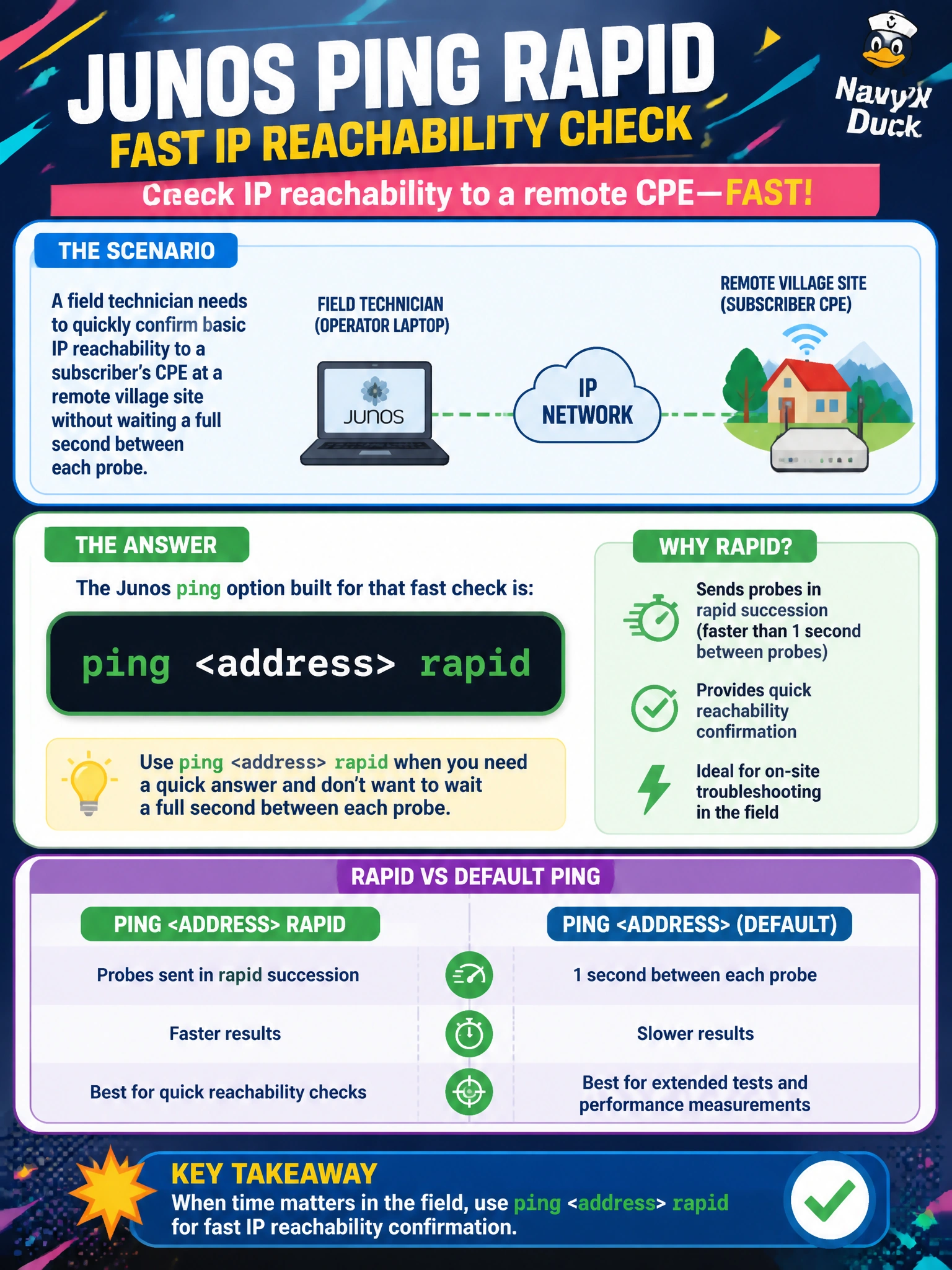
A field technician needs to quickly confirm basic IP reachability to a subscriber's CPE at a remote village site without waiting a full second between each probe. Which Junos ping option is built for that fast check?
Select an answer to reveal the explanation.
Short Explanation
Normal ping paces itself, waiting a beat between each request like a polite knock on the door. Add rapid, and it stops waiting — probes go out back-to-back, so you get a fast reachability read instead of standing around for several seconds.
Full Explanation
The rapid option changes ping's timing behavior specifically: instead of pausing roughly a second between each echo request, it fires probes as quickly as replies allow, which is exactly the behavior wanted when a technician just needs a quick yes-or-no reachability answer rather than a paced latency trend. count 5 only limits how many probes are sent — it does nothing to the interval between them, so five probes at the default pace would still take several seconds. bypass-routing is a different tool entirely: it sends the probe directly to a host on an attached network while skipping the routing table lookup, useful for testing a locally-connected device even if its route is broken, but unrelated to probe speed. do-not-fragment sets a flag used for path-MTU testing, revealing whether a packet of a given size can cross the path unfragmented — again, a different diagnostic goal than a fast reachability check. A caveat worth noting: rapid probing sends more traffic per second, so it should be used briefly on constrained rural links rather than left running. A concrete check: run ping <address> rapid count 20 and confirm all replies return before moving on to deeper diagnostics.