
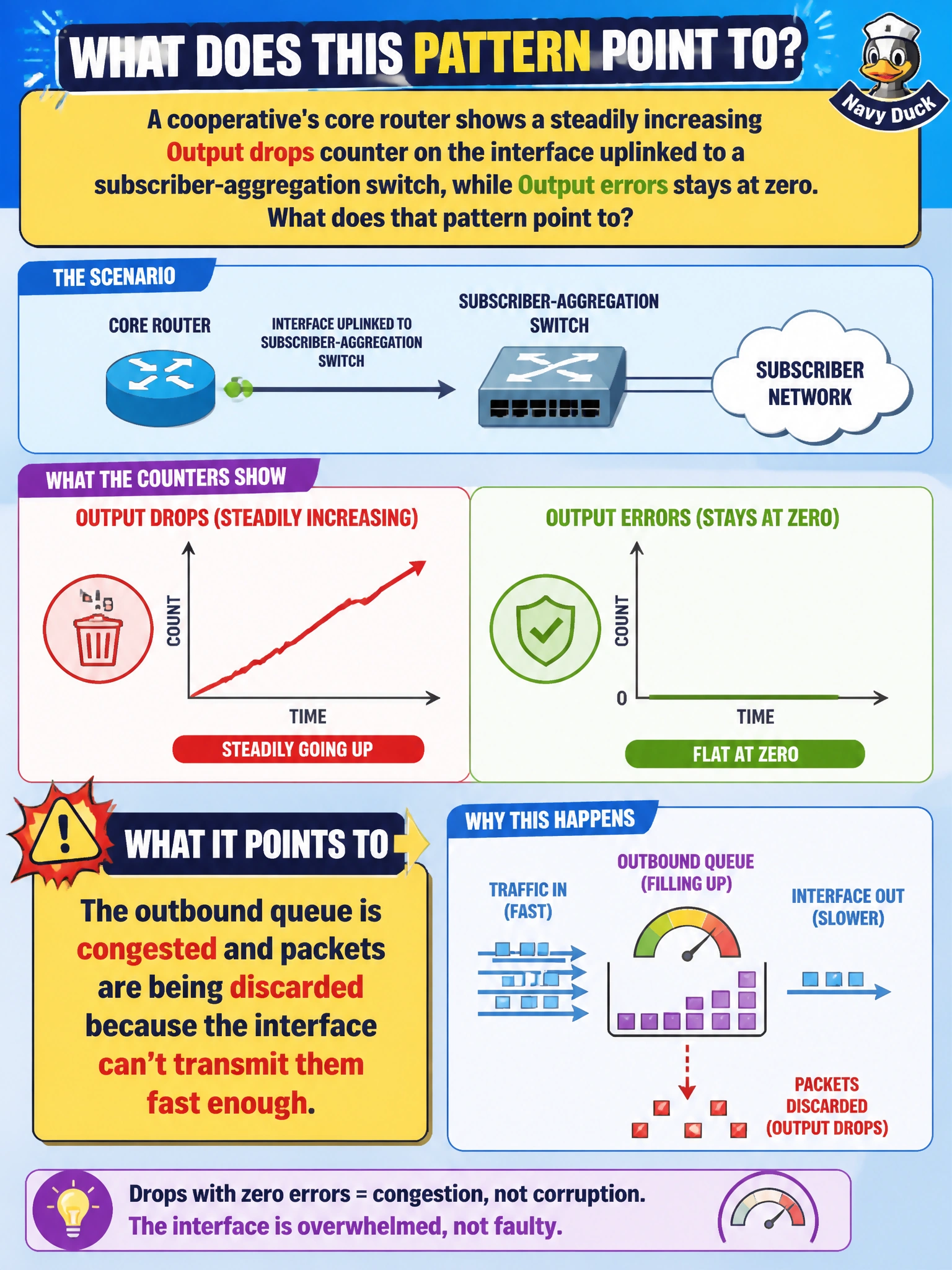
A cooperative's core router shows a steadily increasing Output drops counter on the interface uplinked to a subscriber-aggregation switch, while Output errors stays at zero. What does that pattern point to?
Select an answer to reveal the explanation.
Short Explanation
Picture a highway on-ramp backing up because more cars want in than the lane can absorb — that's an output drop. Output errors sitting at zero rules out a broken interface; instead, the queue is simply fuller than the link can drain, a textbook oversubscription symptom.
Full Explanation
Output drops and output errors measure two different failure modes, and the pattern in this scenario cleanly isolates one of them: drops happen when a packet is correctly formed and ready to transmit but the outbound queue is full, so the router has no choice but to discard it, while errors reflect a transmission problem with frames actually put on the wire. Zero output errors tells you the interface's physical transmit path is healthy, which rules out a bad transceiver corrupting outbound frames — that would raise the error counter, not the drop counter. An administratively disabled interface wouldn't be forwarding or dropping traffic at all; its state would show down in show interfaces terse, not a climbing drop counter. Malformed frames failing a CRC check is also a receive-side concern on the far end, unrelated to this router's own output queue. The operational takeaway is that the uplink is oversubscribed relative to the traffic being pushed onto it. A concrete check: run show interfaces queue on the interface to see which forwarding class is absorbing the drops, and compare offered load against the link's rated bandwidth to confirm oversubscription is the root cause.