
A NOC engineer at a rural telecom cooperative notices the Carrier transitions counter on a POP's uplink interface has climbed into the hundreds over the past hour, while the link currently shows up. What does that counter tell the engineer?
Select an answer to reveal the explanation.
Short Explanation
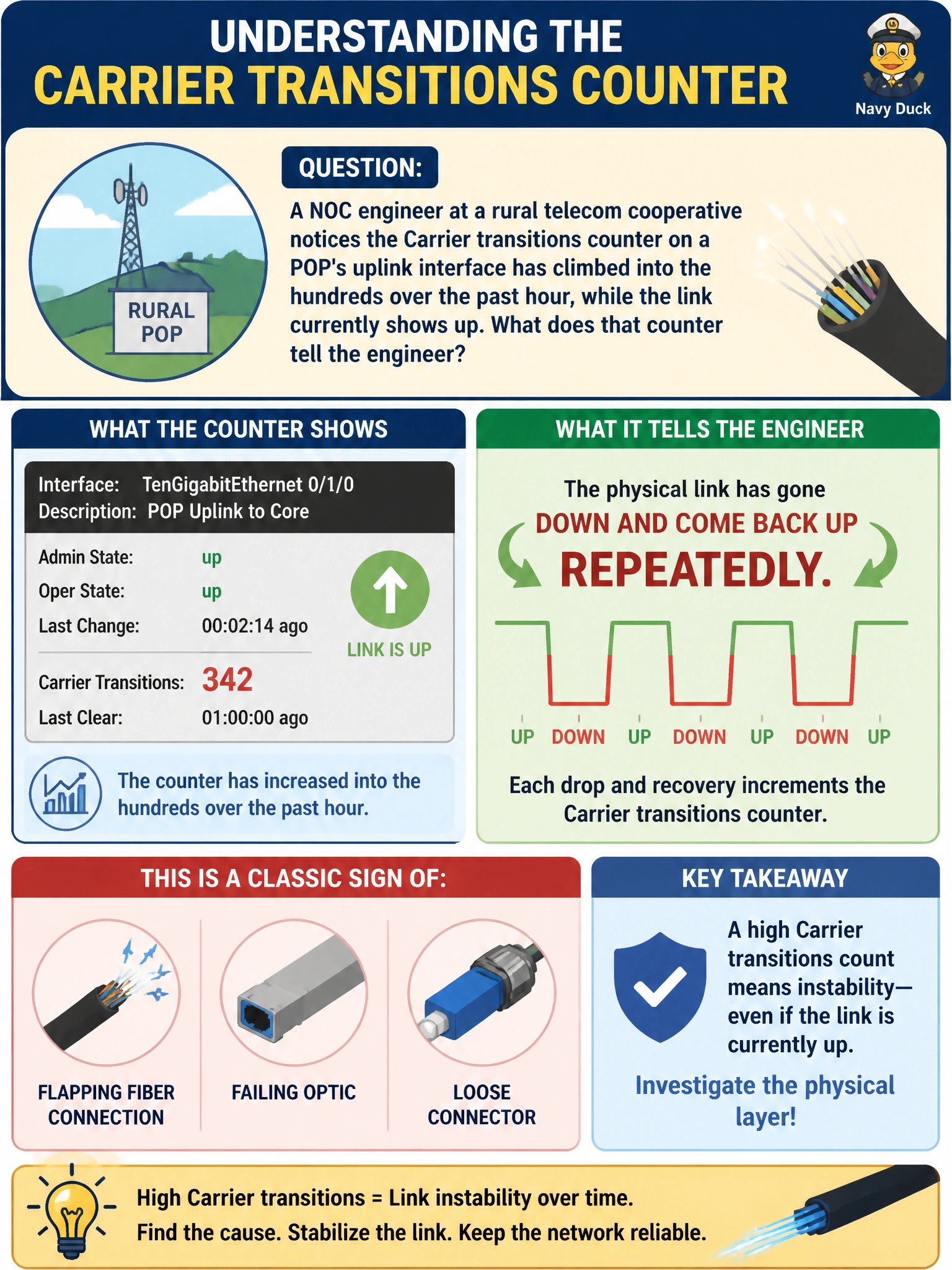
A high Carrier transitions count is the interface's way of keeping a diary of every time the light went out and came back on. If that diary has hundreds of entries in an hour, the link isn't stable even though it happens to be up right now — something physical is flapping.
Full Explanation
Carrier transitions is a cumulative counter of how many times an interface's link-layer carrier signal has toggled from down to up, and it persists across those toggles rather than resetting when the link recovers — which is exactly why it can read "up" right now while still showing a large, worrying count. The mechanism that drives it is almost always physical: a fiber connector working loose, an optic nearing end of life, moisture or temperature stress on an outdoor enclosure, or a media converter resetting intermittently. Buffer exhaustion is a queueing concern that shows up as drop counters, not as carrier-state changes, so that option describes a real but different failure. Broadcast-frame processing is tracked separately as a traffic-type counter and has nothing to do with the physical carrier signal. Exceeding a configured MTU produces fragmentation or drop behavior on oversized packets; it doesn't cause the link's carrier to toggle. As a concrete next step, correlate the transition timestamps against show log messages for matching link-down/link-up events, then physically inspect or reseat the fiber connector and transceiver at that port.