
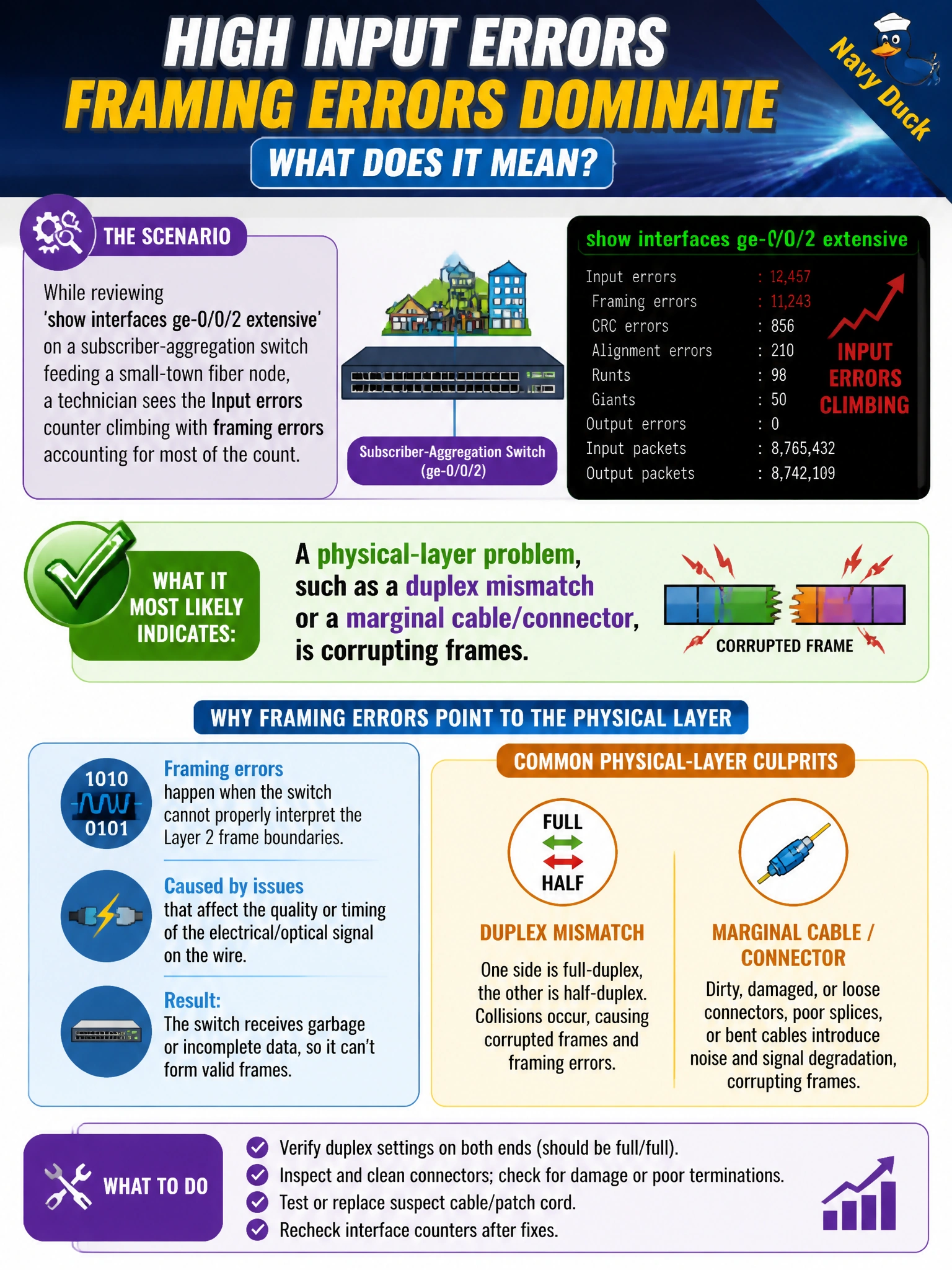
While reviewing show interfaces ge-0/0/2 extensive on a subscriber-aggregation switch feeding a small-town fiber node, a technician sees the Input errors counter climbing with framing errors accounting for most of the count. What does this most likely indicate?
Select an answer to reveal the explanation.
Short Explanation
Framing errors are the interface telling you the bits arriving don't line up the way a clean Ethernet frame should. That's almost always a physical-layer symptom — a mismatched duplex setting, a marginal cable run, or a flaky connector — not something happening further up the stack.
Full Explanation
Framing errors are counted at the physical/data-link boundary: the receiving interface detects that incoming bits don't form a properly delimited frame, which points squarely at the physical layer or the link's negotiated parameters rather than anything in software. A duplex mismatch between the switch port and the device on the fiber node's other end is a classic cause, along with a degraded cable, a dirty or damaged connector, or a failing transceiver. Congestion-driven queue drops show up as output drops on the transmitting side, not as input framing errors, so option A describes a real but unrelated counter. A flapping routing adjacency is a control-plane symptom that could follow from a bad physical link, but it isn't what the framing-error counter itself measures. Firewall-filter discards are counted separately as policy discards and only apply to frames that were received cleanly and then evaluated against filter terms — a corrupted frame never gets that far. As a concrete check, confirm both ends of the link have matching duplex and speed settings, then swap the patch cable or transceiver if the counter keeps climbing after that.