
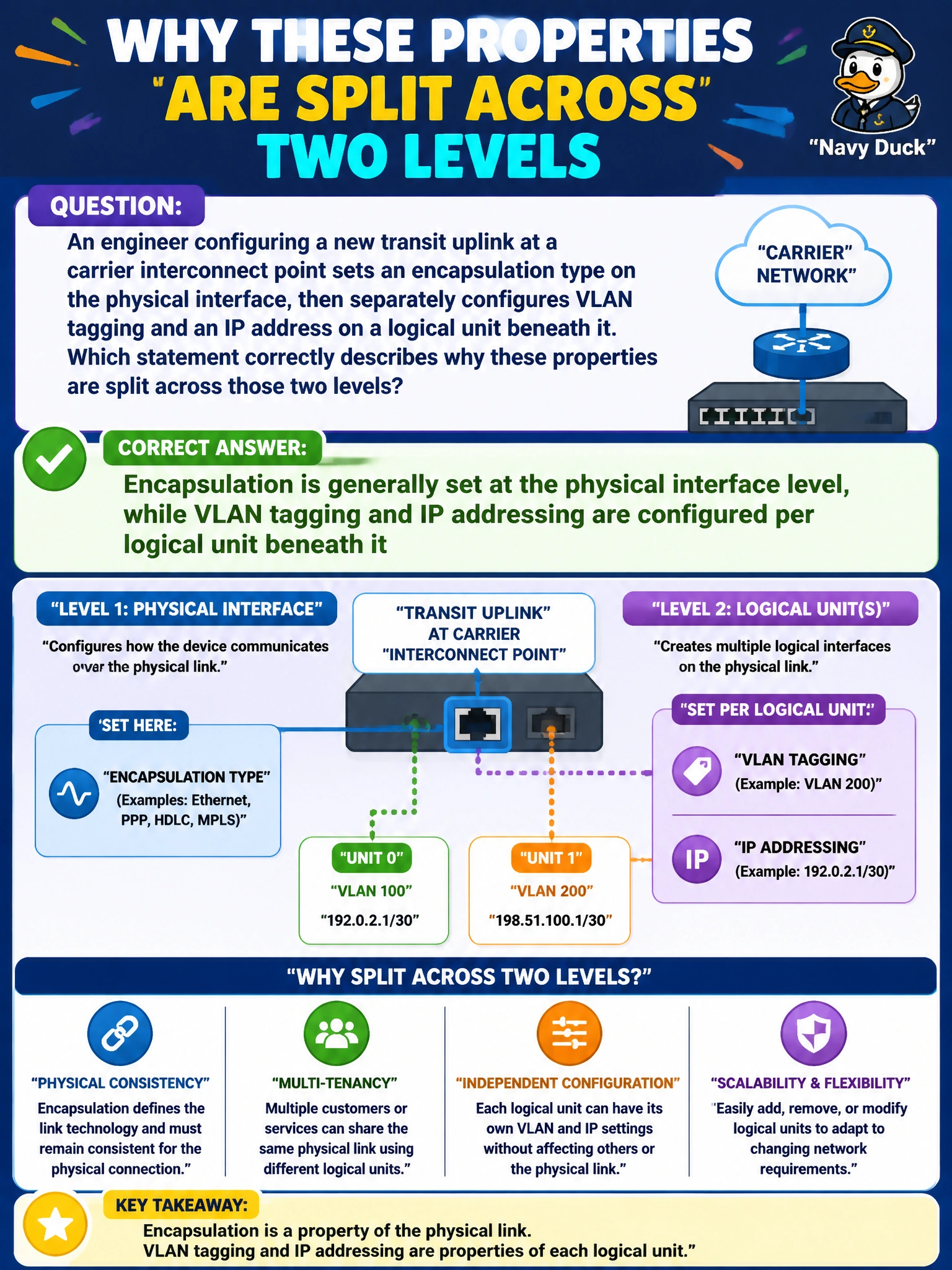
An engineer configuring a new transit uplink at a carrier interconnect point sets an encapsulation type on the physical interface, then separately configures VLAN tagging and an IP address on a logical unit beneath it. Which statement correctly describes why these properties are split across those two levels?
Select an answer to reveal the explanation.
Short Explanation
The physical port needs to agree on how frames are framed before anything else can happen, so encapsulation sits there. VLANs and IP addresses describe individual traffic streams riding that port, so those live down at the unit level.
Full Explanation
Encapsulation defines how frames are structured on the wire itself, which is a property of the physical medium and is therefore configured at the physical interface level, applying to every logical unit riding on top of that port. VLAN tagging and IP addressing, by contrast, describe individual logical traffic streams that can be multiplexed over a single physical port — a transit uplink can carry several logical units, each with its own VLAN and address — so those properties are configured per logical unit rather than once for the whole port. Forcing VLAN tagging to the physical level would make it impossible to carry multiple distinct VLANs over one physical interface, which is a core use case for logical units. Claiming encapsulation is a per-unit property gets the hierarchy backwards; the physical interface's framing must be established before any logical unit's traffic can be interpreted at all. Encapsulation is not limited to loopback interfaces — it is a routine setting on physical transit and access ports, and loopback interfaces do not carry a physical-medium encapsulation in the same sense at all. To verify, show configuration interfaces <name> shows the encapsulation statement sitting above the unit blocks, with vlan-id and family inet address nested inside each individual unit.