
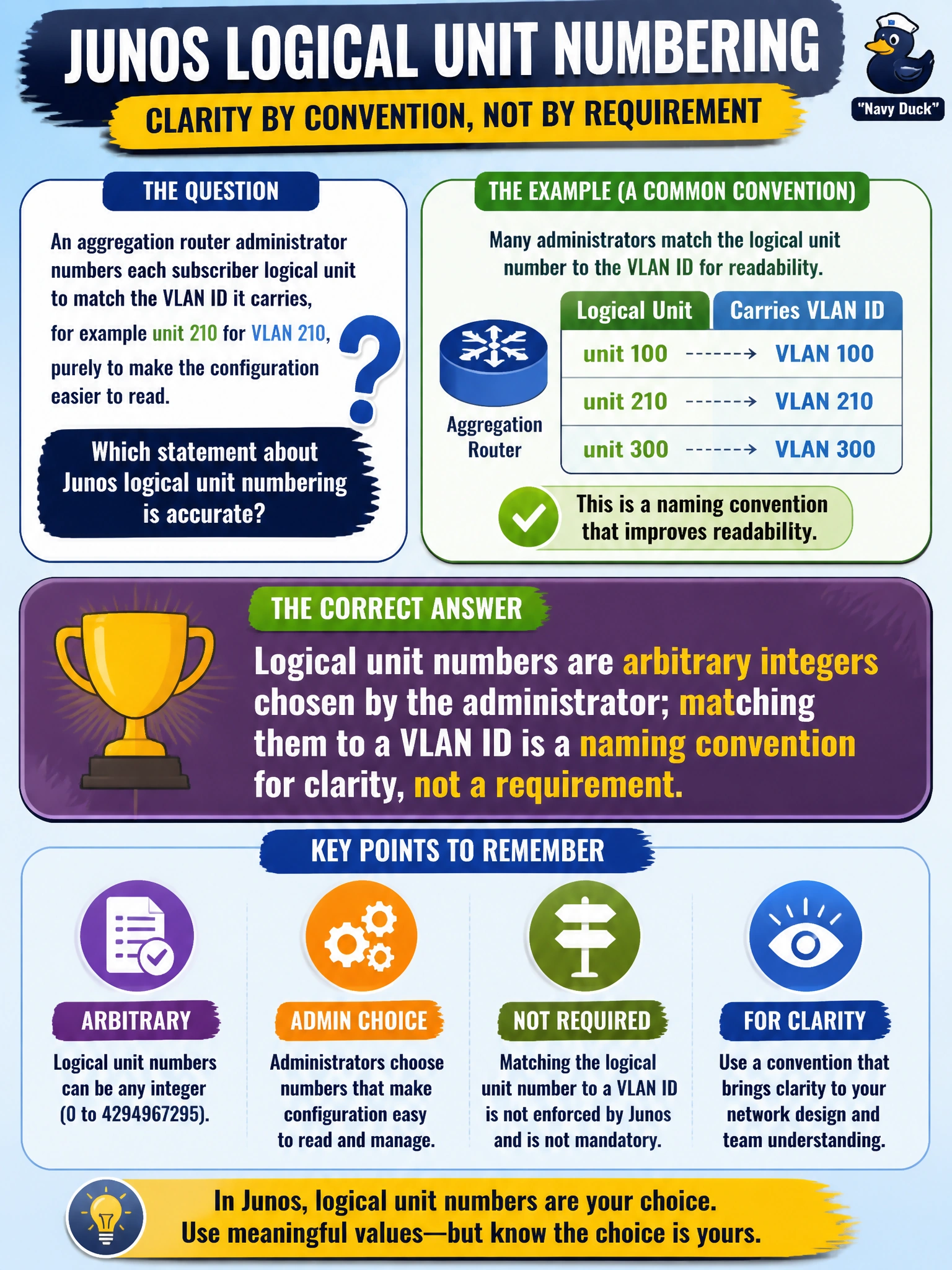
An aggregation router administrator numbers each subscriber logical unit to match the VLAN ID it carries, for example unit 210 for VLAN 210, purely to make the configuration easier to read. Which statement about Junos logical unit numbering is accurate?
Select an answer to reveal the explanation.
Short Explanation
Nothing forces the unit number and the VLAN ID to match — that's just a habit engineers pick up because a config full of unit 210 for vlan-id 210 is a lot easier to scan at 2am.
Full Explanation
A logical unit number in Junos is simply an administrator-chosen integer identifying a logical interface beneath a physical port; it carries no inherent relationship to the VLAN ID configured on that unit's vlan-tagging statement. Numbering unit 210 to carry VLAN 210 is a widely used convention purely for human readability during troubleshooting and auditing, not a Junos requirement, and a unit numbered arbitrarily, say unit 7, would function identically as long as its vlan-id statement is set correctly. The claim that they must match is false and would incorrectly suggest a configuration error where none exists whenever an engineer numbers units differently from VLAN IDs. Logical unit numbers are always explicitly chosen by whoever writes the configuration; Junos does not assign them automatically. Unit 0 has no special reservation preventing subscriber use; it is commonly used as the first or only logical unit on an interface and functions like any other unit number. To confirm the actual mapping in use, show configuration interfaces <name> shows exactly which unit number pairs with which vlan-id, regardless of whether the numbers happen to match.