
A rural broadband cooperative operates 40 small POPs, each running an identical block of NTP and syslog configuration on its router. Maintaining that block by hand in 40 separate candidate configurations is error-prone whenever a setting needs to change. What is the Junos-recommended way to keep that shared block consistent across every POP router?
Select an answer to reveal the explanation.
Short Explanation
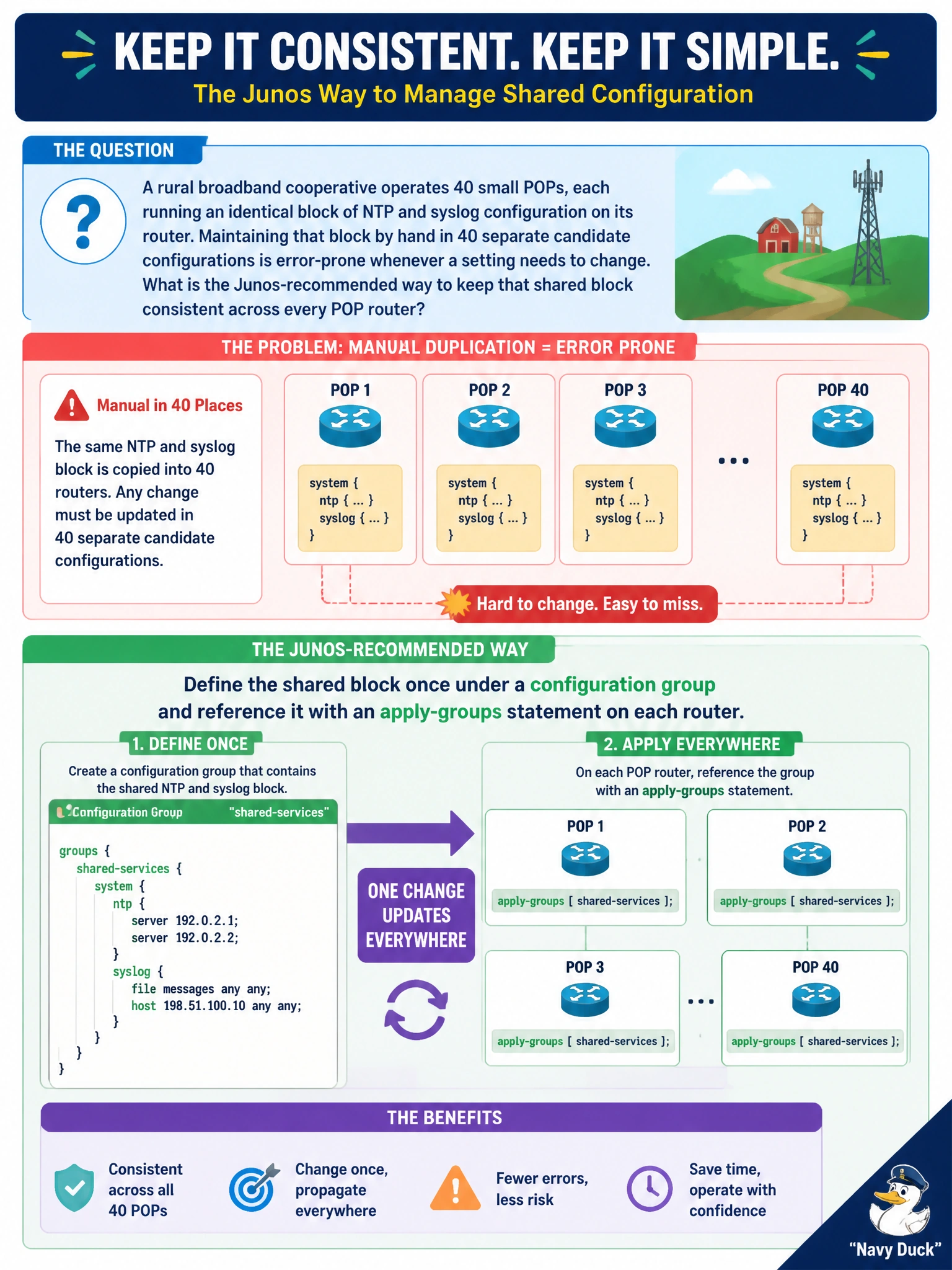
Write the shared boilerplate exactly once, under a named group, then just point every router at that group. Update the group in one place later, and every POP that references it picks up the change on its next commit.
Full Explanation
Junos configuration groups let an administrator define a reusable block of statements once under the groups hierarchy, then activate it on a device with an apply-groups statement, so the same NTP and syslog block can be authored a single time and referenced identically across all 40 POP routers. This keeps every site consistent and makes a future change a one-line edit to the group rather than 40 separate edits. Manually copying the block into each router's candidate configuration is exactly the error-prone, hard-to-maintain pattern the scenario flags as a problem, since a typo or missed router silently diverges from the rest. A routing instance is a separate routing-table construct meant for isolating routing information, not a mechanism for reusing configuration text across devices. Interface-range solves a different problem entirely — sharing settings across multiple interfaces on one router — and has no role in replicating system-level services like NTP or syslog across many routers. As an operational check, show configuration groups on any POP router should display the shared block verbatim, and show configuration | display inheritance shows exactly which lines were inherited from the group versus configured locally.