
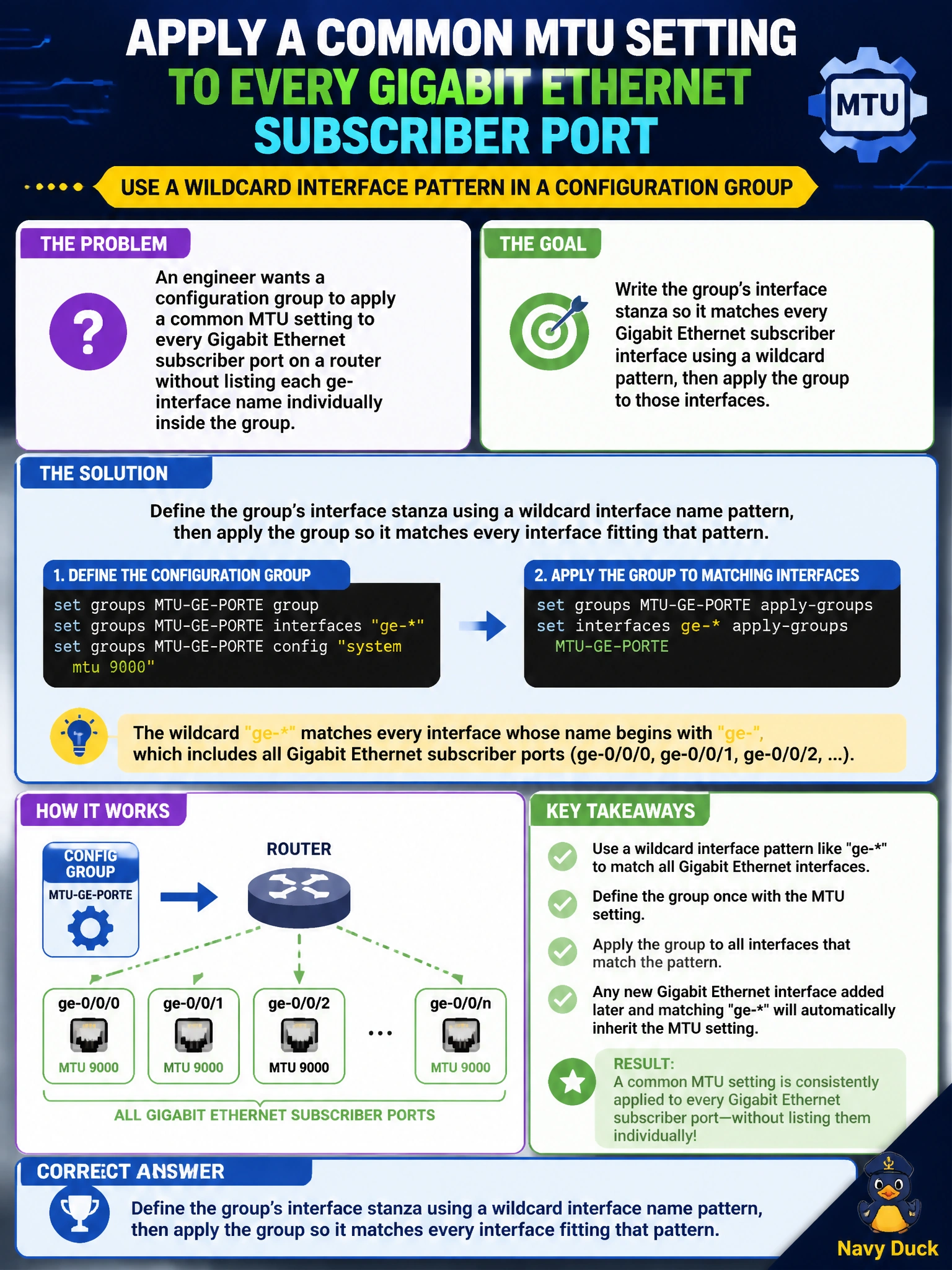
An engineer wants a configuration group to apply a common MTU setting to every Gigabit Ethernet subscriber port on a router without listing each ge- interface name individually inside the group. How should the group's interface stanza be written to achieve that?
Select an answer to reveal the explanation.
Short Explanation
A wildcard inside a configuration group means you write the pattern once and Junos matches it against every interface name that fits — no manual list to keep updated as ports get added.
Full Explanation
Junos configuration groups support a wildcard interface name, written as a pattern such as an asterisk under the interfaces hierarchy inside the group, so a single group definition expands to match every physical interface whose name fits that pattern when the group is applied. That is the intended way to push one setting, like a shared MTU, across an entire class of interfaces without hand-listing them, and it automatically covers new ports added later without editing the group again. Listing every interface individually inside the group defeats the purpose of the wildcard and reintroduces the exact maintenance burden the feature exists to remove. member-range is a statement that belongs to the separate interface-range feature, not to configuration groups, and mixing the two syntaxes together does not work. Referencing the group from routing-options instead of interfaces misapplies it to the wrong configuration hierarchy entirely, since the group's interface wildcard must live under the interfaces stanza to match interface names. After committing, show configuration interfaces | display inheritance on one of the matched ports confirms the MTU value was actually inherited from the wildcarded group rather than configured locally.