
Inside an interface-range block, an engineer needs to add ge-0/0/10 through ge-0/0/23 as a contiguous block of subscriber ports, separately from a handful of individually named interfaces elsewhere in the network. What is the functional difference between the member and member-range statements available inside that block?
Select an answer to reveal the explanation.
Short Explanation
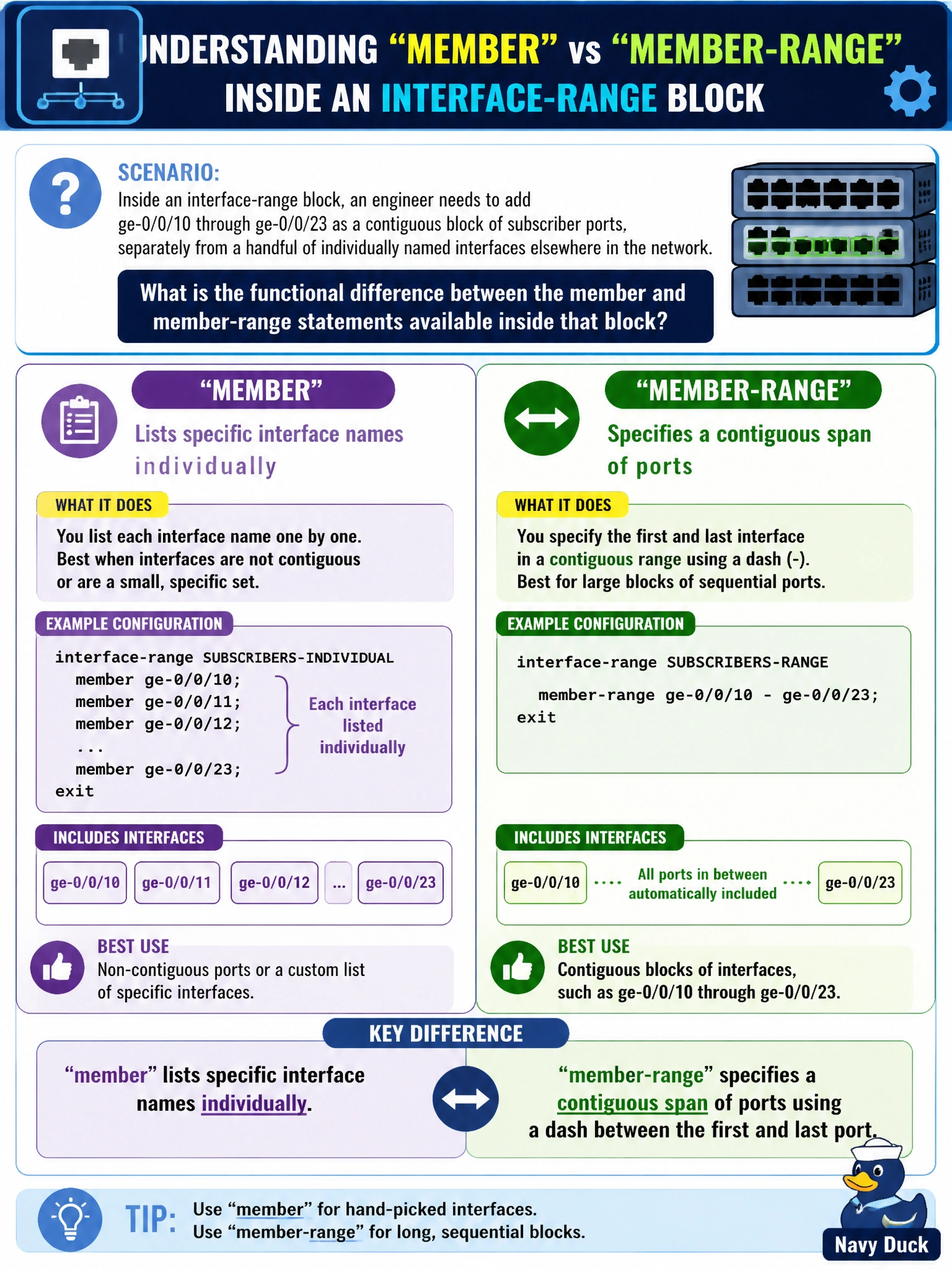
member is you naming ports one by one, like reading names off a list. member-range is you pointing at a shelf and saying "all of these, port 10 through port 23" in one line.
Full Explanation
The member statement adds one explicitly named interface at a time to an interface-range, which suits a handful of specific, non-contiguous ports scattered across a chassis. The member-range statement instead accepts a first and last interface name separated by a dash and expands to every port in that contiguous span, which is the efficient choice for a block like ge-0/0/10 through ge-0/0/23 rather than typing fourteen separate member lines. Neither statement touches IP addresses or VLAN IDs directly; those are properties applied to the range as a whole once membership is established, not what the membership statements themselves express. Treating the two as interchangeable synonyms misses that member-range requires the endpoints to form a valid contiguous port sequence, while member accepts any interface name regardless of adjacency — using the wrong one for the wrong shape of port set either fails to expand correctly or forces unnecessary, repetitive lines. Neither statement is restricted to logical units versus physical interfaces; both operate at the physical interface-range level. Running show configuration interfaces interface-range after commit confirms which physical ports actually got pulled into the range.