
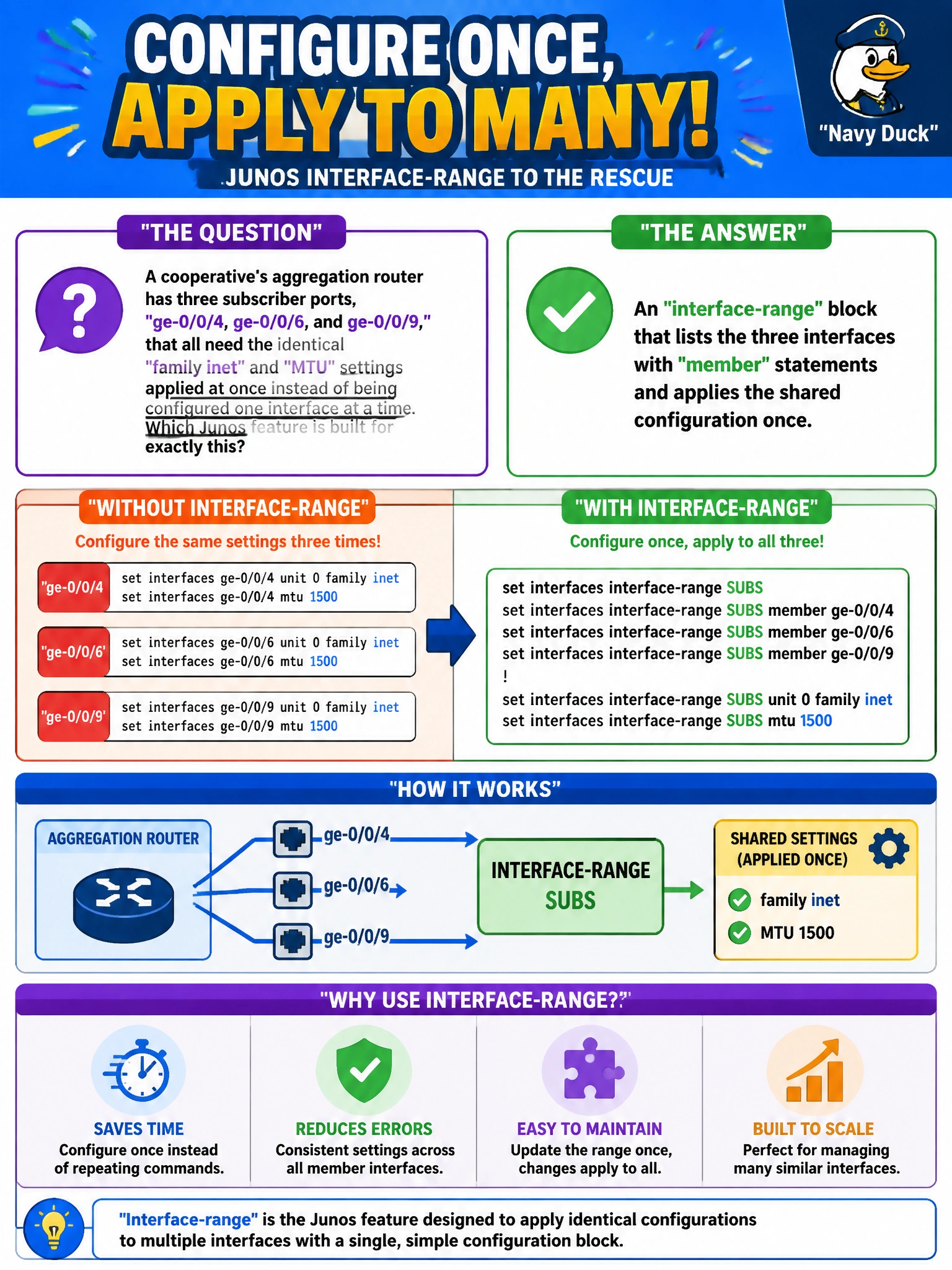
A cooperative's aggregation router has three subscriber ports, ge-0/0/4, ge-0/0/6, and ge-0/0/9, that all need the identical family inet and MTU settings applied at once instead of being configured one interface at a time. Which Junos feature is built for exactly this?
Select an answer to reveal the explanation.
Short Explanation
Instead of typing the same MTU and family lines three separate times, you name the group of ports once and hang the shared config off that one name. That's an interface-range doing exactly the job it was built for.
Full Explanation
An interface-range configuration stanza lets an administrator name a set of physical interfaces with member statements and attach a single block of shared properties — family, MTU, VLAN tagging, and similar settings — that Junos then applies to every listed member interface, which is precisely the labor-saving mechanism this scenario calls for. Wildcard apply-groups is a related but distinct mechanism: it matches interface names by pattern inside a reusable configuration group rather than listing explicit members, and reaching for it here skips the more direct, purpose-built interface-range tool. Transfer-on-commit is entirely unrelated — it controls automatically pushing a configuration archive to an external server after a commit, not applying shared interface settings. Creating a routing instance would isolate these interfaces into a separate routing table, which has nothing to do with sharing family or MTU configuration across ports. After committing an interface-range, show configuration interfaces displays the expanded, effective configuration on each member interface, confirming the shared settings actually applied to all three ports.