
After a POP router is fully commissioned with a management IP address and SSH enabled, a co-op still keeps a console cable connected to it in the equipment rack. What operational purpose does that console connection continue to serve?
Select an answer to reveal the explanation.
Short Explanation
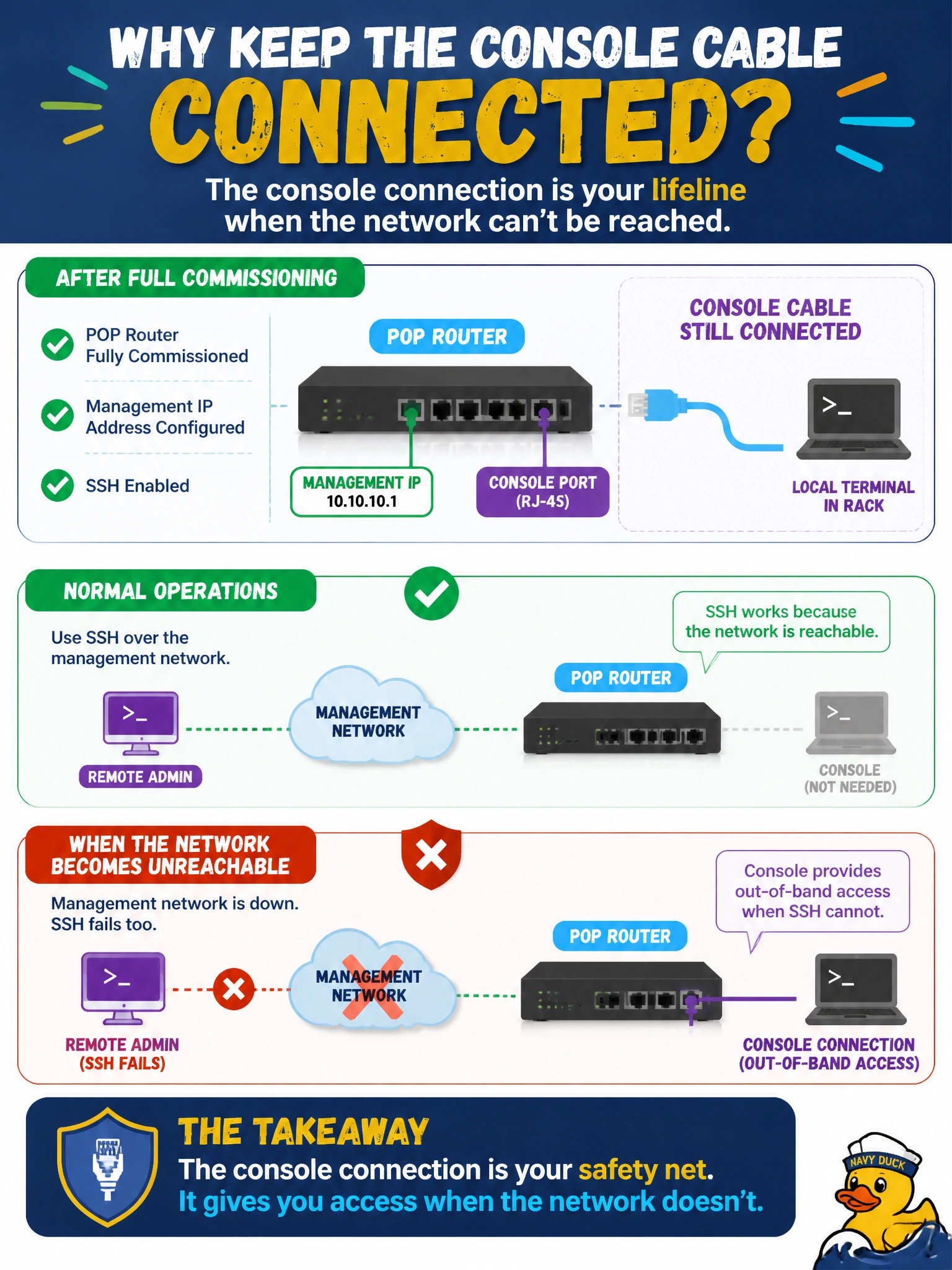
SSH only works if the network path to the router is actually up — and the whole point of a console cable is that it doesn't care whether the network is up. Keeping that connection live means there's always a way in, even on the day the management network itself is the thing that's broken.
Full Explanation
SSH is an in-band access method — it depends entirely on IP reachability across the management network, so if that network segment fails, whether from a switch outage, a routing problem, or a fiber cut affecting the management path, SSH access to the device fails right along with it. A console connection is out-of-band: it's a direct serial path to the device that doesn't depend on any network infrastructure being functional, which is exactly why cooperatives keep it connected even after a router is fully commissioned for remote SSH access — it's the fallback for the scenario where the network itself, not just the device, is the problem. SNMP has no dependency on an active console session; it's an independent, network-based polling protocol that functions or fails based on IP reachability and agent configuration, unrelated to whether a console cable is plugged in. A console connection doesn't synchronize the router's clock in any way — that's NTP's job entirely, configured separately under the system ntp hierarchy. It also isn't a syslog transport path; syslog messages are forwarded over the network to a configured host, and a console session displays interactive output to whoever is physically connected, not a substitute delivery mechanism for log forwarding. In practice, maintaining console access, often via a terminal server for remote-console capability, is standard resilience planning for any unattended remote site.