
A rural cooperative wants log messages from every POP router forwarded to a central log server at its NOC so technicians don't have to check each device individually after an outage. Which configuration accomplishes this?
Select an answer to reveal the explanation.
Short Explanation
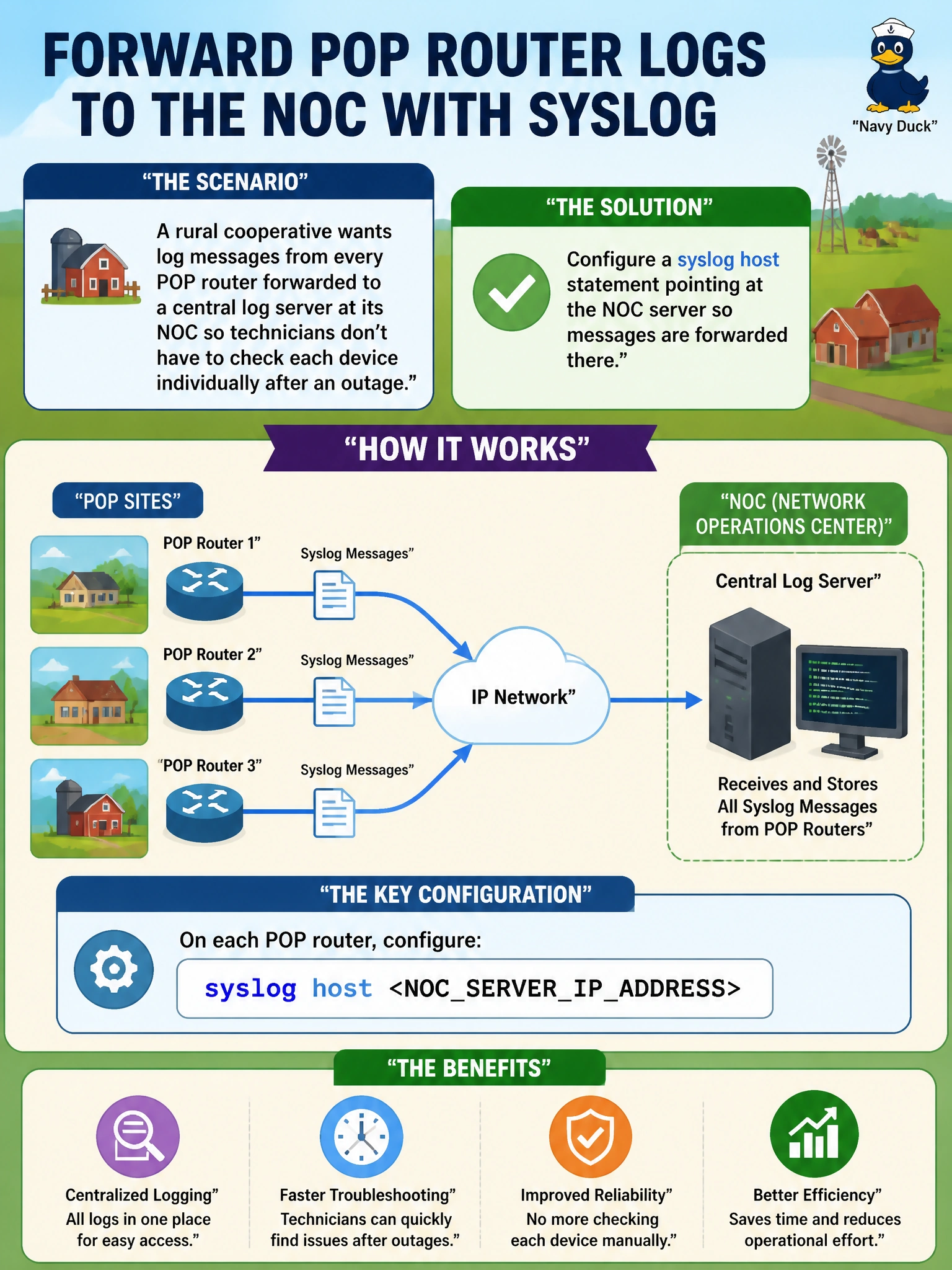
Instead of walking (or dialing) into every POP one by one after something goes wrong, you point each router's syslog config at one central box, and the messages just show up there. That's the whole idea behind a syslog host statement — logs go home to the NOC automatically.
Full Explanation
The syslog host statement, configured under the system syslog hierarchy with a chosen facility and severity, tells Junos to forward matching log messages to a remote server in real time, which is exactly the centralization a cooperative running many geographically dispersed POP routers needs. Rather than logging into each device individually after an event, technicians can review one aggregated feed at the NOC. Authentication-order is unrelated — it governs how administrative logins are verified, not where operational log messages are sent, and a NOC server address doesn't belong in that list. SNMP traps are a related but distinct mechanism: they push discrete event notifications for specific conditions defined by MIB objects, which is a narrower and differently structured stream than general syslog messages, and configuring a trap destination doesn't forward the router's ordinary log content. Setting matching host-names on every router would make every device report itself identically in the log stream, actively defeating the purpose of centralizing logs by making individual routers indistinguishable from one another. A practical follow-up check after configuring this is generating a test event and confirming it actually lands at the NOC server, since firewall or routing issues between a remote POP and the NOC can silently prevent delivery.