
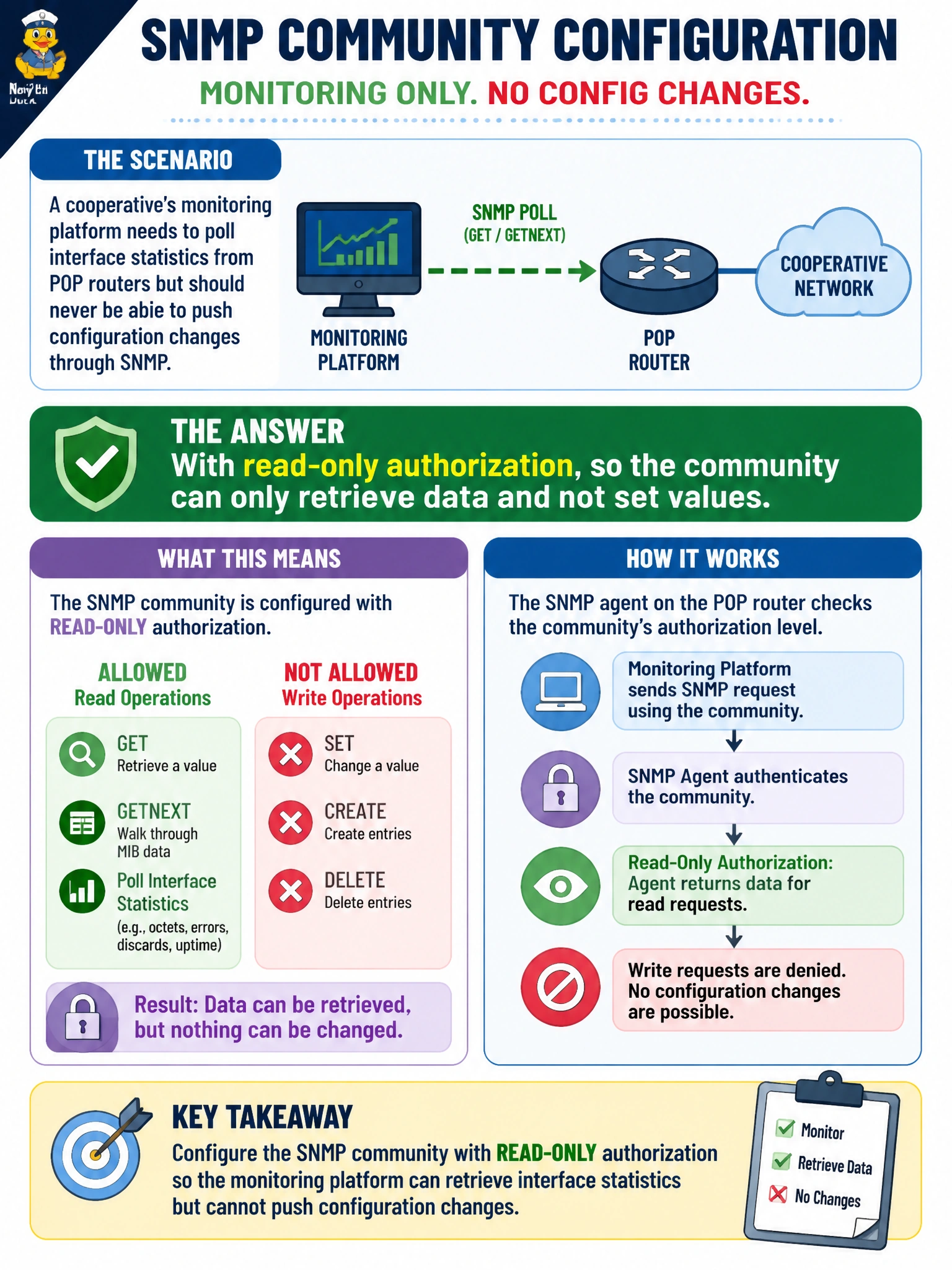
A cooperative's monitoring platform needs to poll interface statistics from POP routers but should never be able to push configuration changes through SNMP. How should the SNMP community be configured?
Select an answer to reveal the explanation.
Short Explanation
SNMP communities aren't shy about what they allow — you tell Junos explicitly whether a community can only look or also touch. Setting authorization to read-only means the monitoring platform can pull every counter it wants but has zero ability to change a single setting on the router.
Full Explanation
Setting a Junos SNMP community's authorization explicitly to read-only restricts that community strictly to retrieval operations, with no ability to perform set operations that would alter device configuration or state. This is exactly the safeguard needed for a monitoring platform that should observe interface statistics without ever being able to push changes. Junos does treat an SNMP community as read-only when the authorization keyword is left off, but relying on that implicit default is poor practice for a security-relevant setting: the intent is invisible in the configuration, and a default can shift across releases or be misread by the next engineer who edits the stanza. Setting authorization read-only explicitly makes the access level a documented, deliberate fact rather than an assumption. A community name carries no permission semantics of its own — a well-known string like "public" is not magically read-only by Junos; permission comes entirely from the authorization keyword, and assuming otherwise is a common and dangerous misconception. Configuring read-write authorization and trusting the monitoring software to behave is not access control at all; if the community string were ever discovered or reused elsewhere, a read-write community offers no technical barrier to a write. SNMP communities have nothing to do with authentication-order, which governs administrative login authentication methods such as radius and password, an entirely separate configuration hierarchy from SNMP's own access model. A sound operational practice is to also restrict which source addresses can use the community, in addition to setting it read-only, further narrowing who can query the device at all.