
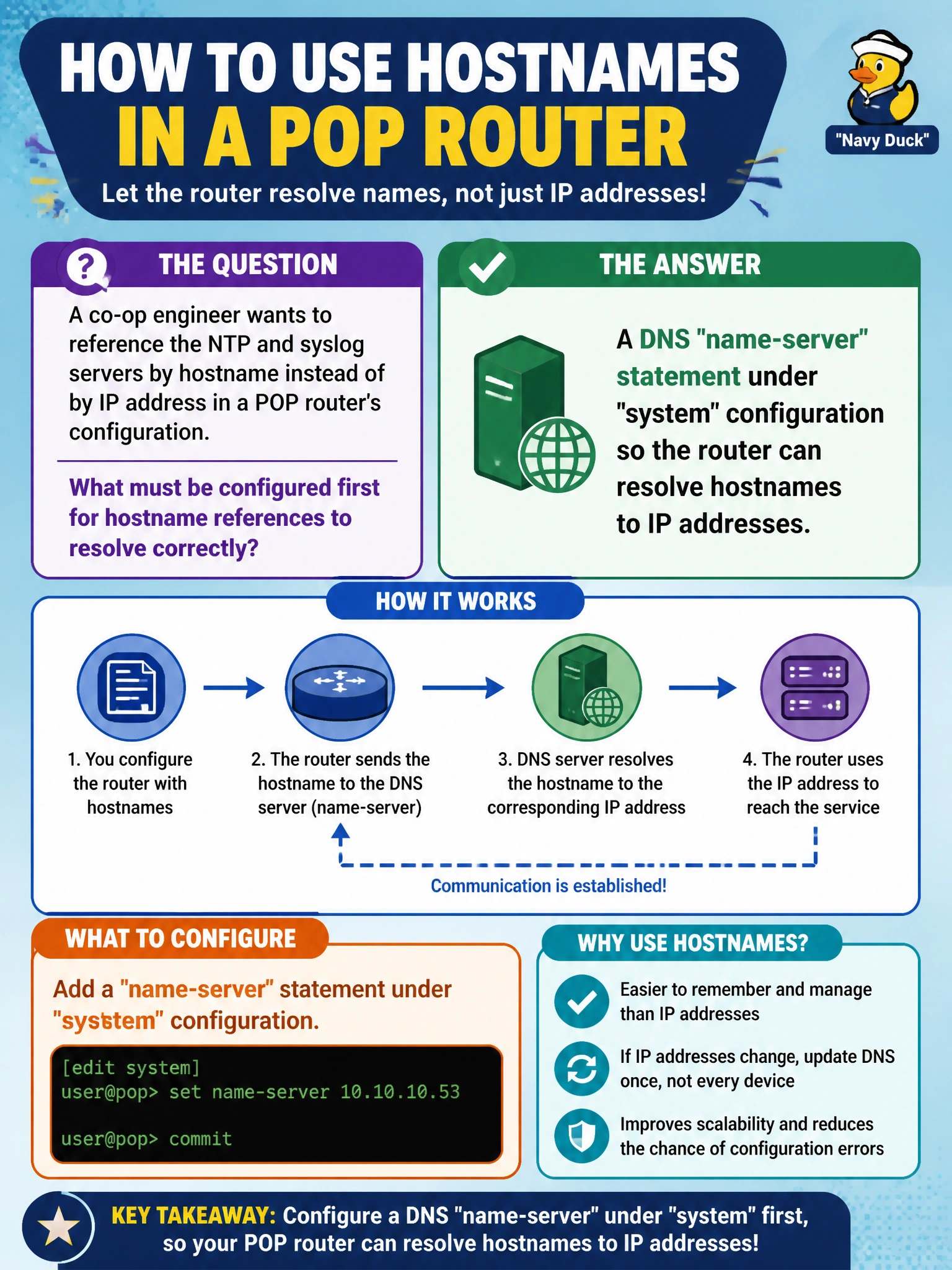
A co-op engineer wants to reference the NTP and syslog servers by hostname instead of by IP address in a POP router's configuration. What must be configured first for hostname references to resolve correctly?
Select an answer to reveal the explanation.
Short Explanation
A router can't turn a hostname into something it can actually connect to unless it knows where to ask. Pointing it at a DNS name-server is what lets it translate a hostname like 'ntp.co-op.example' into an IP address it can send packets to.
Full Explanation
For a Junos device to resolve a hostname referenced anywhere in its configuration — an NTP server, a syslog host, or any other remote target named rather than addressed by IP — it needs a configured DNS resolver, set under the system name-server hierarchy. Without that statement, Junos has no path to translate a hostname string into a usable IP address, and configuration referencing an unresolved hostname will fail to function even though the syntax is accepted. The router's own host-name statement is unrelated to resolving other systems' names; it only labels the local device itself and has no bearing on outbound DNS resolution. Login-class permissions govern what an authenticated administrator is allowed to do on the device — there's no permission bit that gates DNS lookups, because name resolution is a system-level network function, not a user-authorization concern. Authentication-order configures how administrative logins are verified against methods like radius or a local password; DNS is not one of those methods and doesn't participate in login authentication at all. Once a name-server is configured, a useful check is to reference a hostname in a test statement and confirm the router resolves it, rather than assuming the DNS statement alone guarantees successful resolution end to end.