
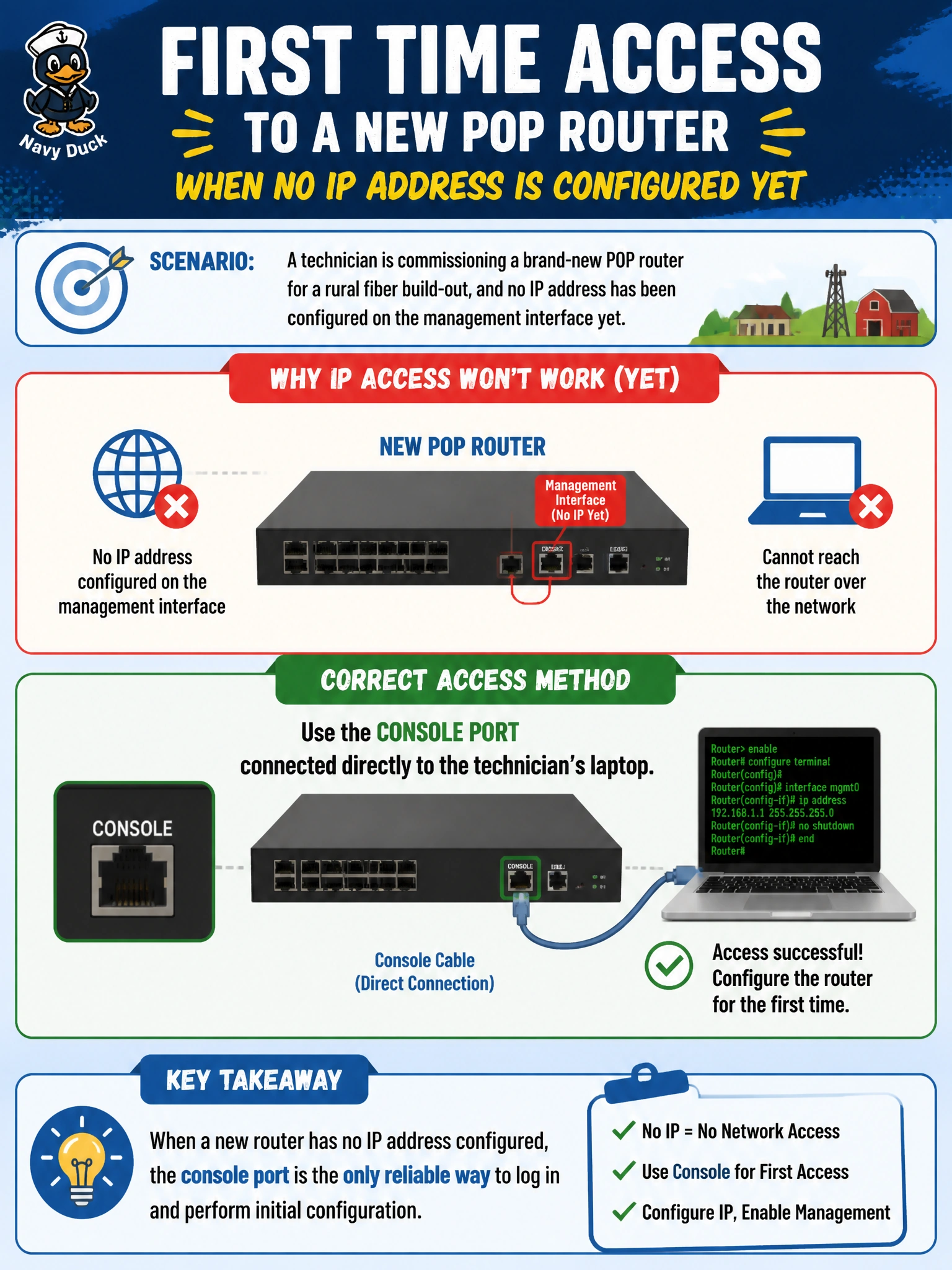
A technician is commissioning a brand-new POP router for a rural fiber build-out, and no IP address has been configured on the management interface yet. Which access method will let the technician log in and configure the device for the first time?
Select an answer to reveal the explanation.
Short Explanation
No IP address yet means no network path in — SSH, Telnet, and SNMP all ride on top of IP, so none of them can reach a device that hasn't been given an address. The console port is a direct serial line to the device itself, no network required. That's why it's always the first stop on a brand-new box.
Full Explanation
A router straight out of the box, before any interface addressing is committed, has no reachable IP path — SSH, Telnet, and SNMP are all services riding on top of IP connectivity that simply doesn't exist yet. The console port sidesteps that entirely: it's a direct serial connection between the technician's laptop and the device's management console, independent of any network reachability, which is exactly why every Junos commissioning workflow starts there. SSH fails here because there's no printed factory-default management IP to target — Junos doesn't ship with one baked in per device, so that option is simply invented. Telnet to a loopback address fails on two counts: Junos doesn't auto-assign a static loopback address out of the box, and Telnet is disabled by default for security reasons even once IP reachability exists. SNMP polling from a network management station is a monitoring mechanism that itself depends on IP reachability and a configured SNMP agent — neither of which exists on a factory-default device. Operationally, once console access establishes an initial management IP and enables SSH, the technician can disconnect the console cable and switch to remote administration for everything else.