
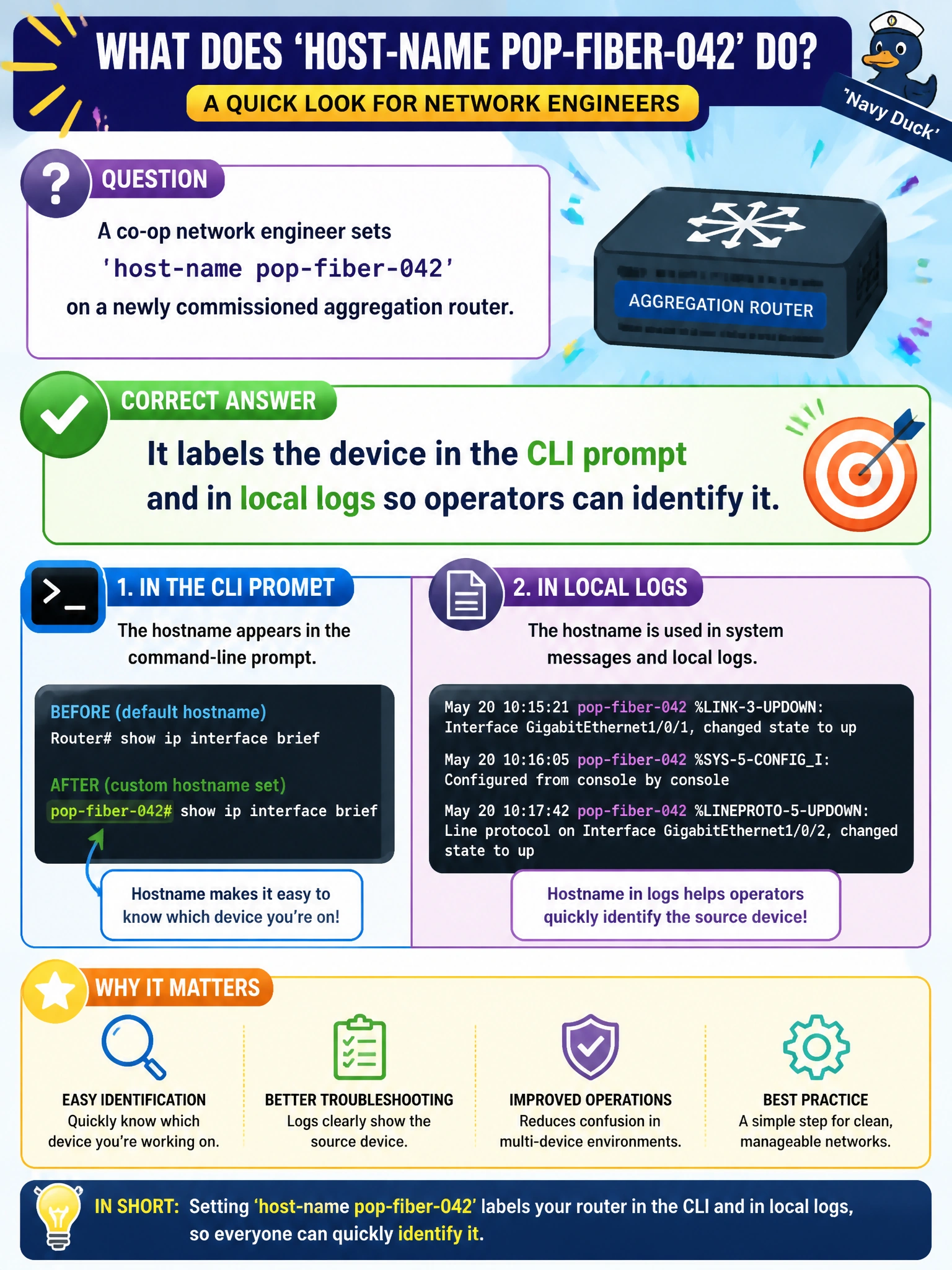
A co-op network engineer sets 'host-name pop-fiber-042' on a newly commissioned aggregation router. What is the primary effect of this configuration statement?
Select an answer to reveal the explanation.
Short Explanation
The host-name is basically the router's nametag — it doesn't touch routing, addressing, or who can log in. It just makes sure that when you SSH into pop-fiber-042 at 2 a.m., the prompt and the log entries actually say pop-fiber-042 instead of some generic default.
Full Explanation
The host-name statement under system configuration is purely an identification label: it sets the string Junos displays in the CLI prompt and stamps into local log entries and many operational command outputs, which matters enormously once a cooperative is running dozens of POP routers that would otherwise all look identical in a terminal window. It has no effect on IP addressing — that's configured separately under the interfaces hierarchy, and changing host-name never touches an interface's address assignment. It also has nothing to do with DNS service: Junos devices are DNS clients, not authoritative DNS servers, and host-name doesn't stand up any name-resolution service. Login-class authorization is likewise unrelated — which classes and authentication methods are permitted is governed by the login and authentication-order hierarchies, entirely independent of the hostname string. The practical payoff shows up during troubleshooting: when a syslog server at the co-op NOC receives messages from dozens of routers, a distinct, meaningful host-name is what lets an operator immediately tell which POP generated an alert, rather than having to cross-reference by IP address.