
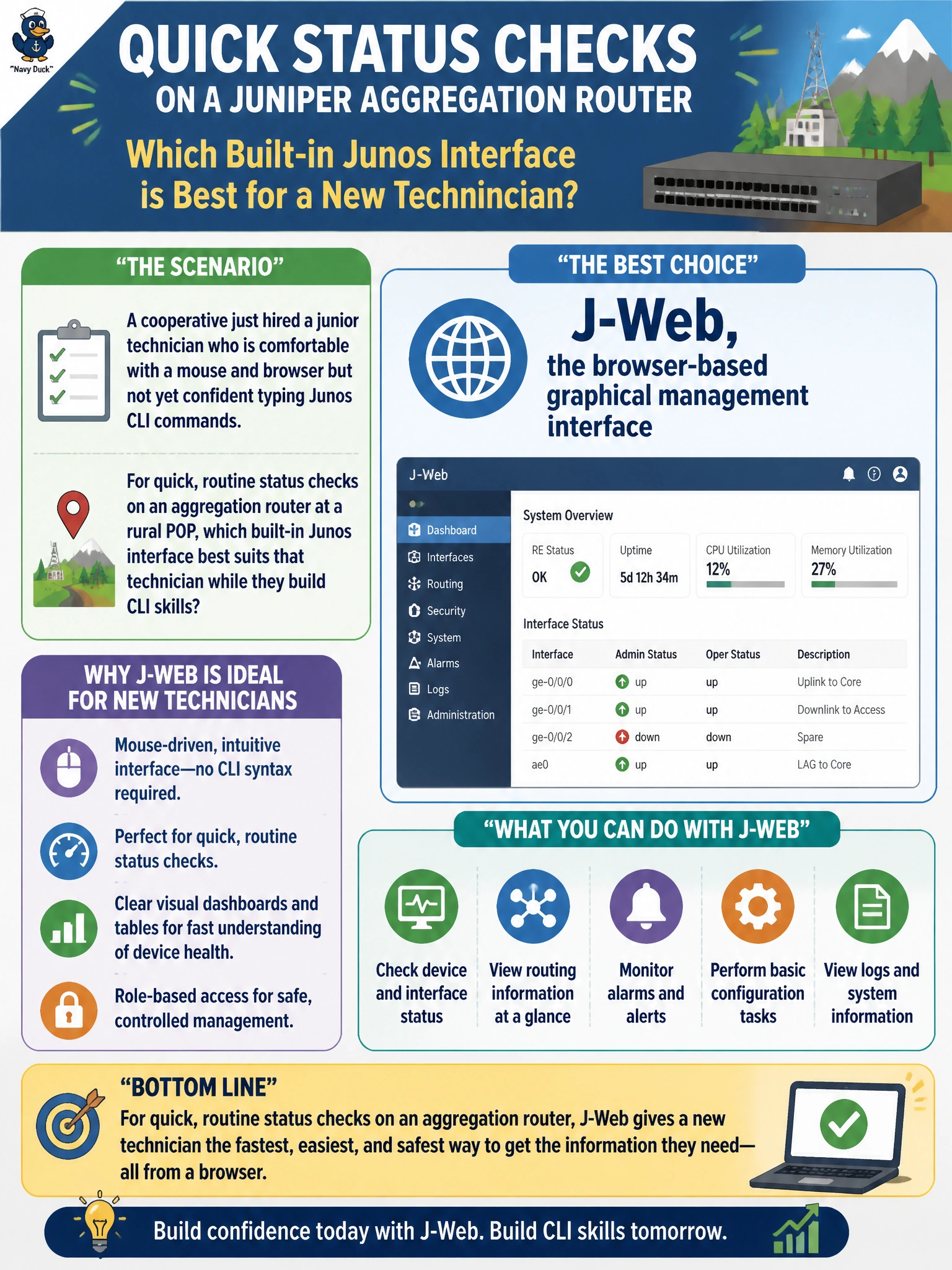
A cooperative just hired a junior technician who is comfortable with a mouse and browser but not yet confident typing Junos CLI commands. For quick, routine status checks on an aggregation router at a rural POP, which built-in Junos interface best suits that technician while they build CLI skills?
Select an answer to reveal the explanation.
Short Explanation
Not every technician is going to start day one comfortable typing raw CLI syntax, and that's fine. J-Web gives them the same kind of point-and-click, browser-based view of the router that most people are already used to navigating, while the CLI skills catch up.
Full Explanation
J-Web is Junos's built-in, browser-based graphical management interface, offering point-and-click access to common monitoring and configuration tasks without requiring memorized command syntax, which makes it a natural fit for a newer technician still building CLI confidence, provided the device and its management network support reaching it. Telnet is simply a remote-access protocol used to reach the same text-based CLI over the network; it does not change the interface's nature or make commands any easier to construct, so it offers no advantage over an SSH-based CLI session for this purpose. SNMP polling is a machine-to-machine monitoring mechanism used by network management stations to gather metrics automatically, not an interactive interface a person sits down and navigates for routine hands-on checks. A rescue configuration is an entirely unrelated concept, a saved fallback configuration a device can load if its active configuration becomes unusable, with no connection to how a technician interacts with the device day to day. One caveat worth flagging to a new technician is that J-Web should be reached over a trusted management network rather than exposed on subscriber-facing interfaces, since a graphical management interface is still a management interface.