
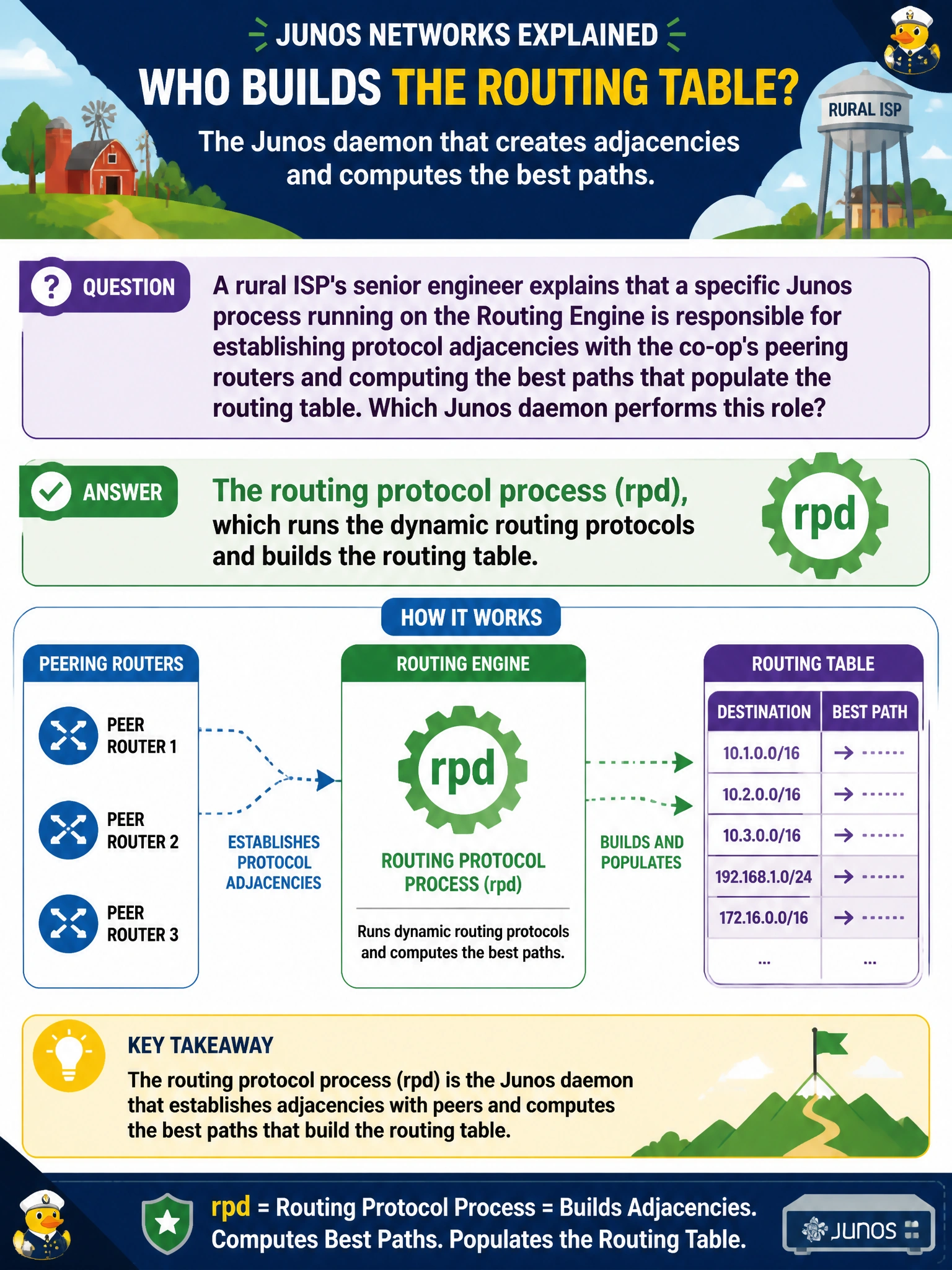
A rural ISP's senior engineer explains that a specific Junos process running on the Routing Engine is responsible for establishing protocol adjacencies with the co-op's peering routers and computing the best paths that populate the routing table. Which Junos daemon performs this role?
Select an answer to reveal the explanation.
Short Explanation
The routing protocol process, or "rpd" for short, is the daemon actually holding the conversation with the co-op's peering routers and doing the route-selection math. It's the software engine behind everything the Routing Engine is known for on the control-plane side. Other daemons handle other jobs, but route computation is rpd's job specifically.
Full Explanation
In Junos's modular software architecture, each major function runs as its own daemon rather than one monolithic program, and the routing protocol process, commonly referred to as rpd, is the one responsible for running dynamic routing protocol sessions - establishing and maintaining adjacencies with neighboring routers - and computing the routing table from everything those protocols and any static routes contribute. This modularity means a fault in one daemon does not necessarily bring down unrelated functions. The distractors describe other real Junos daemons with different jobs: the device control process brings interfaces up and applies their configured properties, but has no routing-protocol intelligence; the management process handles configuration and command-line sessions, not route computation; and the chassis process is concerned with physical hardware health such as power and cooling, entirely separate from routing logic. Recognizing which daemon owns which job is useful for reasoning about fault isolation: an interface flapping due to a cabling issue is a device-control-process concern, while a route failing to appear as expected points toward the routing protocol process. A conceptual check worth remembering is that daemon separation is what lets Junos isolate and restart individual functions without necessarily affecting the whole system.