
An engineer at a regional ISP is troubleshooting why a router's routing table shows several candidate paths to a subscriber aggregation subnet, while only one specific next hop is actually used to forward live traffic toward that subnet. What explains this difference?
Select an answer to reveal the explanation.
Short Explanation
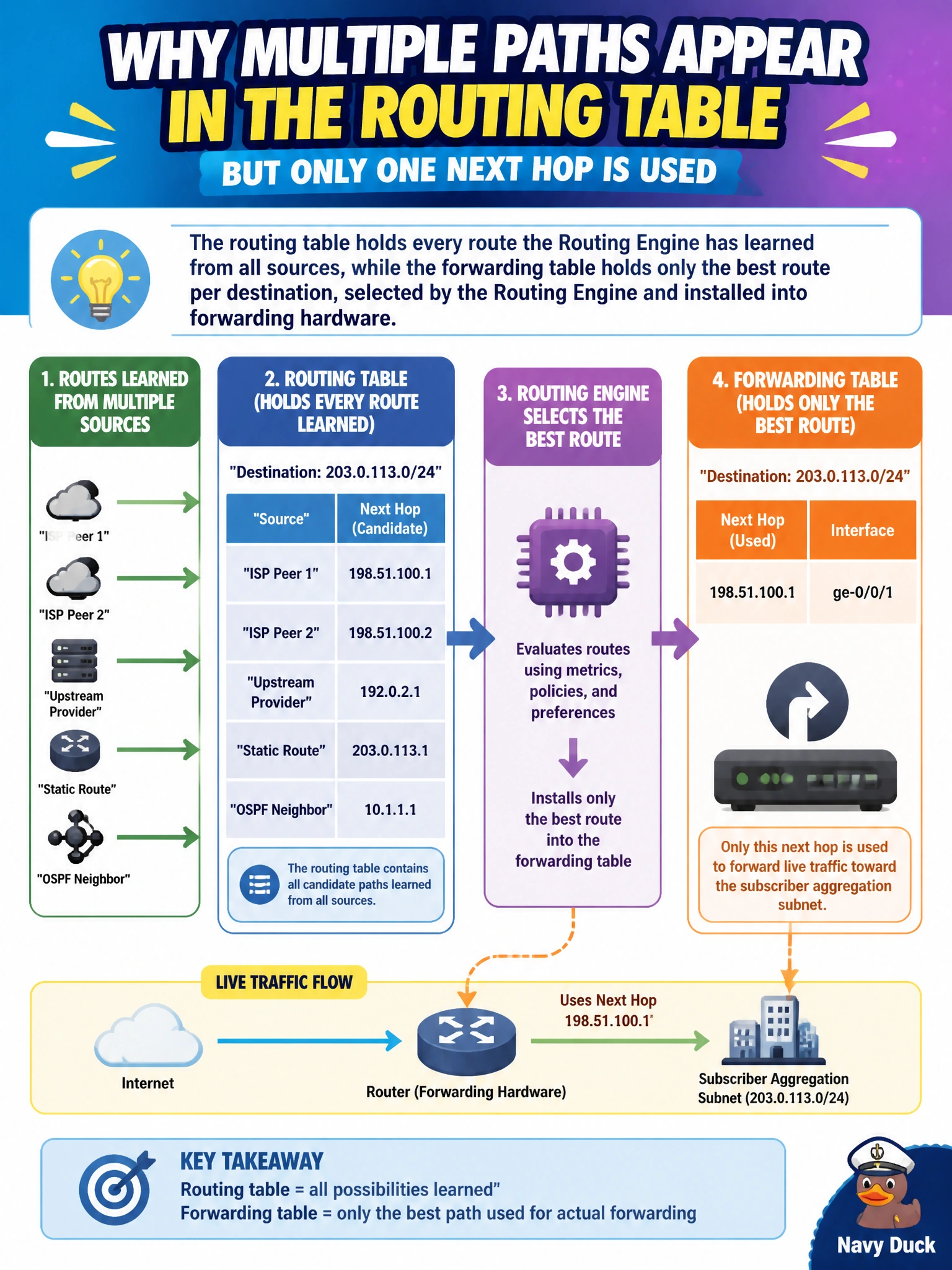
Think of the routing table as a router's full notebook of every path it's ever heard about to a destination, from every source that whispered it a route. The forwarding table is the short cheat-sheet version - just the one best answer per destination - that actually gets used to move packets. The Routing Engine keeps the notebook; the forwarding table is what gets handed down to do the real work.
Full Explanation
The routing table, maintained by the Routing Engine, can hold multiple candidate routes to the same destination learned from different protocols or sources, along with their preferences and attributes. From that full set, the Routing Engine selects the single best route per destination using route preference and protocol-specific tie-breaking rules, and only that selected, active route gets installed into the forwarding table, which actually gets programmed into the Packet Forwarding Engine's hardware for line-rate lookups. This is why a routing table can show several paths to a subnet while the forwarding table and live traffic only ever use one at a time. The distractors get the relationship backwards or invent behavior that does not exist: the two tables are related but distinct, not the same structure under different names; the forwarding table is a subset, never a superset, of the routing table's best routes; and the Packet Forwarding Engine has no path-selection logic of its own - it strictly uses what the Routing Engine already decided. A useful operational check is comparing the routing table's selected best route for a destination against what the forwarding table shows for the same destination; they should always agree once updates have propagated.