
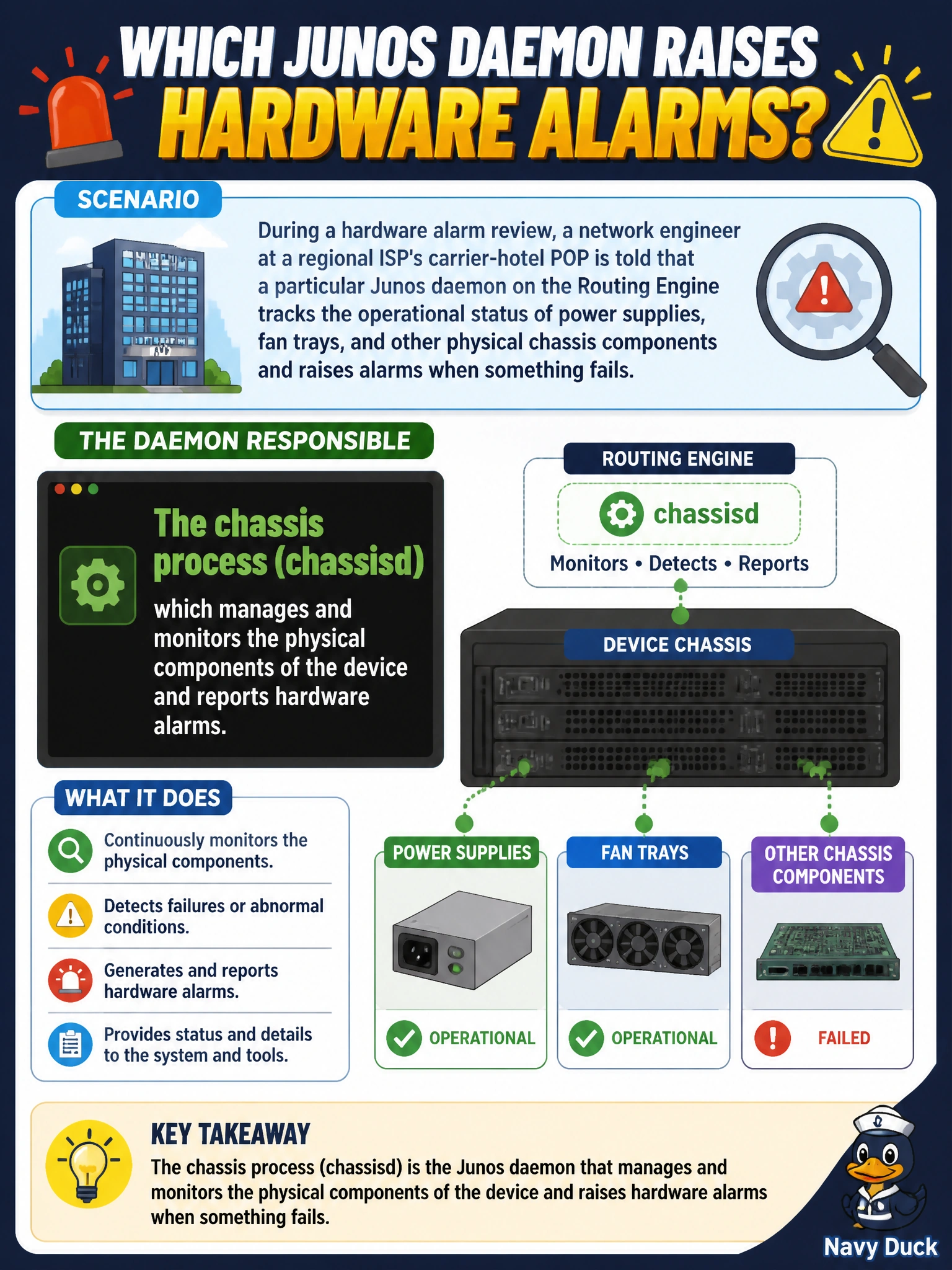
During a hardware alarm review, a network engineer at a regional ISP's carrier-hotel POP is told that a particular Junos daemon on the Routing Engine tracks the operational status of power supplies, fan trays, and other physical chassis components and raises alarms when something fails. Which daemon is responsible for this?
Select an answer to reveal the explanation.
Short Explanation
Think of chassisd as the co-op's building superintendent - it's watching the power supplies, fans, and other physical gear, not the routing conversations. When something in the hardware trips an alarm, this is the daemon keeping tabs on it. It's a hardware-health job, separate from anything about routes or interfaces.
Full Explanation
The chassis process, chassisd, is the Junos daemon dedicated to monitoring and managing the platform's physical components - power supplies, fan trays, temperature sensors, and similar hardware elements - and it is the process responsible for generating chassis-level alarms when a component degrades or fails. This separation matters operationally: hardware health monitoring continues to function through daemon-level modularity even when other processes are busy or restarting. The distractors mix up job boundaries: the routing protocol process is concerned with protocol adjacencies and route computation, not hardware sensors; the device control process manages interface configuration and logical or physical interface state such as link up or down, a related but distinct concern from chassis-wide component health; and while some hardware issues do eventually surface through logging, chassis alarms are generated by dedicated chassis monitoring, not by the management process that handles CLI and configuration sessions. A practical way to keep this straight is to sort each daemon by the question it answers: chassisd answers whether the hardware is healthy, while the device control process answers whether an interface is up and configured correctly. A useful check after any hardware alarm is confirming which specific component triggered it before assuming a routing or interface issue is the cause.