
A network technician at a rural broadband cooperative learns that some packets arriving at a core router cannot simply be switched by the forwarding hardware and instead get sent up to the Routing Engine for special handling. What is this category of traffic called in Junos, and what is a defining trait of it?
Select an answer to reveal the explanation.
Short Explanation
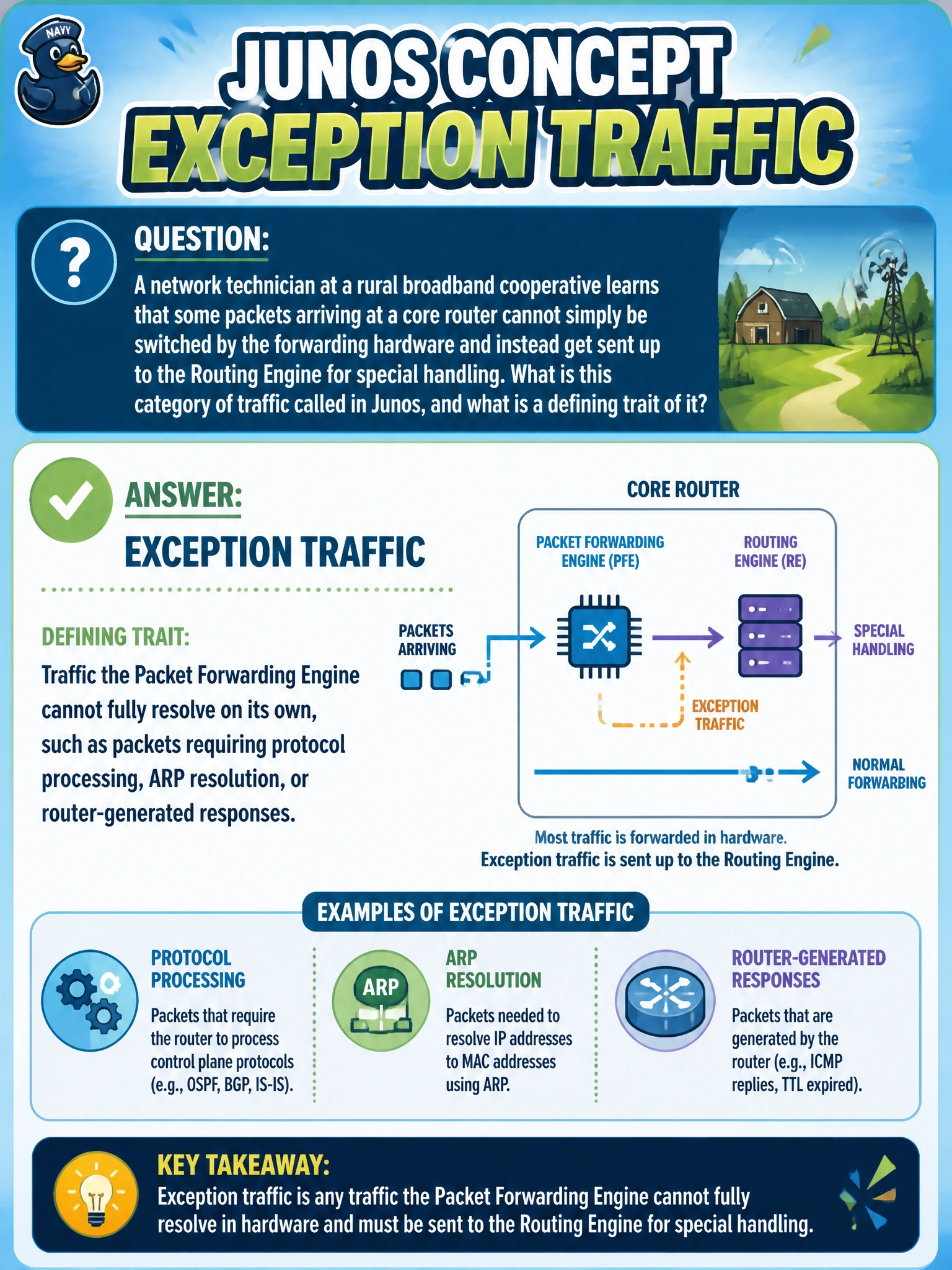
Exception traffic is the stuff the loading-dock crew can't handle alone and has to walk upstairs to the office for - things like routing protocol hellos, ARP requests, or a packet that needs the router itself to reply. It's the exception to the normal fast hardware path, hence the name. Most traffic never needs this detour; exception traffic is deliberately the minority.
Full Explanation
Exception traffic covers packets the Packet Forwarding Engine cannot resolve using its hardware forwarding table alone and must instead punt up to the Routing Engine for software processing. Typical examples include routing protocol packets addressed to the router itself, ARP requests needing resolution, packets requiring a router-generated reply such as an ICMP error, and packets carrying options the hardware path does not handle. This is intentionally a small slice of overall traffic, because sending every packet to the Routing Engine would overwhelm its general-purpose CPU and defeat the purpose of a dedicated forwarding plane. The wrong options misuse standard terms: control-plane traffic is not defined by carrying a subscriber address - most subscriber traffic is ordinary transit traffic; local traffic describes packets destined to or from the router's own addresses, not merely packets from an external peer; and transit traffic is specifically traffic the forwarding hardware handles on its own, the opposite of the exception case described here. A useful operational habit is keeping exception traffic volume low deliberately, since a flood of it - whether malicious or accidental - is exactly what can overload a Routing Engine's CPU and degrade routing stability.