
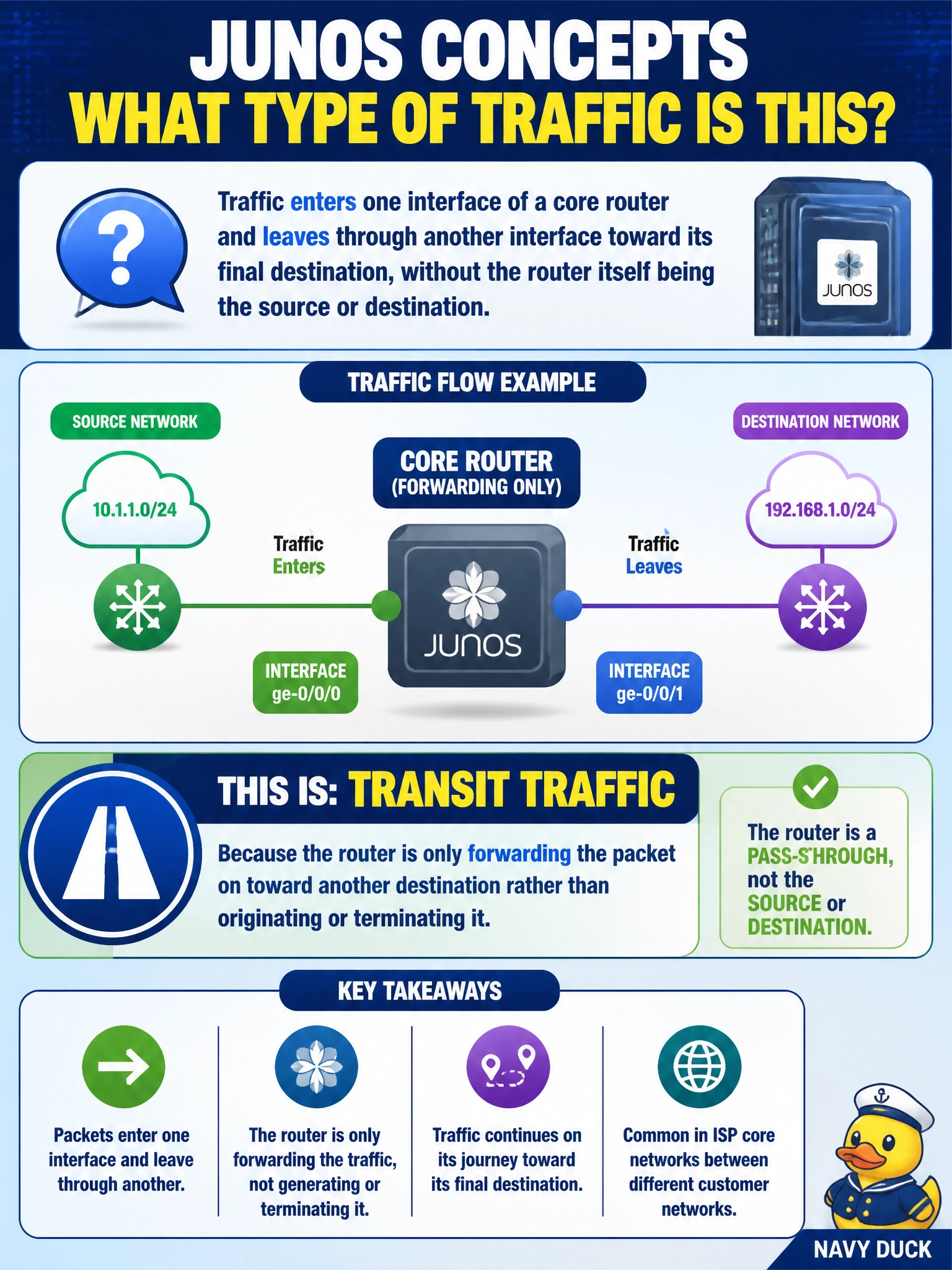
While explaining Junos concepts to a new hire, a senior engineer at a regional ISP describes traffic entering one interface of a core router and leaving through another interface toward its final destination, without the router itself being the source or destination. What category of traffic is this?
Select an answer to reveal the explanation.
Short Explanation
Transit traffic is basically anything just passing through, the way traffic passes through a small town's fiber hub on its way to somewhere else entirely. The router isn't the source, and it isn't the final stop - it just needs to move the packet toward the next hop as fast as possible. That's exactly the job of the forwarding plane, not the control plane.
Full Explanation
Transit traffic is defined by role, not by protocol or content: it is any packet that enters the router on one interface and needs to leave on another, with the router acting purely as an intermediate hop rather than the packet's origin or destination. Because the destination and forwarding decision can be resolved from the existing forwarding table, transit traffic is handled entirely by the Packet Forwarding Engine in hardware and normally never needs Routing Engine involvement at all. The distractors misapply adjacent terms: calling it exception traffic reverses the actual rule - exception traffic is the smaller category that does require Routing Engine handling, and ordinary transit traffic is specifically the traffic that avoids that path; local traffic describes packets destined to or originating from the router itself, such as management sessions, not packets merely passing through; and transit forwarding does not require a routing protocol to run per packet - the protocol already did its job earlier when it built the forwarding table. A good exam habit is to ask whether the router is the source or destination of this packet - if the answer is no to both, it is transit traffic. Checking interface traffic counters over time can confirm that a given path is carrying primarily transit load.