
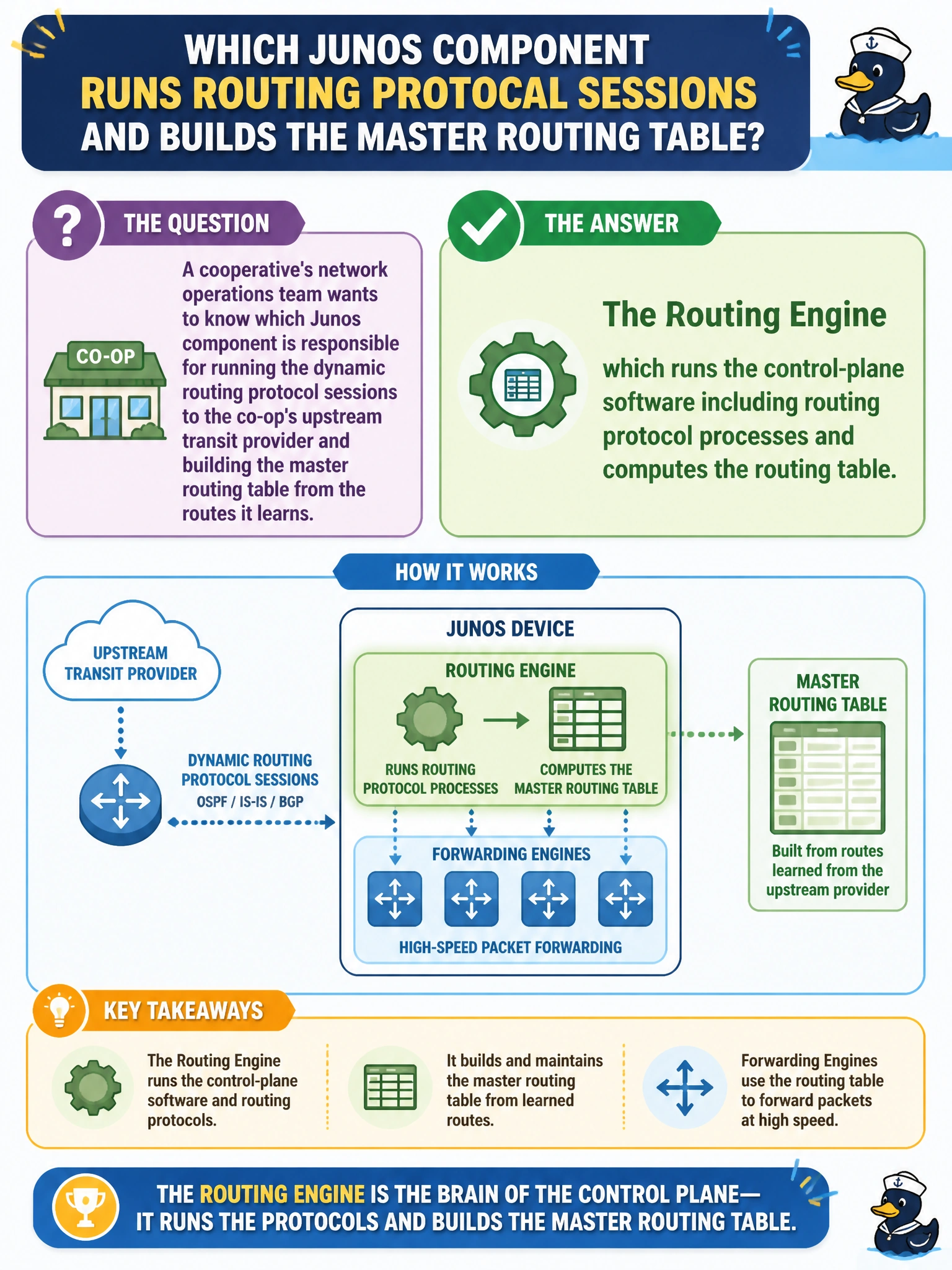
A cooperative's network operations team wants to know which Junos component is responsible for running the dynamic routing protocol sessions to the co-op's upstream transit provider and building the master routing table from the routes it learns. Which component performs this role?
Select an answer to reveal the explanation.
Short Explanation
The Routing Engine is the co-op's dispatcher - it's the one holding conversations with the upstream transit provider's router, exchanging routing information, and deciding which paths are best. All of that protocol talk and route-table math happens in software on the Routing Engine, not out on the forwarding hardware. Once it settles on the best routes, it hands a distilled copy down to the forwarding side.
Full Explanation
Dynamic routing protocols - the sessions that negotiate reachability with an upstream transit or peering router - run as control-plane software on the Routing Engine, which also maintains the routing table built from everything those protocols learn plus any statically configured routes. This is a software function, not a hardware one, because it involves complex computation like best-path selection and protocol state machines that general-purpose CPUs handle well and dedicated forwarding hardware does not. The wrong options confuse this with the forwarding plane or with configuration handling: the Packet Forwarding Engine has no protocol intelligence of its own and cannot negotiate adjacencies; the chassis control process only reports hardware health and interface physical state, not routing information; and while a management-style process does apply configuration, dynamic routing protocols are not limited to what gets typed in as static routes - they actively exchange and recompute reachability information continuously. A useful checkpoint: if a function involves talking to another router's control plane or comparing route attributes, it belongs to the Routing Engine, not the forwarding hardware. Confirming protocol adjacency state is itself something only the Routing Engine can report on, since it alone holds protocol session state.