
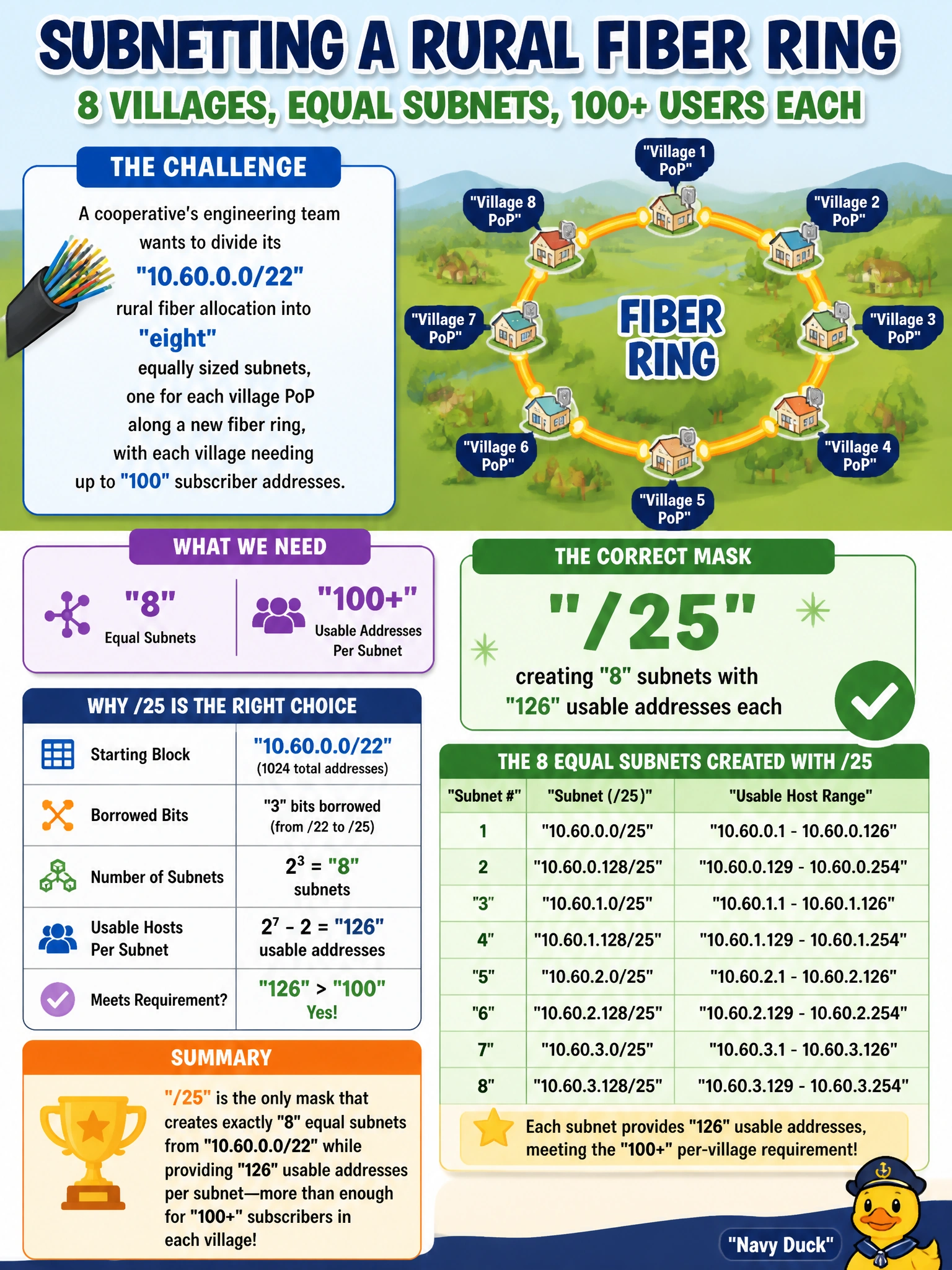
A cooperative's engineering team wants to divide its 10.60.0.0/22 rural fiber allocation into eight equally sized subnets, one for each village PoP along a new fiber ring, with each village needing up to 100 subscriber addresses. Which mask correctly creates exactly eight equal subnets from this /22 block while still meeting the per-village host requirement?
Select an answer to reveal the explanation.
Short Explanation
Splitting a block into eight equal pieces means borrowing 3 extra bits, since 2 to the 3rd power is 8. Starting from a /22 and borrowing those 3 bits lands exactly on /25 — eight village subnets, each with 126 usable addresses, plenty of room for up to 100 subscribers.
Full Explanation
Creating a specific number of equal subnets from a parent block requires borrowing enough bits so that 2 raised to the borrowed-bit count equals the target subnet count; eight subnets require borrowing 3 bits (2^3 equals 8), and adding those 3 bits to the /22 starting prefix produces /25. A /25 leaves 7 host bits, giving 2^7 minus 2 equals 126 usable addresses per subnet, comfortably covering the 100-address-per-village requirement with headroom to spare. The /26 option borrows 4 bits instead of 3, producing 16 subnets rather than the 8 the plan calls for, and while each subnet's 62 usable addresses would still cover 100 subscribers only barely — actually falling short, since 62 is less than 100 — the subnet count alone already disqualifies this option. The /24 option only borrows 2 bits, producing 4 subnets, half the number needed for eight villages. The /23 option moves in the wrong direction entirely, merging address space rather than subdividing it, and produces only 2 subnets. A dependable operational check when a plan specifies both a target subnet count and a minimum host count per subnet is to solve for the borrowed bits from the subnet count first, then verify separately that the resulting host bits still satisfy the host-count requirement.