
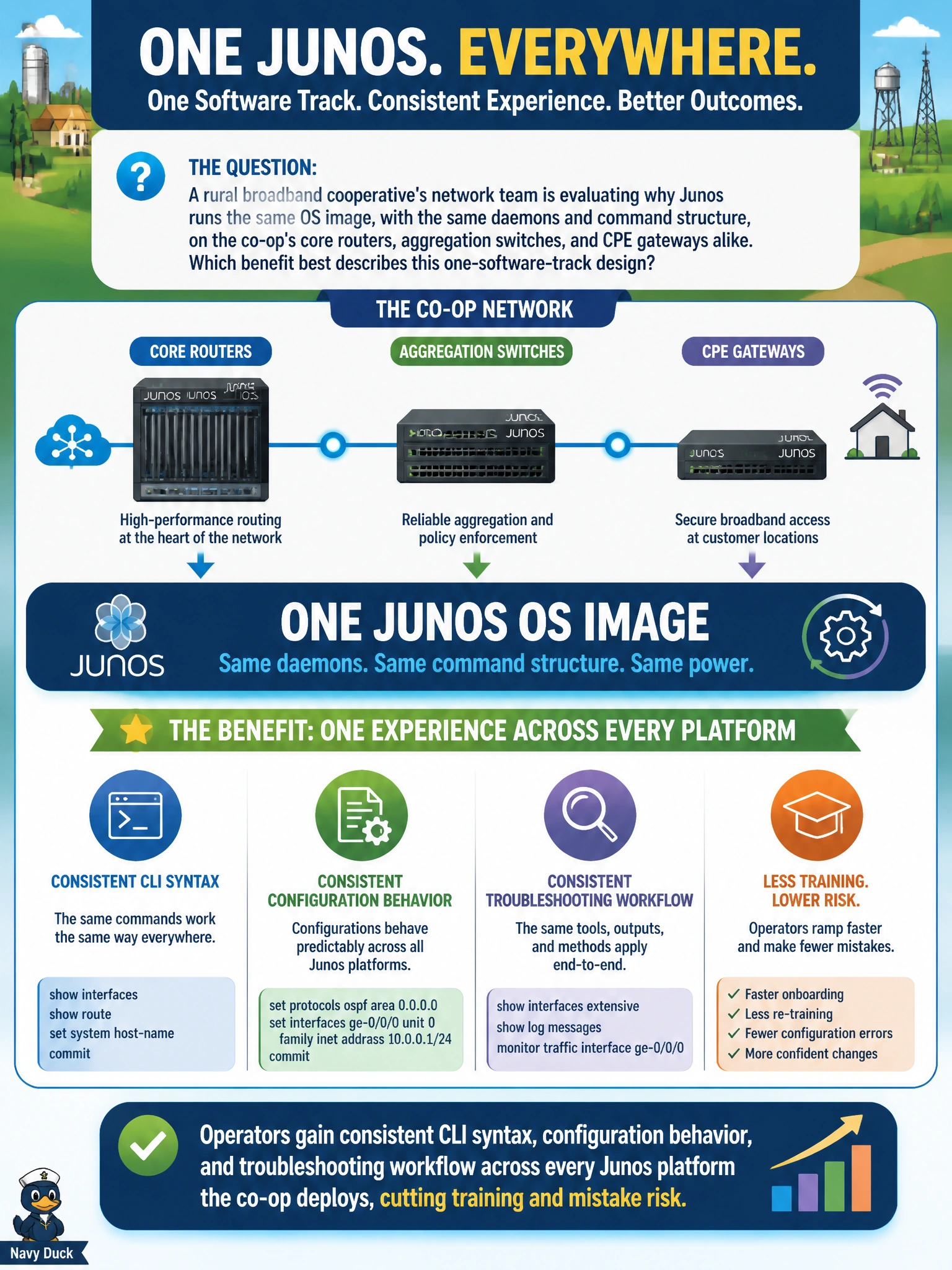
A rural broadband cooperative's network team is evaluating why Junos runs the same OS image, with the same daemons and command structure, on the co-op's core routers, aggregation switches, and CPE gateways alike. Which benefit best describes this one-software-track design?
Select an answer to reveal the explanation.
Short Explanation
Think of Junos like one dialect spoken across every job site the co-op runs, whether that's a core router in the carrier hotel or a switch in a rural head-end. Because the OS, CLI grammar, and daemon model stay the same everywhere, a tech who learns one platform can troubleshoot the next without relearning a whole new interface. That consistency, not identical hardware, is what "one software track" buys you.
Full Explanation
Junos's one-software-track model means every platform family - router, switch, or security gateway - runs from the same modular OS codebase, sharing the same underlying daemon architecture, configuration syntax, and behavior even though the underlying hardware and forwarding capacity differ widely. For a rural ISP that mixes core routers in its carrier hotel with aggregation switches at small-town head-ends, this means a technician who learns one platform already knows most of what they need on the next, and configuration habits and troubleshooting instincts transfer directly. The wrong answers confuse this operational consistency with hardware uniformity or with architectural change: one software track does not mean every chassis forwards the same volume of traffic, and it does not collapse the routing-engine/forwarding-engine split that Junos relies on for stability - the Routing Engine still runs control-plane software and the forwarding hardware still does the data-path work, on every platform. The caveat worth remembering is that CLI and daemon consistency does not remove the need to check platform-specific hardware limits, such as maximum interface counts, before a rollout. A useful check is comparing which daemons are active on two different Junos platforms in the co-op's inventory, which is the daemon-level signature of the shared code base.