
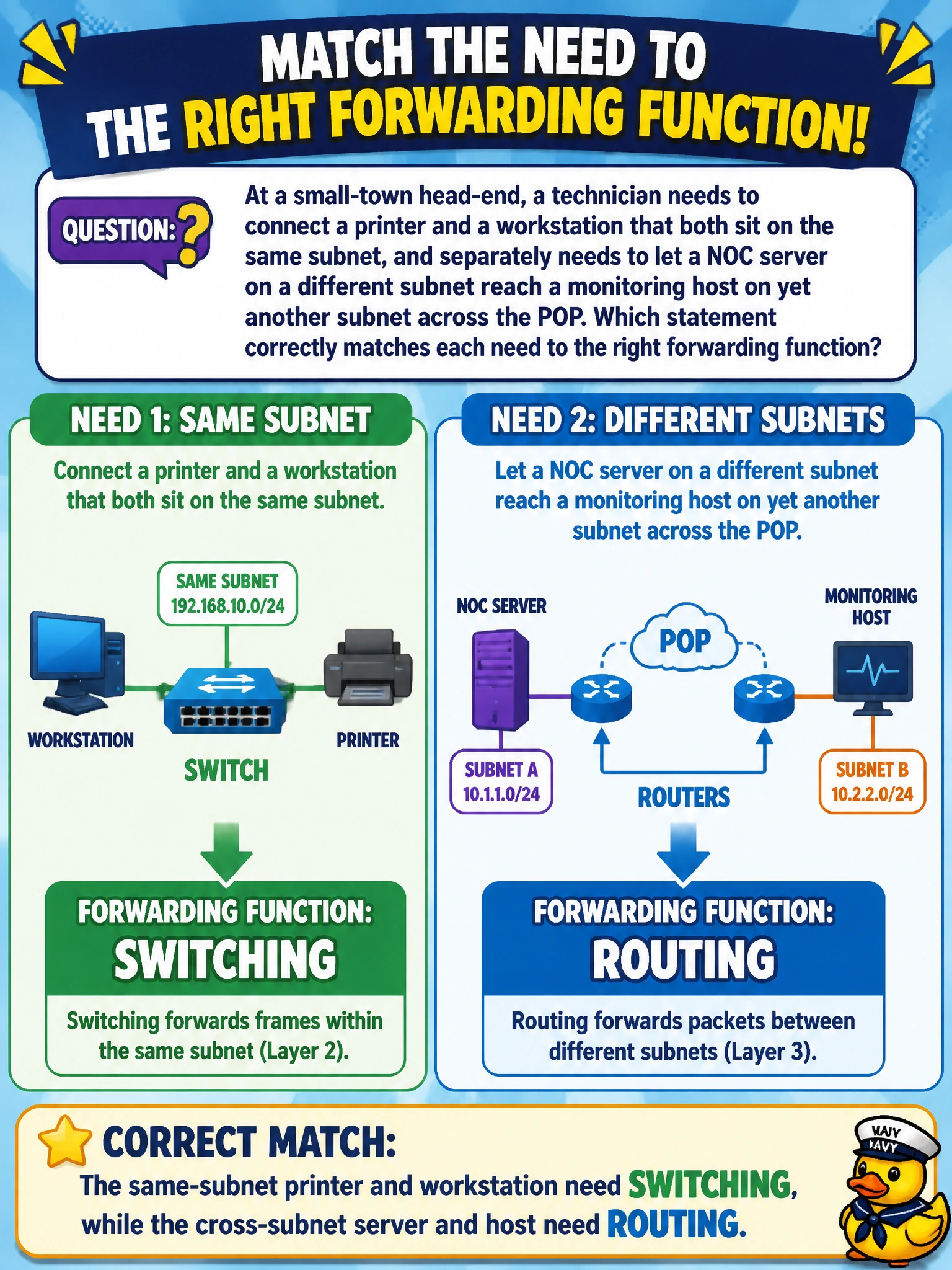
At a small-town head-end, a technician needs to connect a printer and a workstation that both sit on the same subnet, and separately needs to let a NOC server on a different subnet reach a monitoring host on yet another subnet across the POP. Which statement correctly matches each need to the right forwarding function?
Select an answer to reveal the explanation.
Short Explanation
Two devices sharing a subnet can just hand traffic off directly at the local level — that's switching. The moment traffic needs to cross from one subnet to a different one, something has to make a Layer 3 forwarding decision between them, and that's routing's job.
Full Explanation
The fundamental distinction between switching and routing is scope: switching forwards traffic between devices that share the same subnet, using local addressing to move frames directly between ports, while routing forwards traffic between devices on different subnets, making a Layer 3 decision about which next hop leads toward the destination network. The printer and workstation sharing one subnet only need switching, since no subnet boundary separates them. The NOC server and monitoring host sitting on different subnets need routing, since traffic must cross that subnet boundary to reach its destination. The all-routing option overstates routing's role; two devices on the same subnet do not need a routing decision at all, since they can reach each other directly at the local level. The all-switching option invents a "switch first, route as fallback" behavior that is not how forwarding decisions work; the choice between switching and routing is determined by whether source and destination share a subnet, not by a fallback order. The swapped option reverses the correct pairing entirely. An operational check when troubleshooting reachability is to first compare the source and destination IP addresses against their respective subnet masks: if both addresses fall within the same network, the issue is local and switching-related; if not, the packet's path depends on routing between the two networks.