
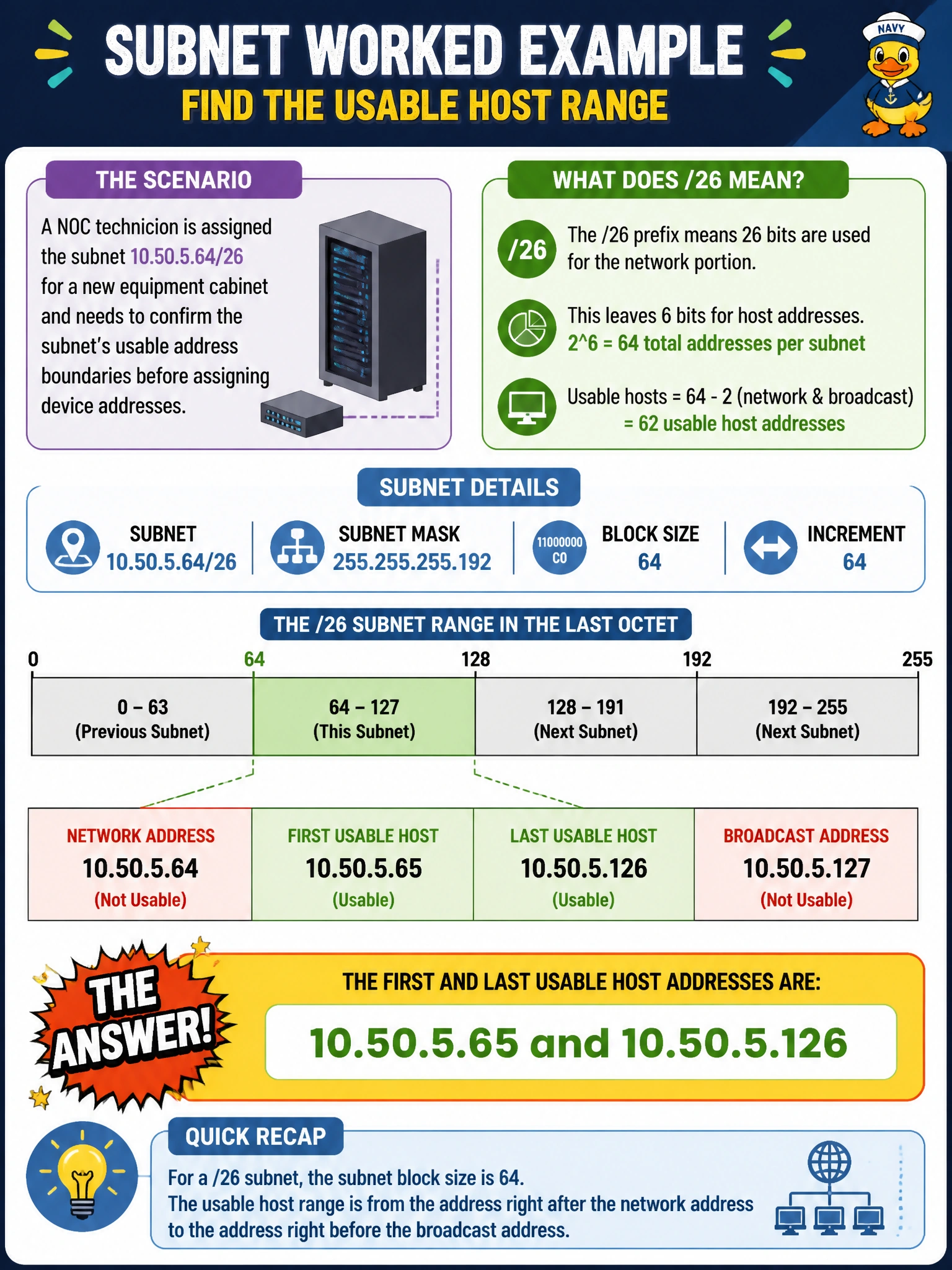
A NOC technician is assigned the subnet 10.50.5.64/26 for a new equipment cabinet and needs to confirm the subnet's usable address boundaries before assigning device addresses. Which pair of addresses correctly marks the first and last usable host addresses in this subnet?
Select an answer to reveal the explanation.
Short Explanation
A /26 carves out blocks of 64 addresses, and the one starting at .64 runs through .127, with .64 reserved as the network address and .127 reserved for broadcast. That leaves .65 through .126 as the usable range for actual devices in the cabinet.
Full Explanation
A /26 mask leaves 6 host bits, producing blocks of 64 addresses; the block beginning at 10.50.5.64 spans through 10.50.5.127, with .64 serving as the network address and .127 serving as the broadcast address, leaving .65 through .126 as usable host addresses. The first incorrect option lists .64 as a usable start and .128 as an end, but .64 is the reserved network address, not assignable to a host, and .128 actually belongs to the next /26 block entirely, outside this subnet. The second incorrect option describes the boundaries of the previous /26 block (.0 through .63) rather than the assigned .64 block, an easy mistake when scanning octet values quickly. The third incorrect option correctly identifies the usable start at .65 but mistakenly includes .127, the broadcast address, as a usable host address rather than stopping one address short of it. A reliable operational check is to compute the block size from the host bits, identify the network address as the block's first address and the broadcast as its last, and confirm the usable range excludes both endpoints before handing addresses out to devices.