
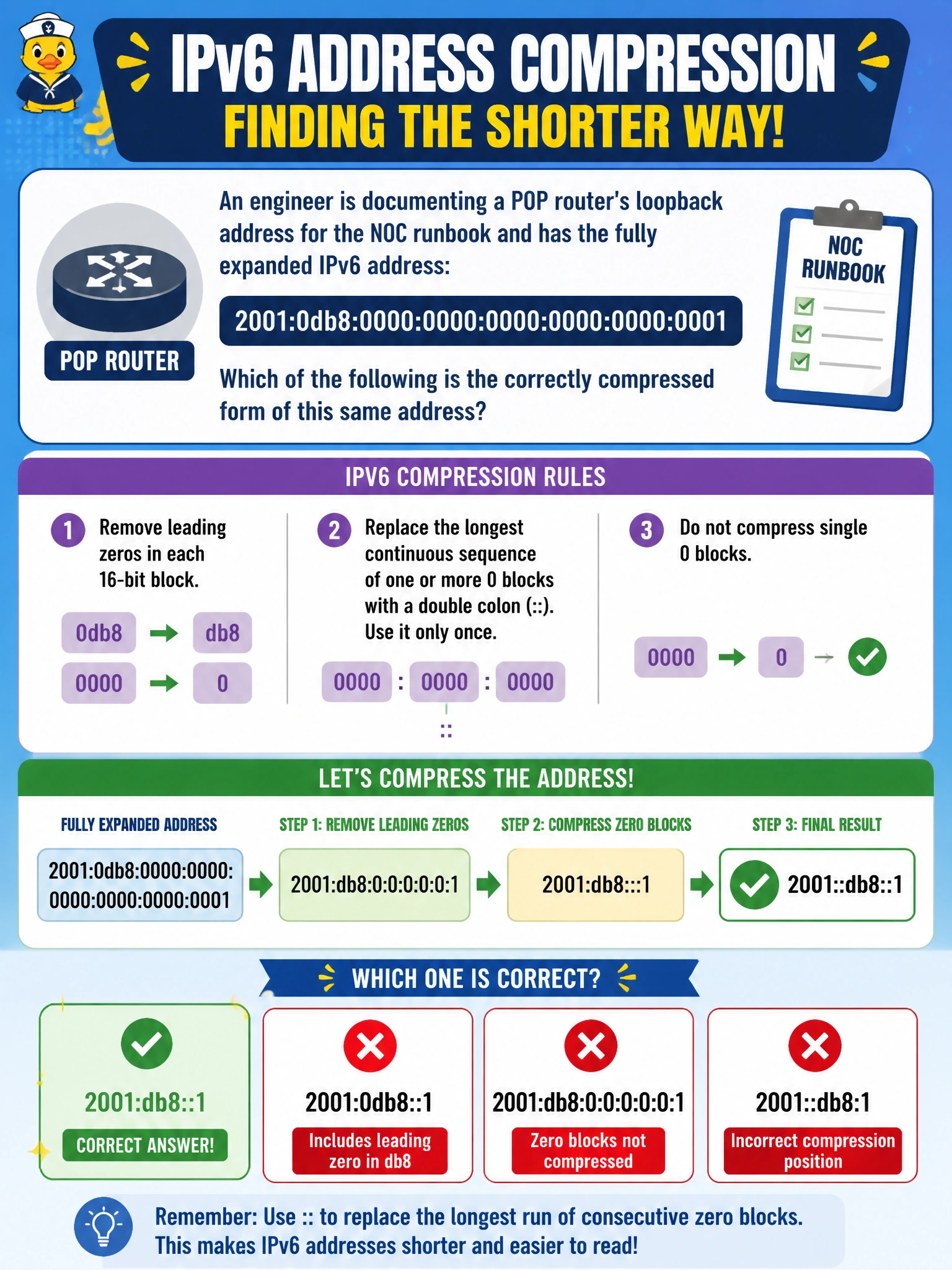
An engineer is documenting a POP router's loopback address for the NOC runbook and has the fully expanded IPv6 address 2001:0db8:0000:0000:0000:0000:0000:0001. Which of the following is the correctly compressed form of this same address?
Select an answer to reveal the explanation.
Short Explanation
IPv6 compression has two simple moves: drop leading zeros within each group, and collapse one run of all-zero groups down to a double colon. Applying both here turns that long expanded address into the tidy 2001:db8::1 — same address, far less to type.
Full Explanation
IPv6 address compression follows two rules applied together: leading zeros within any 16-bit group may be dropped, and exactly one contiguous run of all-zero groups may be replaced with a double colon. Here, 0db8 shortens to db8, and the six consecutive all-zero groups between db8 and 0001 collapse into a single double colon, while 0001 shortens to 1, producing 2001:db8::1. The leading-zeros-only option correctly drops the zeros within each group but fails to apply the double-colon rule to the run of all-zero groups, leaving an unnecessarily long address. The double-double-colon option violates the core rule that only one double colon is permitted per address, since using it twice makes the expanded length ambiguous — the address could no longer be reconstructed unambiguously. The partial-compression option shortens 0000 to 0000 rather than collapsing the whole run, and pads 0001 back out incorrectly instead of dropping its leading zeros. A dependable operational check when compressing an IPv6 address by hand is to find the longest single run of all-zero groups first and collapse only that one run, then separately strip leading zeros from every remaining group.