
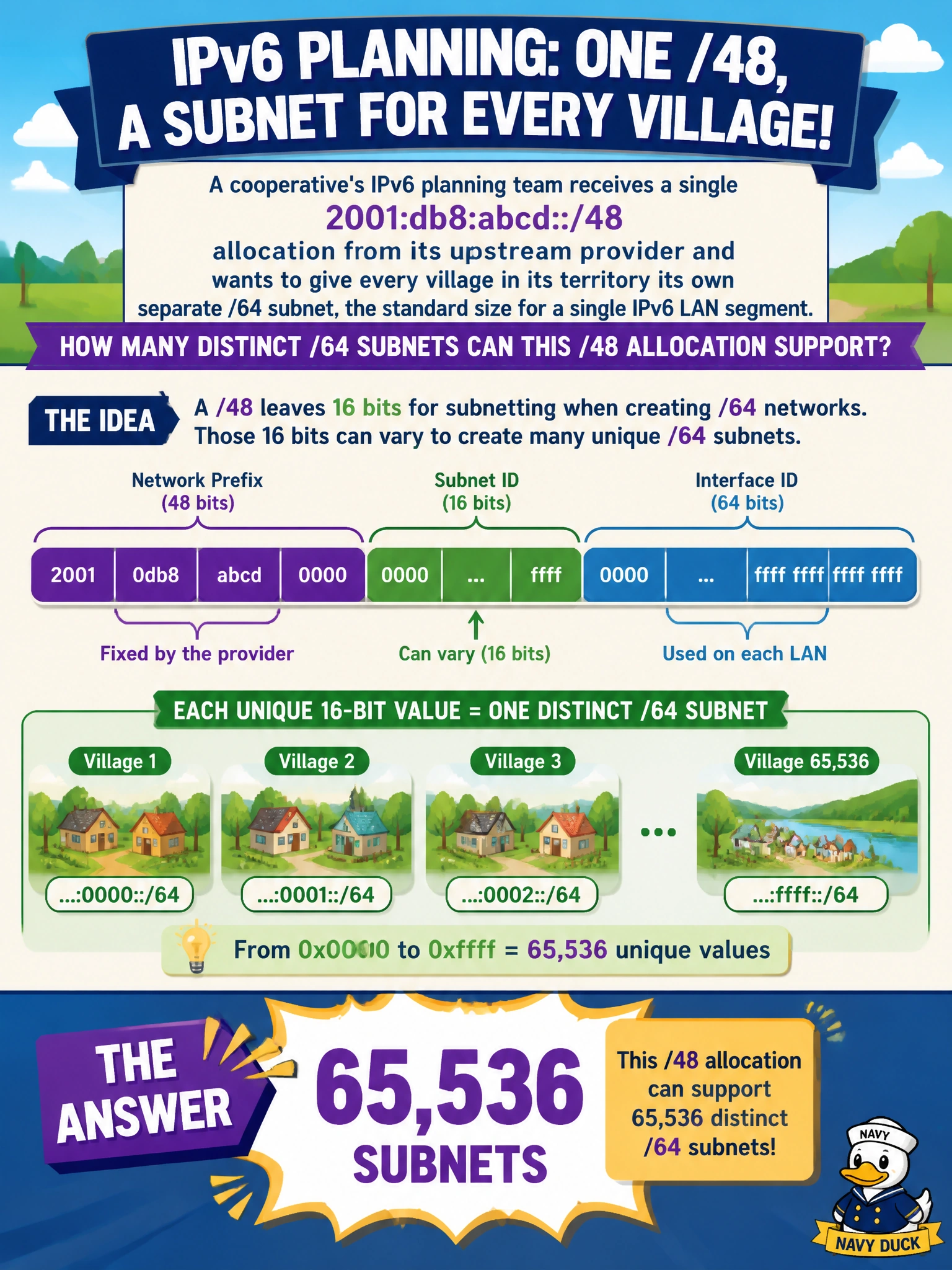
A cooperative's IPv6 planning team receives a single 2001:db8:abcd::/48 allocation from its upstream provider and wants to give every village in its territory its own separate /64 subnet, the standard size for a single IPv6 LAN segment. How many distinct /64 subnets can this /48 allocation support?
Select an answer to reveal the explanation.
Short Explanation
Going from a /48 down to a /64 means handing out 16 extra bits of subnetting room, and each bit doubles your options. Sixteen doublings later, that single /48 allocation splits into 65,536 separate /64 village subnets — vastly more room than most cooperatives will ever need.
Full Explanation
IPv6 subnetting works the same doubling logic as IPv4: the subnet count equals 2 raised to the number of bits borrowed between the starting prefix and the target prefix. Here, the allocation starts at /48 and the target subnet size is /64, a difference of 16 bits, and 2 to the 16th power equals 65,536 — the number of distinct /64 subnets available. This generous split reflects standard IPv6 design practice, which reserves /64 as the fixed size for any single LAN segment regardless of how many hosts actually connect to it, unlike IPv4 where subnet size is tuned to host count. The 256-subnets option corresponds to only an 8-bit borrow, which would land at /56, a common site-allocation size but not the /64 target here. The single-subnet option ignores that a /48 is explicitly meant to be subdivided rather than used as one flat segment. The 4,096-subnets option corresponds to a 12-bit borrow, landing at /60, one increment short of the actual /64 target. A reliable operational check is to subtract the allocation's prefix length from 64 to get the borrowed-bit count, then raise 2 to that power rather than estimating from the decimal digit count.