
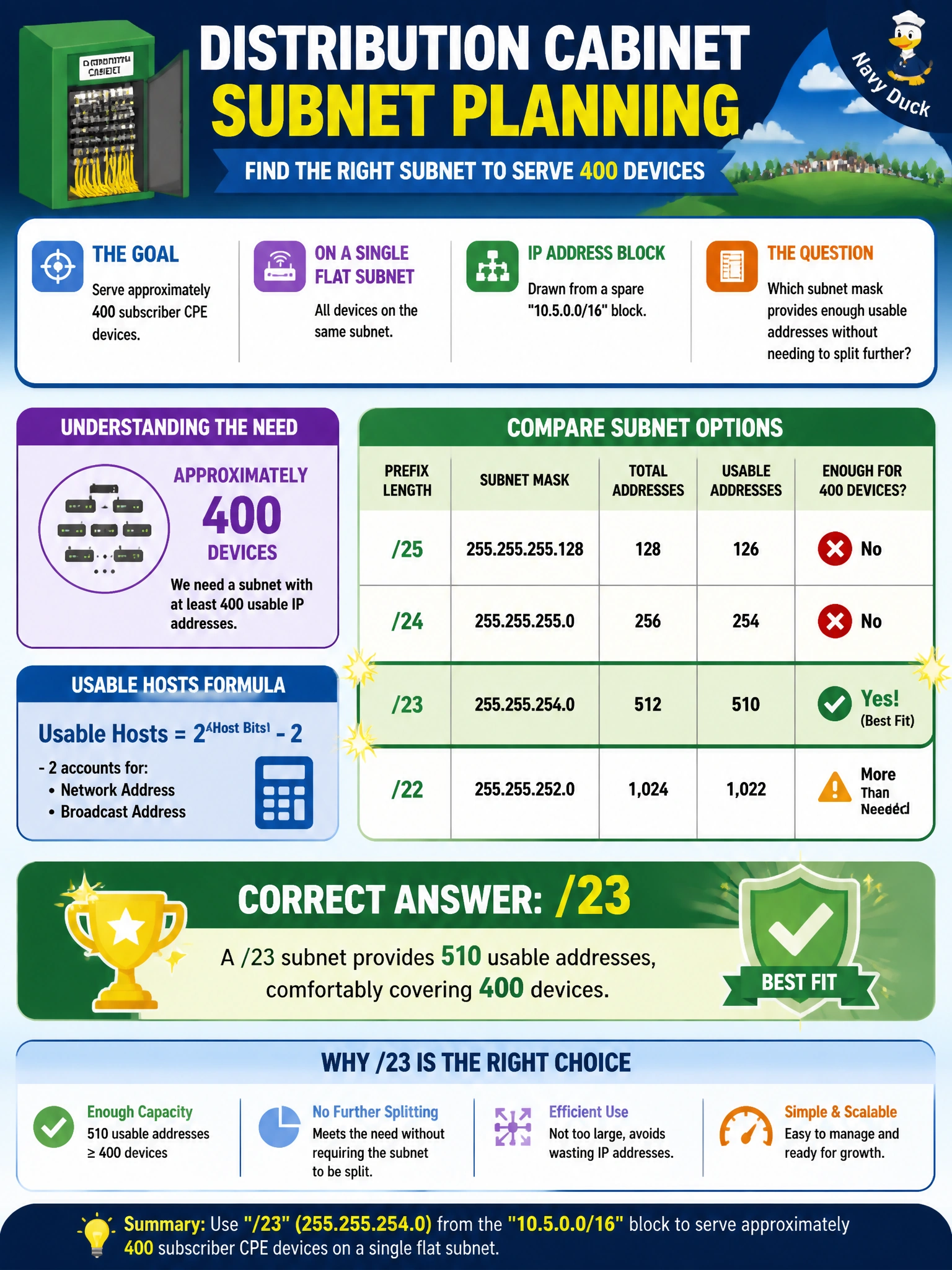
A distribution cabinet is being planned to serve approximately 400 subscriber CPE devices on a single flat subnet, drawn from a spare 10.5.0.0/16 block. Which subnet mask correctly provides enough usable addresses for this cabinet without requiring the subnet to be split further?
Select an answer to reveal the explanation.
Short Explanation
A /24 sounds like the natural default, but it only leaves room for 254 devices — not enough for 400. Stepping up one bit to a /23 doubles that to 510 usable addresses, which comfortably covers the cabinet's subscriber count without going bigger than necessary.
Full Explanation
A /23 leaves 9 host bits, giving 2^9 minus 2 equals 510 usable addresses, which comfortably exceeds the 400 devices the cabinet needs to support while leaving reasonable headroom for growth. This makes /23 the smallest mask that satisfies the requirement without over-allocating. The /24 option is a common but incorrect assumption here: a /24 provides only 254 usable addresses, which falls short of the 400-device requirement by nearly 150 addresses — a classic case of picking the familiar mask instead of doing the math. The /25 option moves in the wrong direction entirely, halving available addresses to 126 instead of growing the pool. The /22-guarantees-no-renumbering option is a flawed justification rather than a sizing calculation; while a /22 (1022 usable addresses) would technically also fit 400 devices, the claim that it "always guarantees no future renumbering" overstates what any fixed allocation can promise, and the option's reasoning, not just its size, is what makes it the wrong pick when a tighter, sufficient mask exists. An operational check before assigning a cabinet subnet is to compute 2^(host bits) minus 2 for candidate masks and choose the smallest one whose result meets or exceeds the projected device count.