
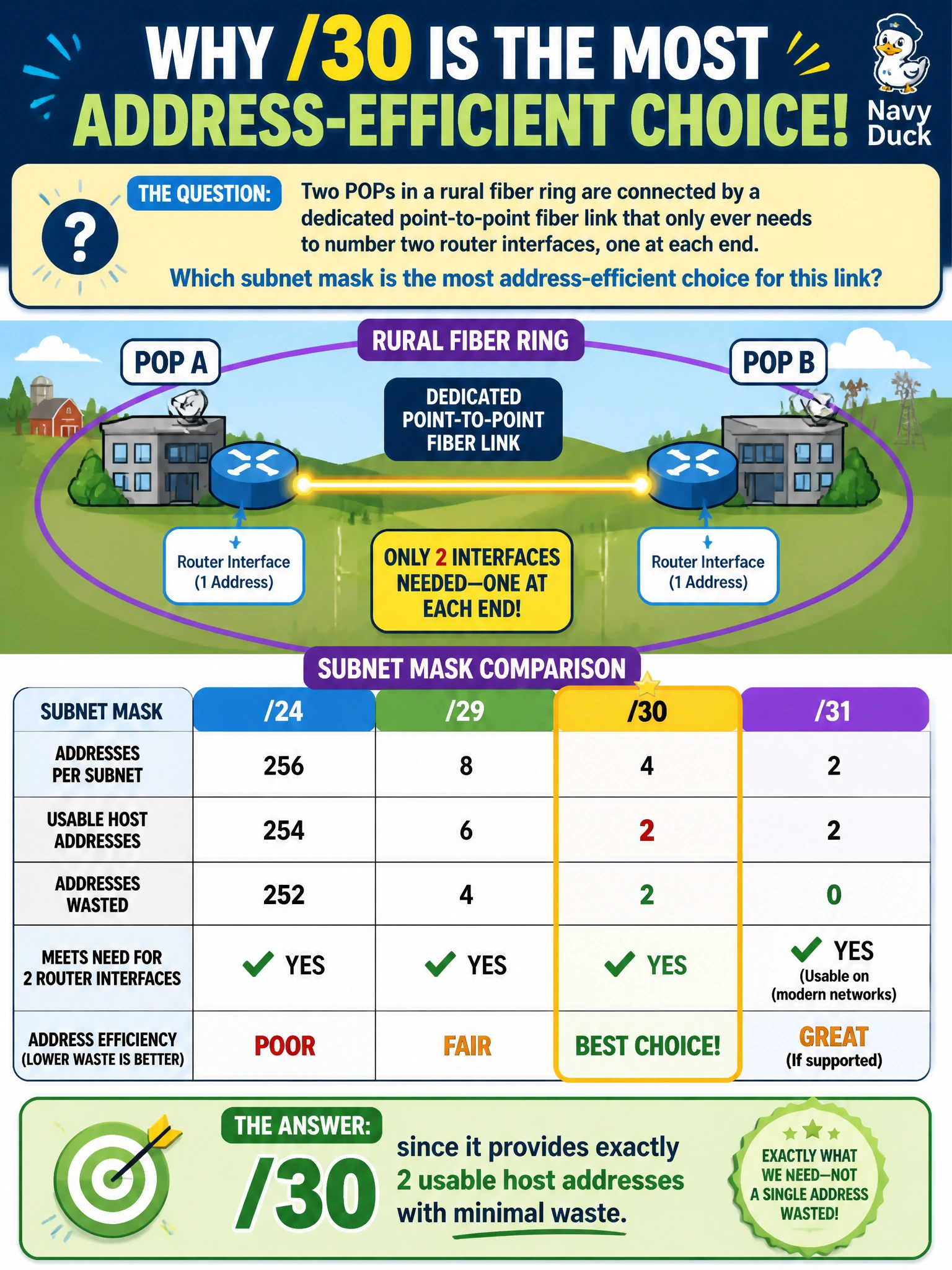
Two POPs in a rural fiber ring are connected by a dedicated point-to-point fiber link that only ever needs to number two router interfaces, one at each end. Which subnet mask is the most address-efficient choice for this link?
Select an answer to reveal the explanation.
Short Explanation
A point-to-point link only ever has two ends talking to each other, so it doesn't need a neighborhood's worth of addresses — just enough for the two of them. A /30 leaves exactly 2 host bits, which works out to exactly 2 usable addresses, one for each router, with nothing wasted.
Full Explanation
A /30 mask leaves 2 host bits, giving 2^2 minus 2 equals 2 usable addresses after the network and broadcast addresses are reserved — precisely enough to number both ends of a two-router link with no addresses left idle. This is the classic efficient choice for point-to-point fiber or serial connections where no additional device will ever join the segment. The /24 option is a common default from enterprise LAN thinking, but it wastes 252 addresses on a link that only ever uses two. The /28 option, while smaller, still wastes 12 of its 14 usable addresses on a link needing only 2. The /31 option describes a real but distinct technique defined for certain point-to-point interfaces that uses both addresses in the block as hosts with no broadcast reserved, but it is a special-case option supported on specific configurations, not a requirement for every point-to-point link, so treating it as mandatory is incorrect. An operational check when sizing any link subnet is to count only the actual devices that will ever need an address on that segment and pick the smallest mask that covers exactly that count.