
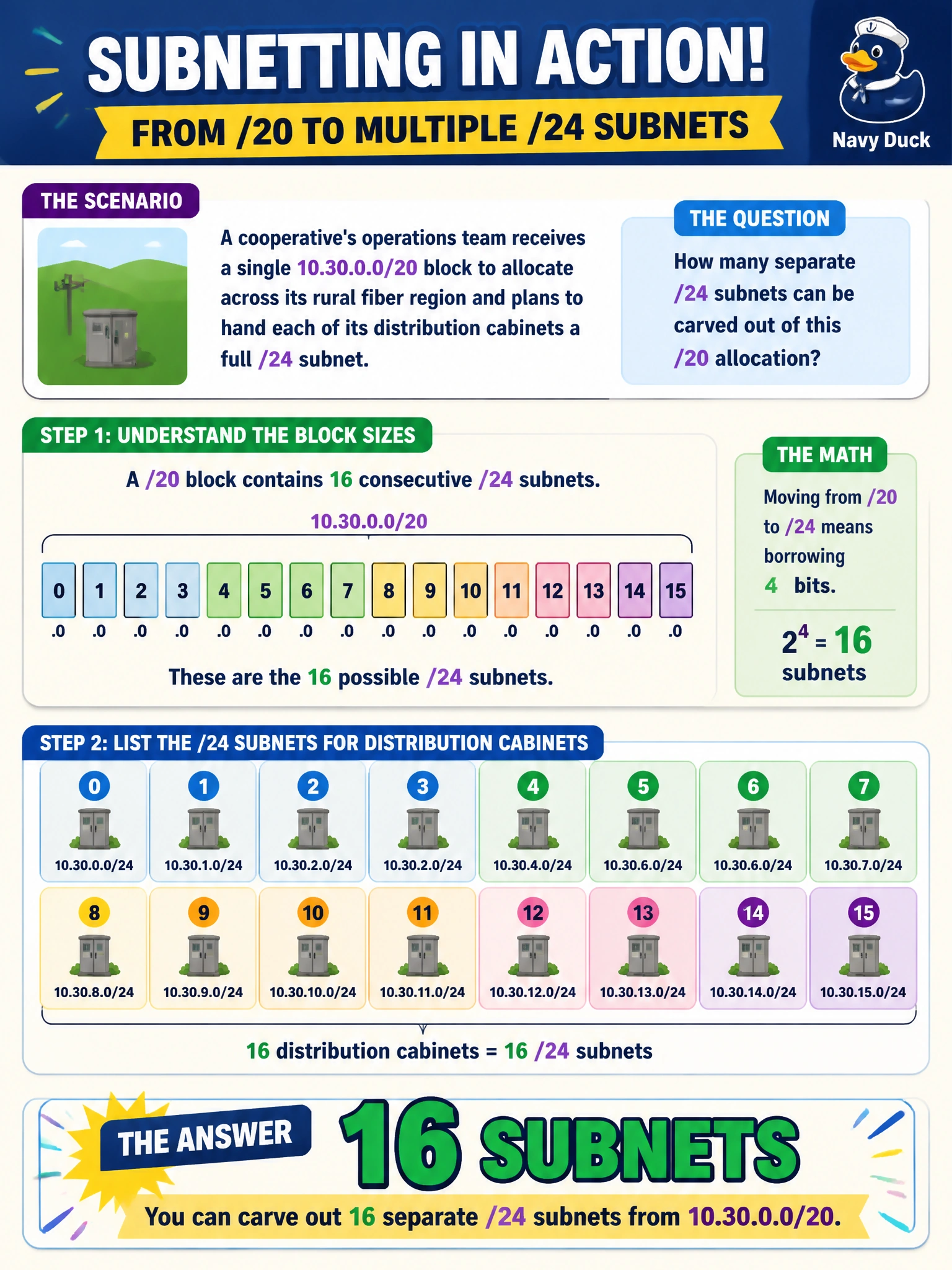
A cooperative's operations team receives a single 10.30.0.0/20 block to allocate across its rural fiber region and plans to hand each of its distribution cabinets a full /24 subnet. How many separate /24 subnets can be carved out of this /20 allocation?
Select an answer to reveal the explanation.
Short Explanation
Going from a /20 to a /24 means borrowing 4 extra bits for the network portion, and each borrowed bit doubles the subnet count. Four bits doubled four times over gets you to 16 — that's 16 full /24 cabinet blocks sitting inside the one /20 allocation.
Full Explanation
The number of subnets created when moving from a shorter prefix to a longer one is 2 raised to the number of bits borrowed. Moving from /20 to /24 borrows 4 bits (24 minus 20), and 2 to the 4th power equals 16, so the /20 block splits evenly into 16 distinct /24 subnets, each with 254 usable host addresses — enough for a good-sized distribution cabinet on its own segment. This kind of block math matters at planning time because a cooperative rolling fiber out cabinet by cabinet needs to know up front exactly how many cabinets a given allocation can support before it has to request a second block from its upstream registry. The 4-subnets option corresponds to borrowing only 2 bits, which would land at a /22 rather than a /24, and undercounts the real subnet supply by a factor of four. The 8-subnets option corresponds to borrowing 3 bits, landing at /23, one step short of the target mask and still half of the true answer. The 32-subnets option overshoots by assuming a 5-bit borrow, which would actually require moving to a /25, not a /24, doubling the real count. A dependable operational check is to subtract the starting prefix length from the target prefix length to get the borrowed-bit count, then compute 2 to that power directly rather than estimating, especially before committing a cabinet allocation plan to paper.