
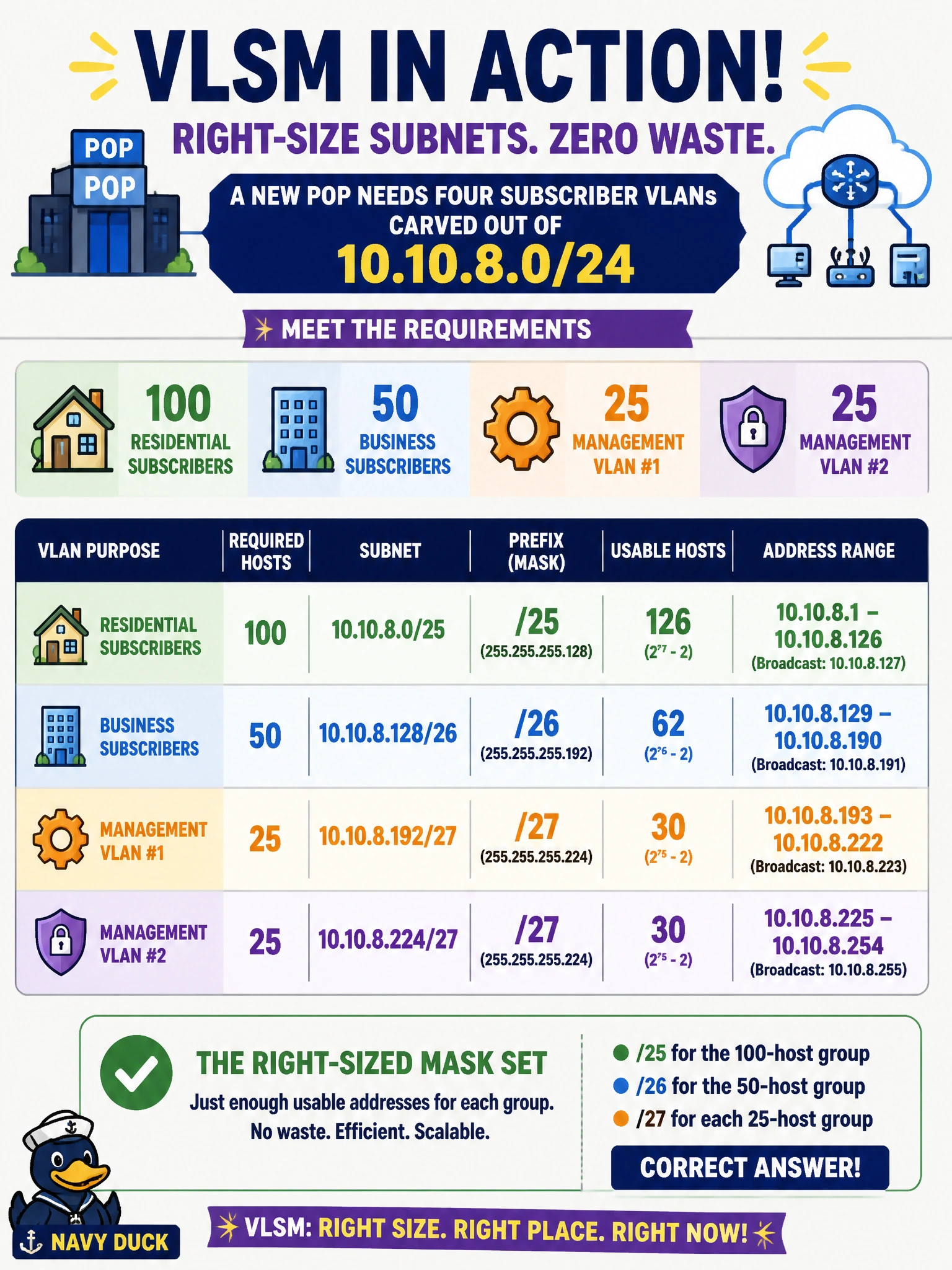
A new POP needs four subscriber VLANs carved out of 10.10.8.0/24: one for 100 residential subscribers, one for 50 business subscribers, and two management VLANs needing 25 hosts each. Using VLSM, which mask set correctly provides just enough usable addresses for each group without unnecessary waste?
Select an answer to reveal the explanation.
Short Explanation
VLSM means you size the container to the load instead of forcing every group into the same box. A /25 gives 126 usable addresses for the 100-subscriber group, a /26 gives 62 for the 50-subscriber group, and a /27 gives 30 for each 25-host management VLAN — each one just big enough, with the leftovers still available for future POPs.
Full Explanation
Variable-length subnet masking assigns each group the smallest mask that still covers its host count, which conserves address space for later use. A /25 leaves 7 host bits (2^7 minus 2 equals 126 usable addresses), comfortably covering 100 residential subscribers. A /26 leaves 6 host bits (62 usable), covering the 50 business subscribers. A /27 leaves 5 host bits (30 usable), covering each 25-host management VLAN with a small margin. All four subnets fit inside the original /24 because their sizes sum to less than 256 total addresses. The all-/24-plus-/25 option wastes the entire original block on one group alone, since a /24 is the whole allocation. The uniform-/26 option undersizes the 100-host group, since 62 usable addresses cannot cover 100 subscribers, and oversizes both 25-host groups, wasting addresses that could serve another POP. The uniform-/25 option repeats that oversizing problem for the smaller groups while also consuming four times the space actually needed. An operational check before finalizing a VLSM plan is to add up the block sizes assigned (128 + 64 + 32 + 32 = 256) and confirm the total does not exceed the parent block's total address count.